The whole industry is pretending these tools are different when most of them are built the same way
Most agencies know the content they’re producing through AI writing tools is bad. They ship it anyway in hopes the client cannot tell the difference.
That window is closing, predictably, and nobody wants to say it out loud because the retainer clears the bank account before the audit happens.
Vendors tolerate this arrangement because it’s convenient and profitable. They know you cannot expose an architectural flaw in a thirty-minute demo, so they bill for “AI-assisted content,” bury the methodology, and let the logos do the rest.
I will not even mention the fact that several of these tools are calling the same OpenAI API endpoint and competing on button color.
What follows is not a ranked list. It is the diagnostic framework that exposes which architectural category AI writing tools actually belongs to, what that means for detection risk and brand voice, and how to match the right approach to your workflow.
If you think passing detection is about sounding human, that assumption is actively costing you
The “best AI writing tool” debate is fragmenting because practitioners have stopped asking which tool is fastest and started asking which tool actually holds up. 55% of departmental AI spend is now going to coding, not content tools. The B2B market has already moved upstream. Writing tools are losing budget oxygen because they keep promising that they’re solving a quality problem when in reality they’re just solving a speed problem at the expense of quality.
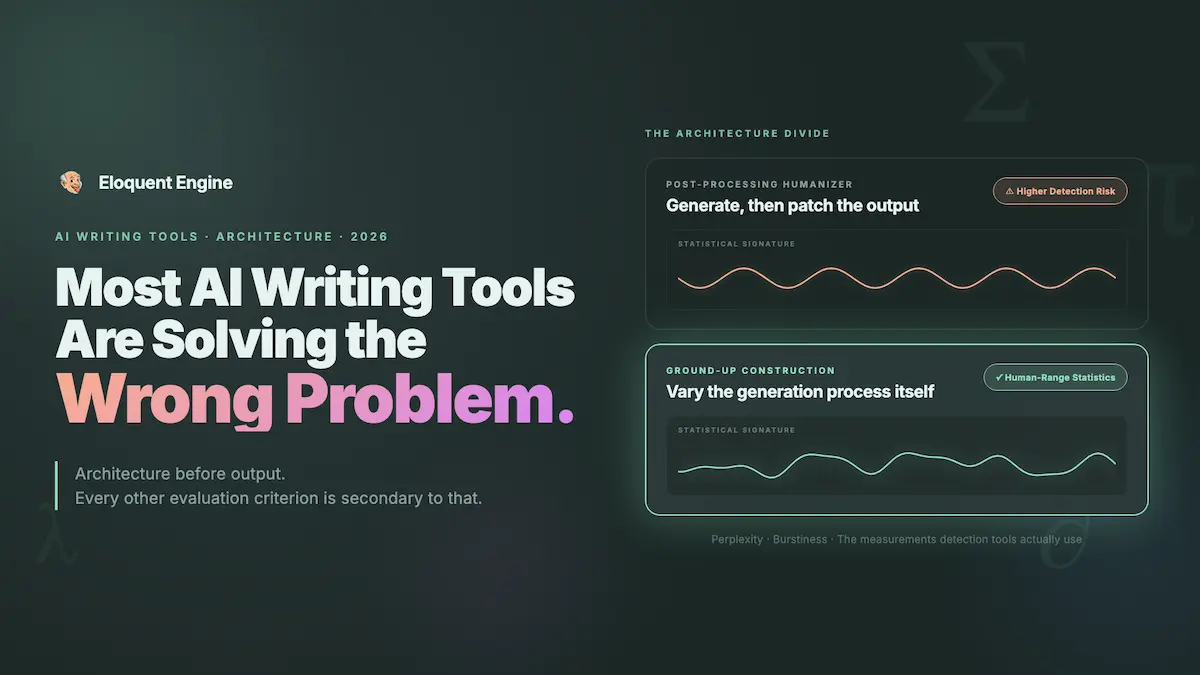
The reason most tools fail detection is not that the output sounds robotic. Detection tools like GPTZero and ZeroGPT measure two mathematical properties: perplexity and burstiness. Perplexity scores how predictable each word choice is given the surrounding context. Language models optimize for coherent, probable sequences, which produces consistently low perplexity scores. Burstiness scores variation in sentence complexity across a document. Human writing is structurally irregular. LLM output trends uniform because it optimizes for well-formed sentences throughout.
These are measurable signals, not impressions. A tool that restructures sentences and swaps synonyms after generation changes the surface without shifting either measurement. The generation signature was set before the humanizer touched it.
The local-versus-cloud debate, Ollama and LM Studio versus SaaS tools, is a proxy for a more important disagreement: control over the generation process versus convenience layered on top of a shared pipeline. Both camps are solving real problems. They are not solving the same problem. Practitioners claiming that psychology-based tailoring through tools like Elaris matters more than “polish” are right for a specific reason. Audience connection requires systematic intent at the generation level. Algorithmic fluency applied after the fact misses the structural point entirely.
How to identify which architecture you are actually dealing with, because the vendor will not tell you
Every tool fits one of three approaches. The marketing copy almost never names the approach directly. The documented process usually does, if you know what to look for.
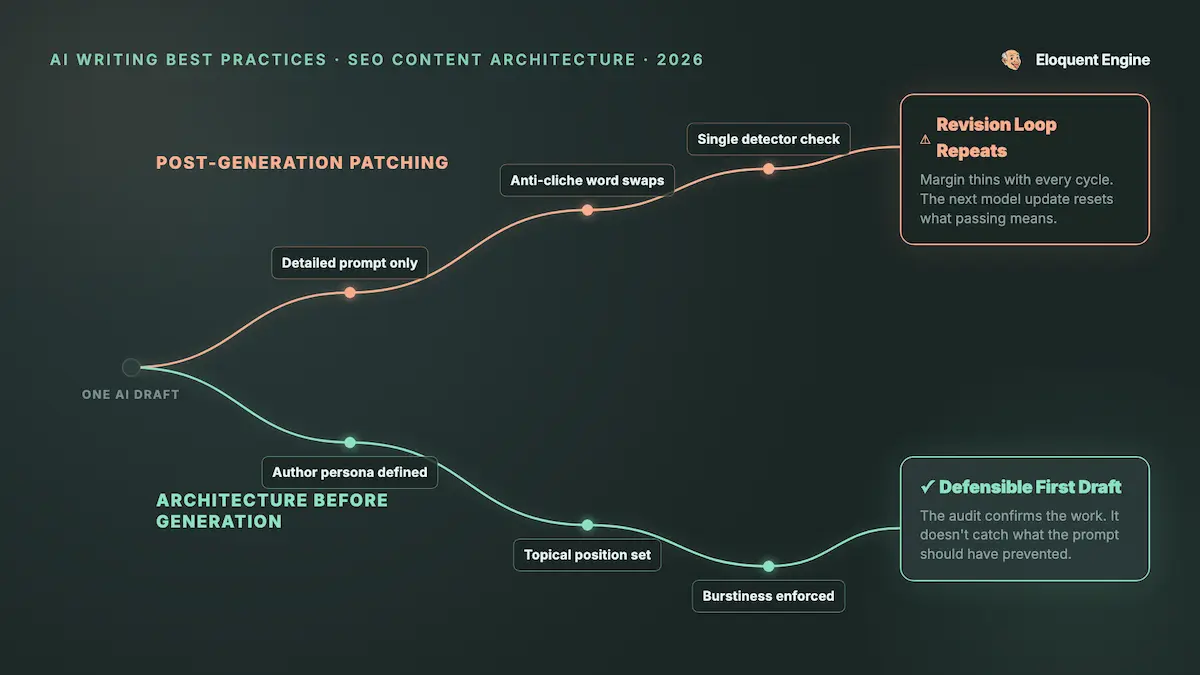
Post-processing humanizers generate text using a standard language model pipeline and then apply a secondary transformation layer. The tell is a two-step workflow: generate, then refine. Sometimes the refinement is surfaced to the user as a “humanize” toggle. Sometimes it runs silently in the background and the documentation describes it as a “proprietary humanization layer” or “anti-detection technology.” Both phrasings describe the same architecture. The generation signature is set upstream. The transformation layer is intervening too late to shift perplexity or burstiness in any measurable way.
Jasper and Copy.ai operate here. Their value is real: template systems, prompt engineering, workflow integration, and content brief scaffolding are genuinely useful. The architectural limitation only becomes a dealbreaker under consistent detection audits. Detectable AI content is a liability, not a feature gap.
Algorithmic assembly tools combine pre-written or pre-structured components: sentence templates, transition banks, topic sentence libraries. Detection behavior varies based on how much live LLM generation is involved versus pre-written blocks. Assembly is fast. The output is consistent. Over time, the output is also formulaic in a way that cannibalize brand differentiation across a content library. Every piece sounds like the same tool wrote it, because the same tool wrote it.
Ground-up construction varies the generation process itself rather than patching output afterward. Statistical properties are addressed before text is produced, which is why the measurement changes instead of just the surface. This approach is harder to market because “we built variation into the generation parameters” does not fit on a features page as cleanly as “humanize your content in one click.”
The market’s growing consensus that Claude produces the closest-to-human output reflects this distinction, though practitioners citing “human-like tone” are often naming the effect without the cause. The real question is not which tool sounds most human. The real question is which tool was structurally built to vary the properties detection actually measures.
Speed is not a differentiator. The market already knows this. Practitioners asking “worth using in 2026” are asking an architectural question, not a throughput question.
Architecture before output. Every other evaluation criterion is secondary to that.
What the best AI writing tool conversation looks like when nobody is trying to sell you something
“Does this tool humanize my content?”
“Yes, it runs your output through our refinement layer.”
That is a post-processing humanizer. Move on.
I assumed strong prompting was enough to differentiate client voices. It is not, if the tool is generating the same statistical signature for every account and smoothing it to the same surface texture afterward. Took longer than it should have to figure that out.
| Tool | Architectural approach | Detection profile | Brand voice differentiation | Real fit |
|---|---|---|---|---|
| Claude Pro (3.5 Sonnet) | Ground-up construction | Lowest risk in general-purpose category | High with structured brief input | Freelancers, single-brand SMBs |
| ChatGPT | Ground-up construction | Moderate; varies with prompt quality | Moderate; brief does the differentiation work | Versatile; workflow dependent |
| Jasper | Post-processing humanizer | Higher risk under audit conditions | Template-constrained | Volume content, low-audit environments |
| Copy.ai | Post-processing humanizer | Higher risk under audit conditions | Limited cross-client differentiation | Short-form copy, marketing teams |
| AuthWriter | Process support layer | Lower risk; human in loop by design | High; built around human decision-making | Writers rejecting the AI-as-replacement model |
| Elaris | Psychology-based targeting | Varies; not primary architecture focus | High for audience-specific positioning | Audience-tailored content, B2B |
| UnAIMyText | Post-processing humanizer | Better than most humanizers; structural limit remains | Low | Detection-pass use cases only |
On the local-versus-cloud split: Ollama and LM Studio are solving a privacy and control problem, not a content quality problem. Both are legitimate concerns. If your workflow requires keeping client data off external APIs, self-hosted is correct regardless of output architecture. If your workflow requires polished UX and team collaboration, cloud SaaS wins on practical grounds. These are different constraints. Picking a side is the wrong frame.
The right tool depends on which problem you actually have
Run this gut-check before evaluating any tool against a feature list.
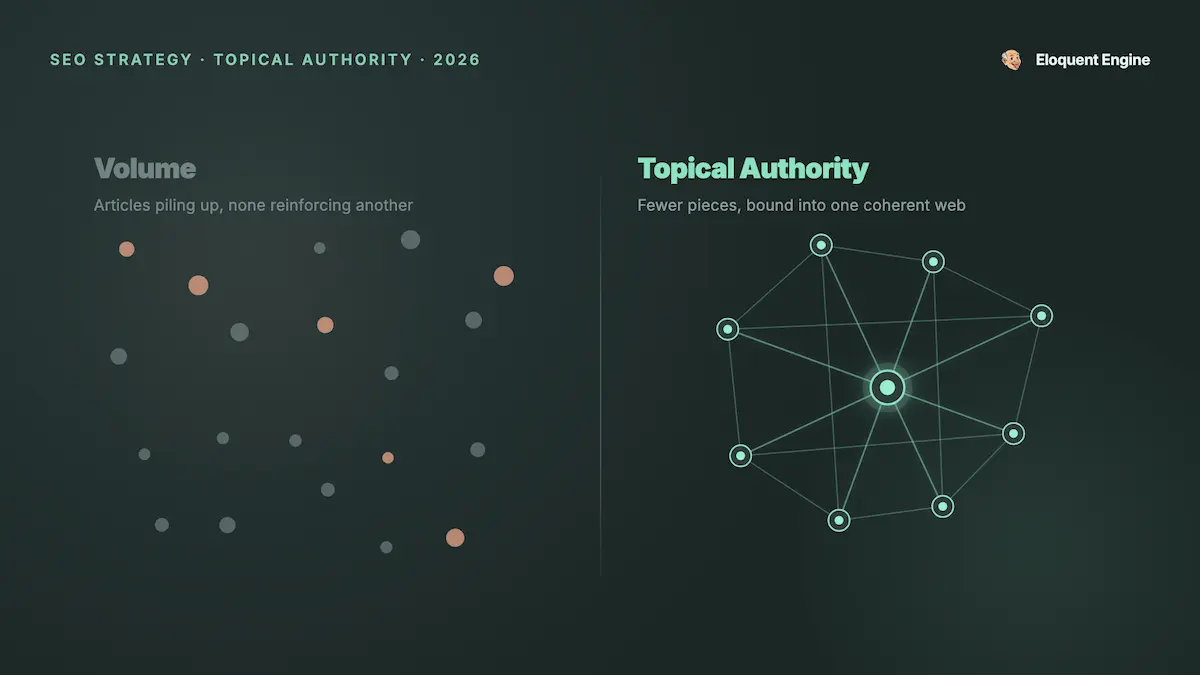
- You manage multiple client accounts. Your primary risk is content cannibalization across brand voices. A post-processing humanizer will produce the same statistical signature and similar surface patterns for every client regardless of the brief. Over time your content library flatlines into one recognizable voice with different logos. The fix is upstream: a tool that takes differentiated input and generates differentiated output, not one that polishes everything through the same refinement pass. This is where ground-up construction earns its cost.
- You publish under your own brand at volume. Detection risk is the dominant concern. Speed is already table stakes. The question is whether your tool’s architecture will hold up when a client runs an audit six months from now, not whether it produced the draft in forty seconds today. No amount of volume fixes a structurally broken detection profile.
- You are a writer who needs AI to reduce friction, not replace your process. AuthWriter’s explicit positioning as a process support tool rather than a generation tool reflects where the most sophisticated practitioners are landing. AI as replacement produces content debt. AI as process support produces content that survives editorial review because a human was making decisions throughout. The “AI as support versus AI as replacement” distinction is the real conversation in 2026. The tools that understand this are architecturally different from the ones that don’t.
- You need audience-specific content that earns search equity. Generic tone-smoothing does not solve an audience connection problem. Tools built around systematic audience intent, like Elaris with Solsten’s psychology targeting, address a structurally different failure mode than detection risk or volume. Identify which failure mode costs you most before defaulting to the tool with the best logo in the sales deck.
For a deeper look at how mathematical content architecture addresses these workflow problems at the system level, the framework behind THREAD is built specifically for this diagnostic.
Three questions that outlast every tool on this list
Here is the thing nobody says at the end of a tool comparison: you already know which category most of these tools belong to. You felt it when the output was predictably smooth in a way that real writing never is. You felt it when the fifth piece sounded like the first piece. You supposed it was your prompting. It was the architecture.
The binary is not “AI tool versus no AI tool.” That framing is dead. The real choice is between tools that modify an output and tools that build content correctly from the start. Most of the market is still selling you the first option while describing it as the second.
Three questions. Any tool, any vendor, any price point.
- Does this tool modify output after generation, or vary the generation process itself?
- What does the documentation say about detection, and is it describing a measurement solution or a surface fix?
- Does it take differentiated input and produce differentiated output, or does every account get the same statistical signature with different keywords?
The answers give you the architecture. The architecture gives you the downstream consequences. Every other evaluation criterion follows from there.