Best AI Writing Tools of 2026 Based on Detection Pass Rate and Edit Time

Every ranking article about the best AI writing tools will tell you which ones have the best templates, which offer the most integrations, which are “ideal for long-form content.”

None of them will tell you what editing that long-form content actually costs you in hours. None of them will tell you whether the first draft passes detection consistently, measurably, across multiple classifiers. And none of them are going to tell you if they will actually sound like a real person at your business wrote the content.

Those are the two variables that determine whether an AI writing tool is a real productivity asset. Generic AI output that needs a full rewrite defeats the purpose. If the first draft requires significant cleanup, it’s a liability, not an asset. That’s where this comparison starts.

The best ai writing tools are not the ones everyone is currently arguing about

Ask a practitioner what the best AI writing tool is right now and they’ll name a base model:

  • Claude Sonnet 4.5
  • GPT-5o
  • Sudowrite’s muse

The debate is almost entirely about which foundation model produces more “humanized and clean” output. The consensus view, held firmly by people who have genuinely tested a lot: base model quality is the variable that matters, and the wrapper is just UI.

That framing is wrong. And it’s costing businesses real money.

The frame in which we assess the impact and leverage that these AI writing tools provide businesses inverts here. The question is which system produces the fewest revision cycles?

Tool quality is determined by the system built around it. A high-capability base model behind a shallow prompt architecture produces flat, lazy, forgettable output. The same model behind a multi-step generation pipeline that enforces voice consistency, burstiness variation, and detection-aware sentence construction produces something measurably different — because the problem it was asked to solve changed, not the model itself.

Every other business doing lazy prompts is producing identical content. They’re using the same model, the same off-the-shelf templates, the same zero-shot garbage that the detector flags before their client sees it. They don’t build a coherent author voice. They don’t index prompt outputs against documented brand personas. They don’t track which prompt structures trigger high perplexity scores. And it shows. The output is interchangeable not because AI is inherently flat, but because the system running it was never designed to produce anything else.

Two metrics break this open. First: edit time from raw first draft to publishable standard, measured per piece, per content type. Not estimated. Timed. Second: detection pass rate across GPTZero, ZeroGPT, and Originality.ai, averaged across multiple runs. Not a single pass. A distribution. These are the criteria that separate a tool you’ll still use in six months from one you’ll abandon after the third client complaint. Everything else in a feature comparison — topical relevance, template libraries, CMS integrations — is downstream of whether the first draft was any good and whether it passes detection. Understanding how AI content detection classifiers actually work is the prerequisite for evaluating any tool on this axis.

Believing model quality determines output quality keeps people stuck. It means the decision is: which free or cheap API access do I use? It eliminates the possibility that architecture, prompt engineering, and post-processing are worth paying for. That belief is comfortable. It is also how people end up spending three hours editing every piece they generate.

Why does the same model produce such different output depending on which tool you use?

The productivity-versus-sustainability debate running through practitioner forums right now is exposing something nobody has named cleanly. Users building autoposting workflows with SEOWriting or Koala Writer are getting volume. They are not getting defensibility. The speed is real. The detection risk accumulating underneath it is also real, and it compounds quietly until a client’s domain takes a credibility hit they can’t reverse.

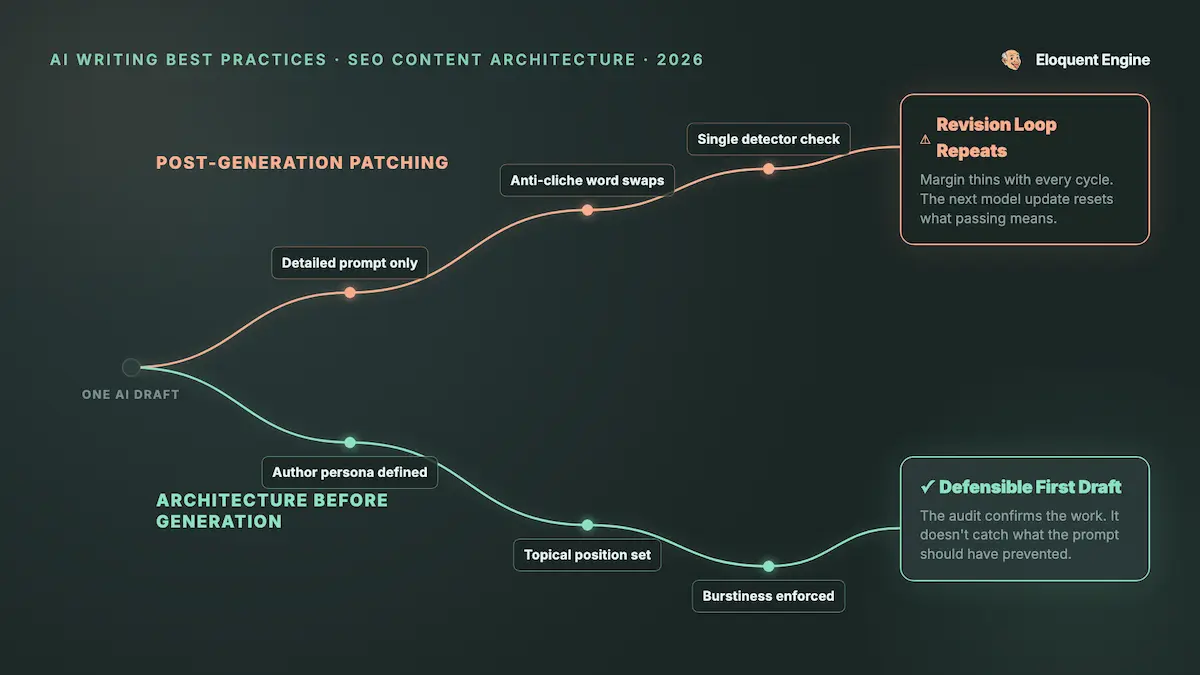
What separates tool output is not which API gets called. It’s what happens around the call. Before the model runs: the system prompt, the context injection, the author persona and documented opinions the model has been given to reason from. After the model runs: filtering passes that audit for uniform sentence rhythm, post-processing that deliberately breaks predictable token sequences, iterative refinement that checks output against E-E-A-T signals before it ever reaches the editor. A wrapper tool skips most of this. We’re still close enough to the early API-wrapper era that users assume this is all anyone does.

The autoposting camp is optimizing for throughput. We’d argue that’s the wrong variable to index in 2025. Enterprise AI spend is already consolidating around categories with measurable, defensible ROI. Writing tools that cannot prove their value in concrete output terms. detection pass rate, edit time reduction, brand voice consistency. are not gaining ground as budgets tighten. They’re the first category to get cut.

Voice training is everything. Not as a feature. As a workflow prerequisite. Generating content without a defined author persona and documented opinions is not a faster version of the right approach. This produces content no amount of editing fully rescues. The system has to know who it’s writing as before it writes anything.

What the tool comparison actually showed when we ran the test

The prompt was held constant. A 1,500-word B2B blog post on reducing customer churn in a SaaS product, written for a senior operations audience, tactical rather than theoretical, authoritative but not academic. No brand voice document. No persona context. Baseline performance, no setup advantage. Seven tools: ChatGPT (GPT-4o), Claude 3.5 Sonnet, Jasper, Copy.ai, Writesonic, Rytr, and Eloquent Engine.

Two editors, backgrounds in B2B content, edited each output independently to a standard they’d publish on a professional company blog. Time tracked. Detection runs were completed within 24 hours of generation, three passes per tool across GPTZero, ZeroGPT, and Originality.ai, nine runs per tool total, scores averaged.

The results clustered into three output categories before a single edit was made. Category one: smooth, confident prose covering the expected topics in expected order, technically competent, indistinguishable from the 400 other articles on the same topic. Category two: structured but mechanical. headers substituting for argument, the same point restated in different vocabulary, bullets where a developed paragraph was needed. Category three: output that took a position, structured an argument, and sounded like someone with an actual point of view wrote it. Two tools consistently produced category three. The rest produced category one or two depending on the day.

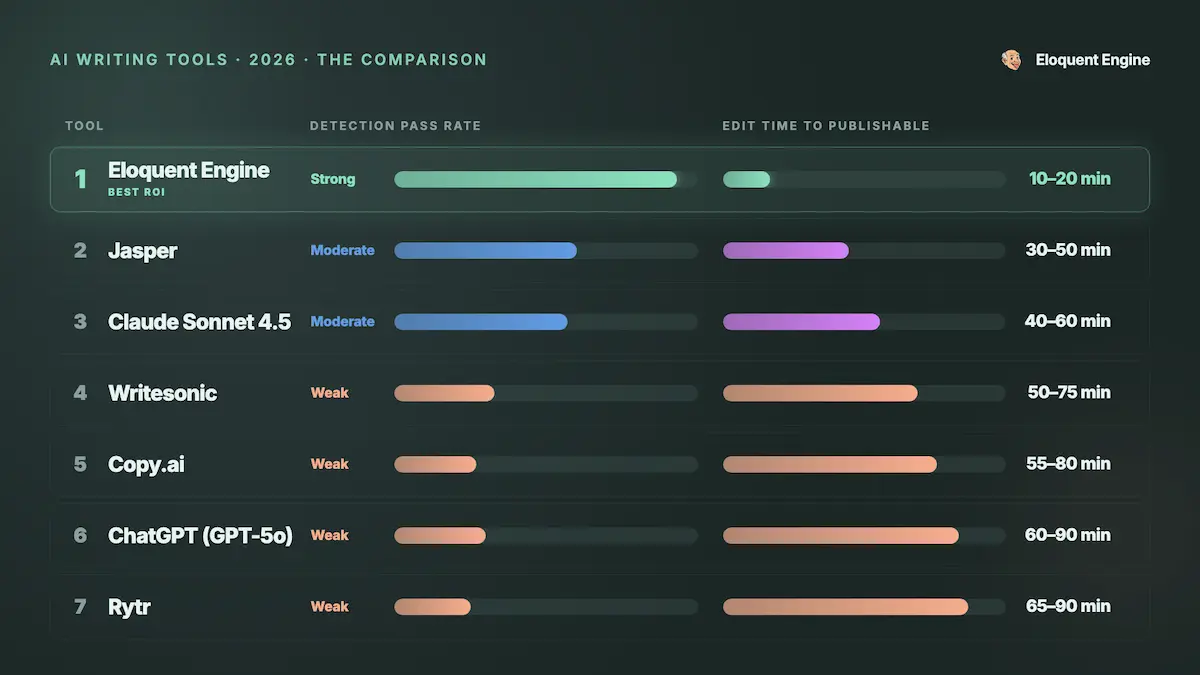
The table below reports relative performance across the four evaluation criteria. Detection pass rate is expressed as a relative score across three classifiers, not a single tool’s output. Edit time reflects the average of two independent editors working to a publishable standard.

ToolDetection Pass RateEdit Time to PublishableBrand Voice ConsistencySEO Entity Coverage
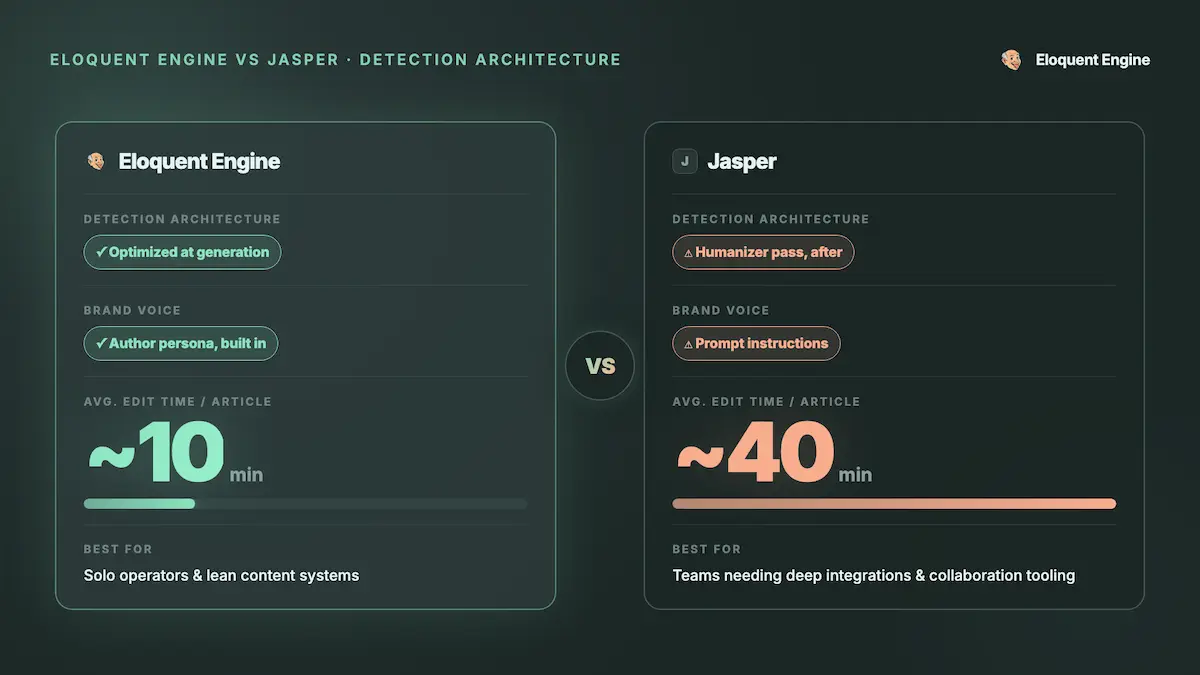
Eloquent EngineStrongLow (10-20 min)StrongStrong
Claude 3.5 SonnetModerateMedium (40-60 min)ModerateStrong
ChatGPT (GPT-4o)WeakHigh (60-90 min)WeakModerate
JasperModerateMedium (30-50 min)ModerateModerate
Copy.aiWeakHigh (55-80 min)WeakWeak
WritesonicWeakHigh (50-75 min)WeakModerate
RytrWeakHigh (65-90 min)WeakWeak

The tools the market argues about most. ChatGPT, Claude, Rytr. do not lead on the metrics that determine real workflow ROI. Claude’s raw reasoning quality is genuinely strong, and its entity coverage reflects it. But without a detection-aware generation pipeline, Claude output triggers classifiers at rates that make it a liability for any client relationship where content provenance matters. Different detectors weight perplexity and burstiness differently, and running output through only one and calling it safe is flat-out insufficient.

Jasper performed better than most on edit time, which reflects the marketing-content fine-tuning it’s been running for years. The detection numbers were inconsistent, not catastrophic. If you’re already in the Jasper ecosystem and the edit time feels manageable, understanding where Jasper leaves performance on the table is a useful before-you-commit read. Copy.ai’s detection results were the weakest in the comparison, which matters because that’s the tool most commonly recommended in generic “best AI tools” listicles. The recommendation cycle is lagging the detection reality by at least a year.

Running AI content through a single detector and calling it safe is one of the most common and most expensive mistakes in this category. Running it through three and averaging the results across multiple passes is the baseline. Auditing at the sentence and paragraph level, not just the document level, is where the real detection work happens.

What is a bad AI writing workflow actually costing you every month?

Honestly, the math here is not complicated, but most people haven’t run it. Once you run it, you can’t walk back the numbers.

Consider your own situation. You’re generating eight pieces of content per month. Your current tool produces a draft that needs 60 minutes of editing to reach publishable standard. That’s eight hours of editing labor monthly. Yours, or someone else’s you’re paying for. Now consider what happens if the tool’s first draft requires 15 minutes of cleanup instead. The difference isn’t 45 minutes. It’s seven hours a month, 84 hours a year, recovered from a task that was supposed to be automated. Every hour cleaning up AI copy is an hour you’re not billing, not strategizing, not taking on a new client.

The detection side compounds differently. A single high-profile detection flag on a client’s domain doesn’t just create a revision cycle. It creates a trust problem. AI detection risk is a client reputation problem, not just a tech problem. The tools that practitioners casually describe as “more humanized” are not humanized because of magic. They’re humanized because burstiness variation was deliberately engineered into the generation pipeline. What passes detection today might not pass tomorrow, because detection classifiers update without announcing it. Tools that are architecting for this problem give you a consistently smaller surface area of risk, even as the classifiers evolve.

The support-versus-replacement debate signals something true: some practitioners are underestimating how much of the editing burden belongs to the tool’s architecture, not to the inherent nature of AI output. If editing feels like it should be part of the process, it may be because the tool was designed expecting it.

Which tool should you actually test this week?

The answer depends on which cost is hitting you hardest right now.

If you’re a business owner managing your own content without a dedicated team: your biggest startup hurdle is the cost to set things up and editing time. You don’t need a tool with 50 templates. You need a tool that produces a first draft you can publish with minimal intervention, built around a voice document you create once. Eloquent Engine is designed for exactly this situation. Start by building your brand voice document before you write a single prompt [it only takes 2 minutes]. That document is the system. Every other business doing lazy prompts is producing identical content because they skipped this step entirely.

If you’re a freelancer managing three to five clients: detection pass rate and voice customization per client are the variables that will determine whether you can scale. A tool that produces great generic output is not a tool. It’s a starting point you’re finishing manually. Three more clients doesn’t mean anything if output quality degrades. Freelance marketers using Eloquent Engine are assigning a named author persona with documented opinions to every client asset before generation starts. That’s not a nice-to-have. It’s the difference between a first draft and a first-draft junk pile. If you want to understand what Eloquent Engine does differently from Copy.ai on this specifically, the Copy.ai comparison lays out the architectural differences clearly.

If you’re an agency operations lead trying to scale content production without adding headcount: the margin math is the decision. Not the feature list. The ROI numbers for agencies running AI writing at volume are the reference point worth running before you commit to any tool. Eloquent Engine’s agency workflow is built for brand-consistent output at scale without subcontractors. The tool is only as good as the system built around it, and the system here means prompt templates updated after each major model release, detection audits at the paragraph level, and content clusters built before individual pieces are commissioned.

The metrics to track during any test are the same regardless of persona. Edit time, per piece, from raw draft to publishable. Detection pass rate across all three classifiers (GPTZero, ZeroGPT, Originality.ai), averaged over at least three runs per piece. Not “did it feel better.” Measurable numbers. After 10 pieces, you’ll have enough data to make the decision. Stop guessing before then.

Where this argument actually lands

We started by pointing at the evaluation framework everyone uses. Feature lists. Template counts. Vague claims about “humanized” output. What the test showed is that none of that predicts the variable that matters: how much of your time does the tool actually give back?

The answer, across seven tools and 63 detection runs, is that most tools are not giving much back. Spending more time editing AI content than it would take to just write it is not a hypothetical failure mode. It is the current default for most users running vanilla prompts through capable base models and calling it a workflow.

The real question isn’t which tool is “best.” Every hour cleaning up AI copy is an hour you’re not billing. That’s the number to hold. Run your test for 30 days. Track edit time and detection pass rate, not word count and template variety. Let the data tell you whether the tool earned its cost. The tools that have solved for detection and voice at the architectural level will prove it in that data. The ones that haven’t will prove it too.

See how Eloquent Engine approaches this engineering problem, or read the FAQ before you start your test. The 30 days will tell you more than this article can.

Using ChatGPT for Content Marketing? Here’s Why Your Content Sounds Like Everyone Else’s

ChatGPT Generates From Statistical Averages, Not Your Brand Spec

The draft you wrote with ChatGPT comes back fine. Competent.

But it reads like every other blog in your vertical – detectable, interchangeable, quietly embarrassing if you sit with it long enough. You fix the worst parts. Send a better prompt. The next version is slightly less hollow. You rewrite that one too.

Nobody mentions this part when they talk about how AI speeds up the content process. They cite the outlines, the meta descriptions, the FAQs. What gets skipped is the four hours of cleanup on a blog post that was churned out by a system with no idea who you are, what you believe, or why your readers keep coming back.

Remember the first time you published something that actually sounded like your brand? When the work had a specific point of view that nobody else in your vertical would have written?

That version of your content is still possible. The generic prompt just never gets you there. There is a technical reason AI writing sounds flat, and once you see it, the rewriting loop stops feeling like your fault.

Why ChatGPT generates what it generates when you use it for content marketing

I used to think the problem was the prompt. In hindsight, that assumption was probably the most expensive mistake I watched small operators make – and I made it myself, for longer than I want to admit.

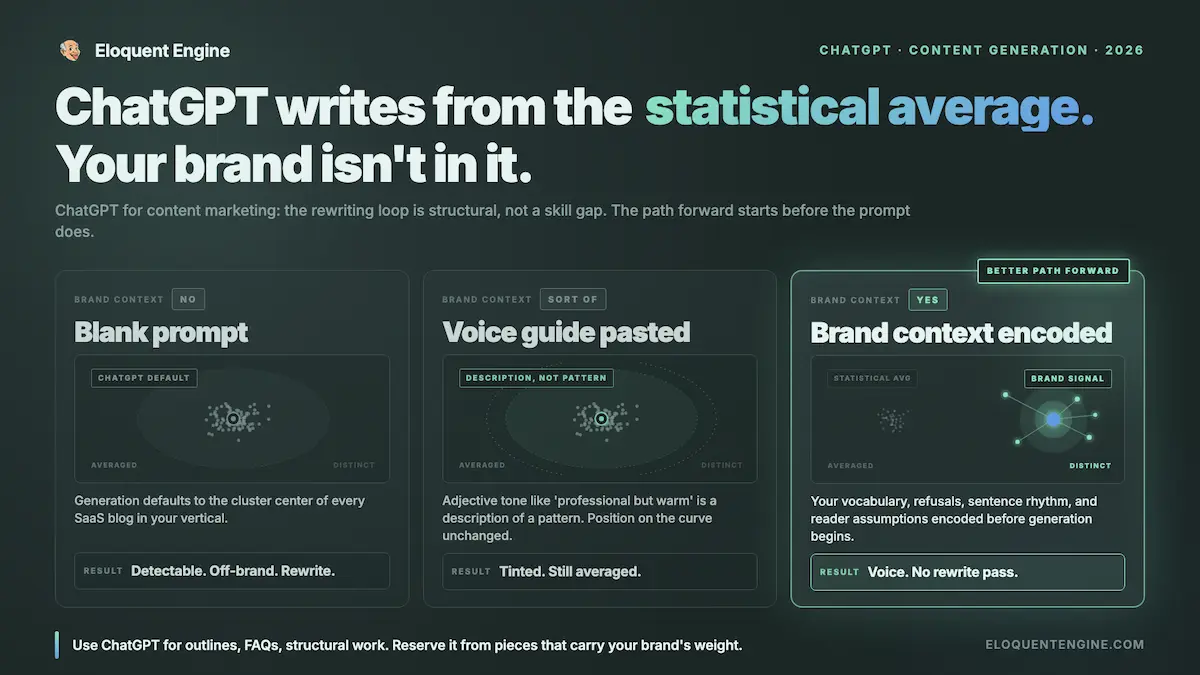
ChatGPT generates text by predicting the most statistically likely continuation of a sequence. Every word follows from every word before it, weighted against patterns in an enormous training corpus drawn from the broad internet. The patterns it learned are the patterns that appear most often across millions of documents. The averaged ones. The interchangeable ones. That is the output: fluent, coherent, and written the way most people write about your topic.

Which is exactly why practitioners keep landing on “not perfect, but…” when they describe what ChatGPT produces for content calendars and captions. They’ve noticed the gap. They’ve just accepted it as the cost of going faster – and that acceptance has a compounding cost that doesn’t show up until reader trust starts eroding quietly.

The detection piece follows directly from the generation process. Tools like GPTZero and Originality.ai score two specific signals, and most people assume AI detection is binary – caught or not caught. It isn’t.

Perplexity and burstiness

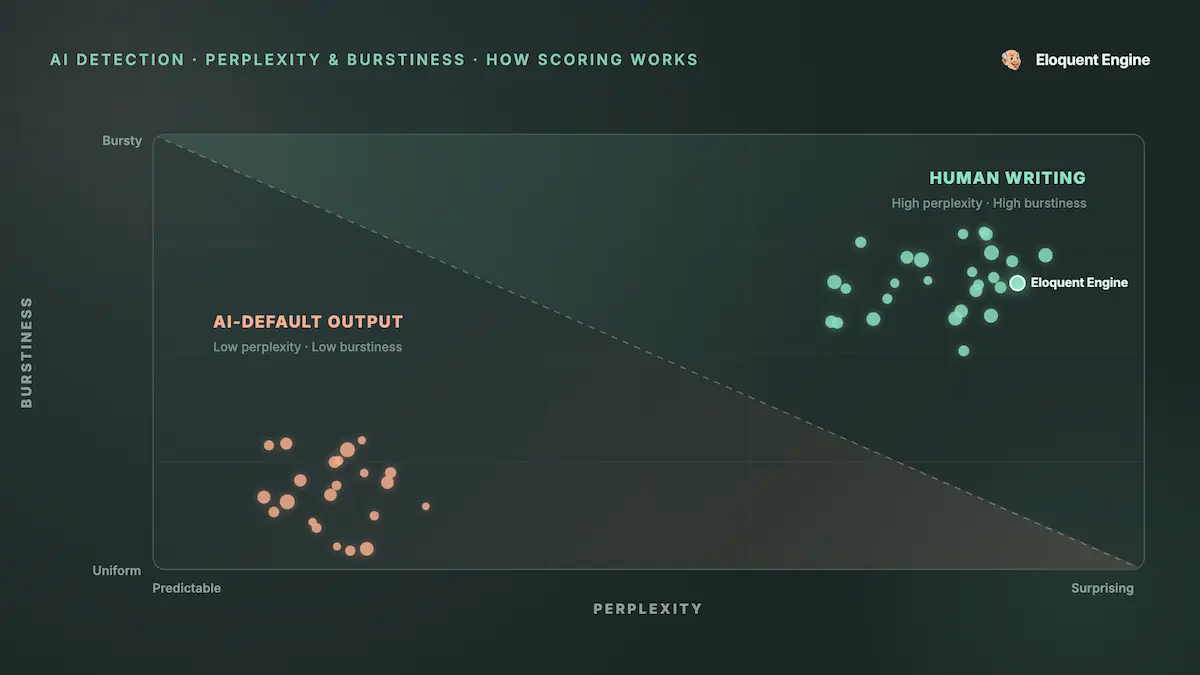
Perplexity measures how predictable the word choices are at the sentence level. Low perplexity means the model could have predicted most of those words – expected transitions, common phrasings, sequences that appear often in training data. Human writers make surprising choices, take syntactic detours, select vocabulary the model didn’t see coming. AI optimized for fluency stays in expected territory because that’s what fluency rewards.

Burstiness measures variation in sentence length and complexity across a passage. Human writers are naturally uneven – three short sentences, then a long subordinate structure, then a fragment, then something complex. AI generation trained for readability produces more consistent variation. Detectors catch that consistency as a signal, not the content of what’s said.

You cannot prompt your way out of this. I say that having watched people build elaborate prompt libraries, layer in custom instructions, try role-play setups with detailed persona briefs – and still have the AI detection score come back at 90 percent with nothing useful to tell a client. The generation process produces low perplexity and reduced burstiness because fluency is what it is optimized for. The two are not separable features you can dial independently.

ChatGPT saves real time on outlines, FAQs, and meta descriptions – practitioners who say so are right. Those tasks work because they don’t require a specific voice. Averaged patterns are fine when the output is structural scaffolding. The problem surfaces when that same process gets asked to produce content that needs to carry a brand’s weight. How AI detection actually fires on content comes down to this: detectors catch predictable writing, and a blank prompt produces exactly that.

Brand voice is an encoding problem

Remember when your content was something only you could have written? When a reader could strip the byline off and still know whose work it was?

Brand voice is an encoding problem. Treating it as a tone preference – “professional but approachable,” “direct but warm” – is why the brand voice guide you built inside ChatGPT keeps producing content that sounds like every other blog in your vertical.

Adjectives are a description of a pattern. The system needs the pattern itself: how your sentences break, which arguments you make that nobody in your space will touch, what your brand consistently declines to say. Those things live in your existing content, your founder communications, your customer language. They are documentable. A brand context document built from real examples – not mood words, but actual constructions – gives a generation system something real to encode against.

“I do most of the planning and let the AI handle specific tasks” is a sensible workflow at face value. The problem is that “specific tasks” expands. It expands until the AI is generating everything except the strategy deck, and the content coming out is detectable, disposable, and diluting a brand that used to mean something.

The live debate among practitioners right now – whether AI content needs substantial rewriting or can publish with a light edit – has a clear answer: substantial rewriting is a signal the generation input was wrong. Fixing the output is the wrong step. Building the brand context document before the first prompt runs is the right one. Document brand voice with real examples before prompting. Validate the content brief against E-E-A-T criteria before handing it to generation. That sequence produces content worth publishing without the four-hour cleanup pass.

SaaStr’s analysis of why B2B buyers are rejecting current AI tools makes the macro case: speed is present, brand signal is not, and the market is noticing. The tools evaluated on feature lists and pricing – without anyone testing whether the actual output is any good – are accumulating a trust deficit that prompt engineering cannot close. Whether Google penalizes AI content is the wrong question to lead with. The right question is whether the content deserves to rank independent of how it was produced. Generic output at scale is its own answer.

The humanizer pass is not a workflow

I’ll be honest – I kept editing the output instead of fixing the input for longer than made sense. At the time, that felt like diligence. In hindsight, it was probably just reluctance to admit that the generation step was broken before the first word appeared.

Tools like Undetectable.ai and QuillBot exist to modify AI-generated text after the fact, raising perplexity and burstiness scores enough to move detection results. They work, to a degree, on the metric. What they cannot do is give the content a coherent brand voice it never had, or restore the argument structure that makes your best pieces recognizable as yours. I won’t even get into what running thin content through a humanizer does to the semantic coherence that entity coverage depends on – that’s a separate problem sitting one layer below the detection question.

The humanizer tool category is a diagnostic, not a solution. Every tool in that category exists because the generation step sold a broken product and then the market sold the fix separately. Running output through a humanizer is admitting the generator failed. The whole category is probably the most expensive evidence that the real problem was the absence of brand context before generation. Building a prompt library as a substitute for a brand voice document is how you get there: the library grows, the output stays hollow, and the humanizer pass becomes a permanent line item nobody wants to acknowledge.

One question that cuts through every vendor claim

Here is the irony of this entire category. The market conversation about AI content tools is a pricing and feature checklist conversation. Storage limits. Integrations. Output speed. Tone sliders. Meanwhile the actual constraint – whether the system has access to anything specific about your brand before it generates – almost never appears on the comparison page.

One question replaces all of it:

Does this system have access to anything unique about my brand before it generates?

Three honest answers:

  1. No. Blank prompt, every time. The system generates from averaged patterns with no brand context. You will post-process generic output. The rewriting cost is structural, and no amount of prompt refinement closes it.
  2. Sort of. You have pasted in a voice guide or custom instructions. The system has a description of your brand. Better than nothing. Still has a ceiling – descriptions of patterns are not the patterns themselves.
  3. Yes. The system ingested your actual content, your research, your documented constructions before generation began. The output starts from your context. The detection score reflects a voice, not a statistical average.

Most operators who feel like they are doing something wrong are working in answer one or two and wondering why the output never quite fits. The gap is architecture, not effort. Evaluate AI writing tools on this question before anything else on the feature list. Tools that cannot answer this clearly are selling speed; tools that can are solving the actual problem. Those are different products, and the feature checklist will not show you which is which.

Use ChatGPT for tasks that don’t require your voice-outlines, FAQs, structural work. Reserve it from pieces that carry your brand’s weight. The rewriting you have been doing for months reflects a context gap, not a skill gap. Name it correctly and the next decision gets easier.

How to Define Brand Voice: A Five-Dimension Extraction Method

Brand Voice Is Not a Feeling. It Is a Set of Choices You Have Not Written Down Yet.

The most durable piece of brand voice advice in the marketing community is to pick three to five adjectives.

  • “Witty but not snarky.”
  • “Helpful without being condescending.”
  • “Casual but not unprofessional.”

These pairs appear in agency decks, Reddit threads, and marketing blogs with enough regularity that they have achieved the status of received wisdom.

They survive as advice because they are easy to agree with. They fail as tools because they describe the effect of your writing, not the cause. “Witty but not snarky” does not tell you whether to open a paragraph with a claim or a question. It does not tell you how long to let a sentence run before landing it, which qualifiers to cut, or what you assume the reader already understands. Those choices generate voice. The adjectives float above all of them.

Practitioners in marketing communities have started naming this frustration directly. The consensus position now is that you cannot follow something that is not defined. Which is correct. The problem is that adjective pairs are definition by analogy. They describe what your brand is like, not what it does on the page. So most teams publish the document, feel briefly more organized, and then write the same way they always did.

Which is fine, right up until someone asks you to brief a freelancer, prompt an AI tool at any meaningful volume, or onboard a team member without months of context. At that point, “witty but not snarky” does not resolve into a sentence. The document was never instruction. It was aspiration.

Brand voice is a construction system. The choices that generate your voice consistently, the words you reach for, the sentences you build, the things you assume the reader knows, the qualifications you cut, these are documentable. They already exist in your best content. The work is extraction, not invention.

You can do this in an afternoon.

Why does your content sound like everyone else’s?

Generic output starts before the first word. A blank prompt fed into ChatGPT has no constraints. No constraints means the model defaults to the statistical average of everything it has seen, which is exactly what most SaaS content sounds like. Originality.ai and GPTZero flag that output not because AI generated it, but because nothing specific was encoded before generation began. Running it through a humanizer pass afterward treats the symptom. The input was the problem.

A prompt library does not fix this either. A collection of templates built on adjective-based voice guidance produces different output every time because the guidance is too abstract to resolve into specific decisions. “Casual but not unprofessional” means something different to every writer, every tool, every Tuesday.

Most teams spend weeks defining brand voice and then wonder why the output still sounds hollow. The content inside the document is the failure. Your writing needs a route, not just a destination.

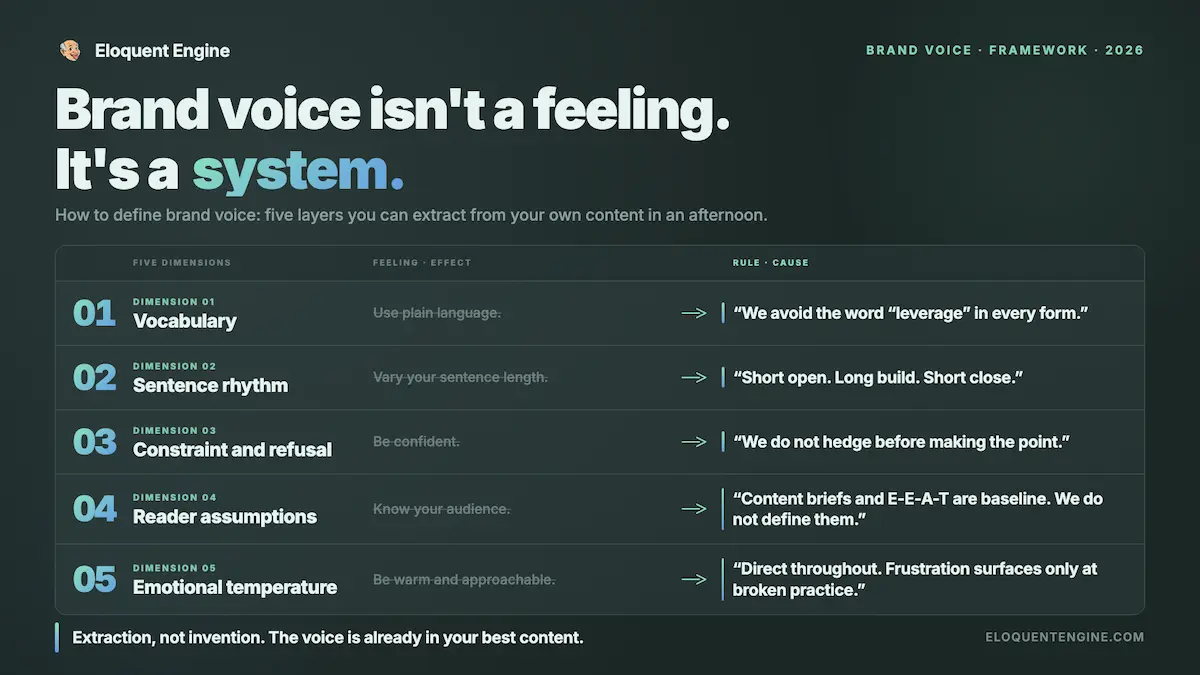
Voice lives in five specific layers: vocabulary, sentence rhythm, constraint and refusal, what you assume about the reader, and emotional temperature. None of those is captured by an adjective pair. Each one can be written down with enough precision that someone who has never read your content could apply it without a follow-up call.

The debate over whether voice should be defined top-down through a guidelines document or discovered bottom-up through audience research is real, but it mistakes the question. Top-down definitions drift from how you actually write. Bottom-up research tells you who the reader is, not how you address them. Extraction, reading your existing content and naming what you find, is where both converge. Your voice is already there. You have just never clocked it systematically.

That changes now. For freelance marketers who need content that sounds genuinely theirs, and for business owners who need consistency without a full team, the process is the same. Five dimensions. One sitting.

How to define brand voice: the five dimensions

Pull three to five pieces of your own content where the draft felt right. Not the best-performing posts. Not the rewrites. The ones you read back and recognized as yours. Those are your source material.

Vocabulary and refusal

Read for two things at once: the words that keep appearing, and the words that never do. Both define your voice. The terms your industry uses constantly that never appear in your writing are as revealing as the ones you reach for. Write the rule for each side. “We avoid the word ‘leverage’ in every form” is useful. “We use plain language” tells a writer nothing. Specific enough that a freelancer could immediately name two words to cut. That is the bar.

Sentence rhythm

Read a section of your best content aloud. You are listening for the pattern your sentences follow. Do you open paragraphs with a short declarative and then expand? Do you build through a long clause and drop something short to close? Do you vary that pattern, or does every paragraph run the same shape?

Rhythm is not aesthetic. It is structural. Document the pattern you actually use, and name one construction you almost never reach for. That gap is as useful as the pattern itself. A technically correct sentence can still feel wrong because the rhythm breaks the contract the rest of your writing established.

Constraint and refusal

This dimension lives in absence, which makes it the hardest to extract and the most differentiating once you do. Look for moments where you could have hedged and did not, could have qualified and did not, could have presented both sides and chose one. Write those as rules. “We do not validate the reader’s skepticism before making the point.” “We do not qualify a claim with ‘it depends’ unless the dependency is named in the same sentence.” Nobody else’s constraint rules will look exactly like yours. That is the point.

Reader assumptions

Every piece of content models a reader. The level of intelligence and familiarity you credit that reader is visible in how you handle terminology, how quickly you move through foundational concepts, and whether you define a term or simply use it. Look at what you explain and what you skip. Document that model explicitly. “We treat content briefs, topical authority, and E-E-A-T as baseline knowledge. We do not define them.” That assumption shapes every sentence that follows it.

Emotional temperature

The brands that feel most consistent usually shift temperature deliberately, not holding one note throughout. Warmth throughout reads as undifferentiated. Consistent dryness with moments of genuine frustration reads as a point of view.

Look at how your content handles industry failures, client mistakes, or genuinely bad advice. Does the temperature stay flat? Does it sharpen? Document where it holds and where it moves, and what triggers the shift. “We stay direct throughout but let frustration surface when naming broken practices.” That is encodable. “We are warm and approachable” is not.

What does a finished voice document actually give you?

The prevailing assumption in most content operations is that a voice document’s job is done once it exists. The guidelines cascade from there. Any writer, any tool, any prompt can execute them.

That assumption is worth examining. SaaStr’s analysis of prompt portability across AI systems identifies a consistent pattern: systems that maintain performance across contexts are those with encoded constraints, not abstract principles. The same logic applies here. A vague voice document produces vague output regardless of who executes it. A constraint-based document changes what the model, or the writer, has available to reach for.

The “voice should stay consistent but adapt to platform” debate points to something real. Voice does shift between a LinkedIn post and a long-form article. The way to manage that shift without losing coherence is to encode the invariant layer, vocabulary, constraints, reader assumptions, separately from the variable layer, temperature, rhythm, format weight. The first stays fixed. The second calibrates to context. That distinction is what makes AI content detection less relevant: detection fires on pattern, and a brand-encoded brief changes what patterns are available.

Three tests tell you whether your document is working:

  • Writing test. Draft something with the document open. Each sentence-level decision should be checkable against a rule. If the rules do not guide decisions at the draft level, they are too abstract.
  • Critique test. Read a draft that does not feel right against your five dimensions. You should be able to name which dimension it breaks. “This doesn’t sound like us” is a feeling. “This assumes the reader does not know what a content brief is, and we treat that as baseline knowledge” is a diagnosis.
  • Brief test. Paste the document into a content brief before generating anything. If the first draft is closer to your voice than it would have been without it, the document is functioning as a constraint set. That is what it should be doing.

So what do you actually leave with?

Probably two to four pages. Maybe five if your constraint rules are detailed. That is it, and I think that surprises people who expected something more substantial.

I used to build the other version, the one with workshops and research phases and weeks of internal review. Those documents were thorough. In hindsight, they were also unusable on a Tuesday afternoon when someone needed to post something and had twenty minutes. Scope was the problem. A process that takes months produces an artifact nobody has time to apply under deadline.

The version that works is faster and, to be honest, messier. You read your own content, name what you find, write the rules specifically enough that someone else could apply them. The document is short enough to read before you start drafting. Short enough to paste into a prompt. Short enough that it actually gets used.

The open question, and I think it is worth leaving open, is how often to update it. Voice shifts. I kept editing output instead of fixing the input for longer than I want to admit, and part of what was happening is that my writing had moved and my document had not. The document should describe the voice you have now. When the output starts feeling wrong again, that is usually the signal to revisit the extraction, not the generation.

Build it. Use it. When the output stops sounding like you, go back to the source content and run the process again. What you are building, underneath all of it, is a constraint set specific enough to generate output that sounds like yours. Not a checklist. A system. One that holds when you are rushing, when you are handing the brief to someone who has never read your content, or when you are evaluating whether an AI writing tool is actually a fit for how your brand works.

The constraint is not the tool. The constraint was never having context in the first place.

How Marketing Agencies Use AI Content Without Killing Brand Voice

You bought the tool after you watched the demos, got impressed by the speed, and ran it on a test article that came back clean. Then you deployed it across actual client accounts, with actual brand requirements and actual audiences, and the drafts came back hollow. Structurally sound. Completely off-brand. Your editors started flagging them, fixing them, eventually rewriting them from scratch, and the time savings you had calculated never appeared.

That cycle will repeat with the next tool, too, unless the input changes.

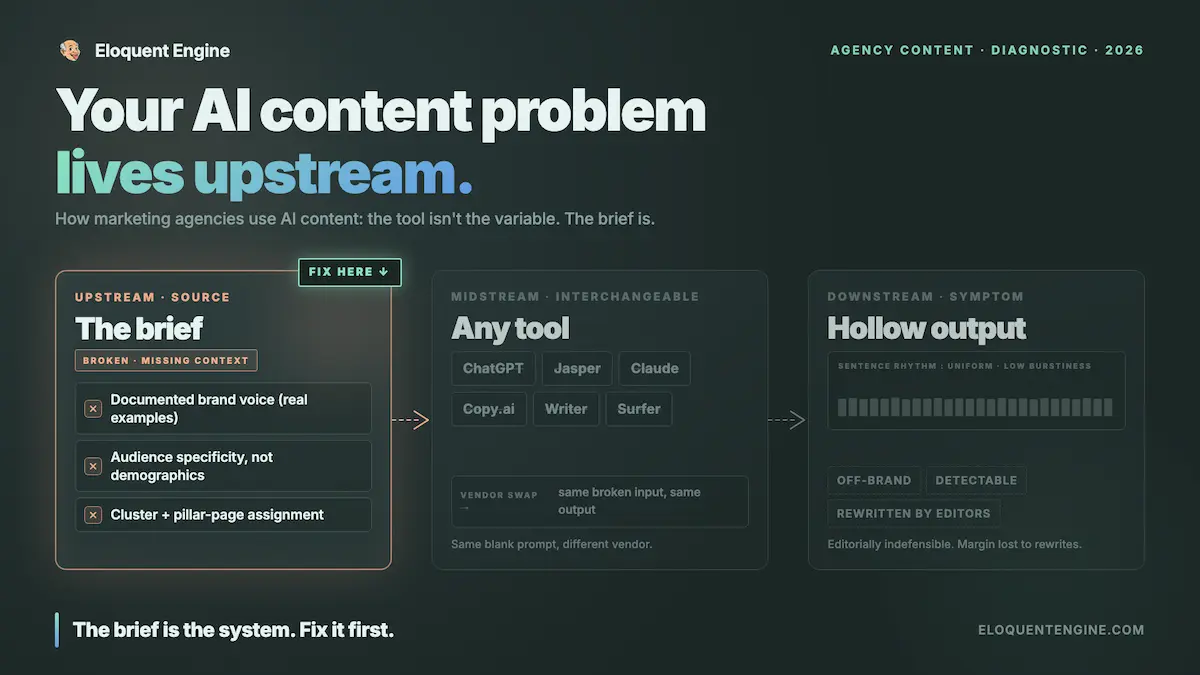
Your client portfolio is heterogeneous. An e-commerce brand sounds nothing like a B2B SaaS company, and neither sounds like an e-learning provider trying to establish authority in a credentialed space. No single configuration serves all of them. But the mistake agencies make is identical across every vertical: generation starts before anyone has encoded what “good” looks like for each client. The tool is irrelevant until that problem is solved.

A prompt library is not a content strategy. It is a faster way to produce the wrong thing at scale.

Why does switching tools keep producing the same problem?

The context fed into the tool is the variable, not the tool itself.

Junior writers running Jasper’s free tier or unstructured ChatGPT prompts are producing detectable, interchangeable content outputs because the generation request contained zero brand intelligence.

It’s common knowledge that generic prompts produces generic articles. I mean, the LLM has to draw from what it is given, and a blank prompt gives it nothing distinctive to draw from. That is the complete causal chain.

The industry debate has quietly shifted from “does AI content rank” to “does this content deserve to rank at all.” That shift matters because it moves the question away from detection mechanics and toward content structure and genuine value. The Google penalty conversation has burned enough calendar cycles. The real constraint is upstream: did the content earn its existence before the model generated a single word?

One emerging signal worth taking seriously: practitioners building content for AI search are structuring pieces differently. Clear sections, direct answers, explicit comparisons. The logic is that models pick up and reuse well-structured content more accurately. That is the inverse of the blank prompt problem. Instead of trying to optimize generation, they are encoding intelligence into content structure so the output is reusable by both humans and machines.

The organizations at the frontier of this are not using off-the-shelf tools with generic prompts. SaaStr documented building a purpose-built AI marketing system with brand context, audience intelligence, and functional specialization encoded at the architecture level, not patched in at the prompt level. That is a systems decision, not a vendor decision. Most agencies have not had that conversation yet.

A system that requires post-humanization before delivery was wrong at the design stage.

How marketing agencies use AI for content when the output is actually defensible

The agencies producing AI content that holds up under editorial review share one habit. They build the brand context document before the content brief, and the content brief before the prompt. In that order, every time.

What goes into a brand context document that actually changes output quality? Not a mission statement. Not a tone-of-voice summary written by committee. Real vocabulary the client uses and vocabulary they would never use. Sentence rhythm pulled from founder communications or high-performing historical content. The specific framing they apply to their category, which is almost always different from how competitors frame it. Customer language sourced from reviews, support tickets, and sales calls. This document travels with every generation request for that client account. Without it, the model writes for a generalized reader. That is how you end up with content that sounds like every other SaaS blog in the category.

The practitioners who have figured this out are consistent on one point: AI works for research, rough drafts, keyword clustering, and structured ideation, but fails when treated as a prompt-to-publish pipeline. Agencies recovering their margins use AI as an input tool with human review gates before publication, not as a prompt-to-publish output mechanism.

AI didn’t kill content marketing. It killed the economics of one specific type of content: the middle-tier SEO article that existed to rank for a keyword and deliver no genuine value to the reader who landed on it. That category is gone. What remains has to earn its place. Content needs real entity coverage, internal linking tied to a pillar page architecture, and E-E-A-T signals that a topic-agnostic LLM cannot manufacture from a blank prompt.

Consider what a functioning content brief actually contains. Encoded brand voice from documented real examples. Audience specificity that goes beyond demographic description into the specific belief the reader needs to hold by the end of the piece. A cluster assignment: which pillar page does this support, and which gap in topical authority does it fill? Entity coverage targets validated against competitor content clusters, not just keyword gap tools. When that brief exists before the model sees any instructions, the output is editorially defensible. Without it:

You are scaling noise, not content.

The other structural failure is volume without architecture. Publishing thin articles across hundreds of keywords with no cluster coherence does not build topical authority. It builds technical debt. Google’s understanding of a site’s expertise is shaped by how well the content covers a topic space, not by how many URLs exist. Running AI generation at volume without entity coverage targets and pillar page logic is how agencies build sites that rank for nothing despite publishing constantly.

So which failure mode is actually breaking your operation?

Think of a content brief the way you’d think about a client intake form before starting a project. An agency that skips the intake and guesses what the client wants will spend more time in revisions than the intake would have taken. A content brief with no brand context is the same mistake, made faster and at scale.

Three failure modes cover almost every agency struggling with AI content right now. Usually more than one is active simultaneously, which is not insignificant when you are trying to diagnose the actual break point.

No brand context document

Generation is running from blank prompts or generic templates copied across client accounts regardless of voice or vertical. The output is detectable, disposable, interchangeable from one account to the next. The fix: build a brand context document for every active client before generating another piece. Document brand voice with real examples from founder communications and customer language. Assign entity-level coverage targets before building the content calendar. This is upstream work. It cannot be skipped and recovered from on the back end.

No client tolerance map

Your team does not have a documented position for each client on AI content. Writers make individual calls that create inconsistent quality and undefined liability. Some clients have explicit no-AI policies that may be getting quietly violated. Others would accept AI-assisted work if the quality holds, but nobody has had the conversation. Map every active account against three categories: AI-comfortable, needs a direct conversation, and AI-excluded. Route workflow accordingly. Document it so the decision is not remade on every new brief.

No detection benchmarking before scaling

Ignoring AI detection scores until a client flags the content is a self-inflicted version of the worst-case scenario. AI detection fires on statistical patterns: low perplexity, low burstiness, sentence-level predictability that comes from generation without sufficient contextual constraint. Benchmark a sample from your current prompt templates against Originality.ai before scaling any new template. High scores mean the brief is the problem, not the output.

On the specialized versus general-purpose tools debate: take a position. The agencies running the most functional AI content operations are using specialized, bounded tools for specific functions. SaaStr’s documentation of 20+ purpose-built AI agents for distinct marketing functions reflects the same logic practitioners are landing on independently: ChatGPT and Perplexity for research and rough drafts, Surfer or Semrush for SEO structure, human review gates before anything goes live. General-purpose models commoditize the output. Specialized, context-encoded systems differentiate it. That distinction is where the real difference between AI writing tools lives, not in feature lists or pricing tiers.

One thing to do before the next generation request goes out

Pull one active client account. Open the brief your team is using to generate content for that client. Ask three questions. Does it contain documented brand voice with real examples, not a one-line tone description? Does it connect to a content cluster with a defined pillar page? Does it encode audience specificity beyond a demographic profile?

If the answer is no to any of those, every piece generated from that brief is starting from broken context. The editing burden you are absorbing, the detection risk you are carrying, the margin you are losing to rewrites: all of it traces back to that brief. Fix the brief. The output changes because the input changed. That is the whole mechanism.

Post-processors are selling a second product to fix the first product’s failure. Understanding why humanizer tools exist tells you exactly what went wrong one step earlier in the process. The agencies that stopped reaching for the humanizer pass are the ones that stopped generating from blank prompts. Same insight, different direction.

The brief is the system. Fix it first.

GPTZero vs Originality AI: Why the Same Content Gets Two Different Scores

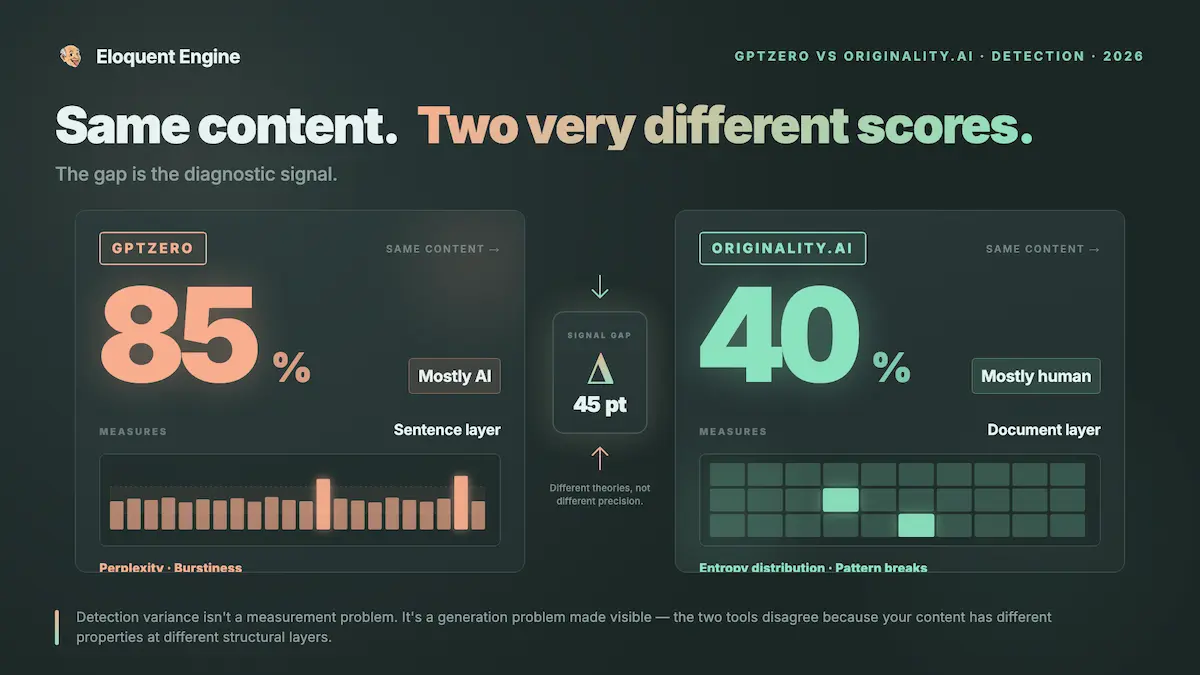
Your Content Scored 85% on GPTZero and 40% on Originality.ai. That Gap Is Telling You Something.

“Which detector is more accurate?” presupposes GPTZero and Originality.ai are measuring the same property with different levels of precision. They’re not. The question encodes a false assumption, and as long as we operate inside it, the comparison produces nothing useful.

Same content. Two tools. One flags it at 85%, one at 40%. This variance is signal—actual diagnostic signal telling you exactly what each system found when it looked at your content through its particular measurement lens. The variance isn’t the problem. The variance is the information.

Here’s the objection I hear most: understanding detector mechanics won’t change the fact that you’ll still edit AI output. And that’s worth taking seriously, because it’s partially true. You will still edit. But knowing why scores diverge changes what you edit, how early you catch it, and whether you’re fixing the right layer of the problem. The editing is a symptom. You can’t address a symptom efficiently without understanding what’s causing it.

GPTZero and Originality.ai encode different theories about what AI-generated text looks like. Not different accuracy levels of the same theory. Different theories entirely. The gap between their scores on the same piece of content is those two theories disagreeing about what they found. Once you understand what each theory predicts, the gap stops feeling like a trap and starts functioning like a diagnostic tool you actually control.

A prompt library is not a content strategy. And running content through two detectors without understanding what either one measures is not a QA process. Both are blind approaches to problems that have specific, knowable causes.

What GPTZero actually measures, and why its scores can feel extreme

GPTZero scores the same text at 84% AI while ZeroGPT scores it at 19%. That’s 65 percentage points on identical input, and it’s been reproducible across enough Reddit threads on r/ChatGPT and r/studytips that calling it an edge case stopped being defensible a long time ago. The tools evaluated on feature lists and pricing while the actual output is garbage – that’s the detection category in miniature. Marketing precision, operational chaos.

GPTZero was built around two specific signals: perplexity and burstiness. Perplexity measures how statistically predictable a piece of text is. When a language model generates content, it selects each word based on what’s most probable given everything before it. The result, even when it sounds natural, is text that flows too smoothly. Too many expected word sequences. Too few surprising choices. Low-perplexity text is GPTZero’s primary target.

Burstiness measures how that predictability is distributed across the text. Human writing is characteristically uneven. Complexity spikes and drops. A technically dense paragraph lands next to a short, punchy observation. A long, subordinate-clause-heavy sentence gets followed by a fragment. AI writing doesn’t do this naturally. The perplexity stays in a narrow band. The rhythm is even. Burstiness detects that flatness, and GPTZero weights both signals heavily in its classification.

The practical result: GPTZero is calibrated for formal, structured writing. Academic essays. Structured reports. The content types where AI generation produces the most uniform output. A practitioner framing it as “GPTZero feels more relevant for academic style text” is describing something real. GPTZero’s sensitivity to perplexity and burstiness makes it sharp at catching that formal register, and notably less reliable on mixed text or lightly edited AI content where a skilled prompt engineer introduced sentence variation.

That’s where the extreme scores come from. GPTZero is not broken when it produces a 90% flag on content that “feels” human. It found specific statistical properties, weighted them against its model, and returned what that calculation produced. Practitioners are using a tool calibrated for academic detection on SEO blog content and treating the output as universal truth.

Whether GPTZero’s extreme scoring reflects sensitivity or poor calibration depends entirely on what you’re running through it. For formal content, the sensitivity is probably appropriate. For mixed or conversational content, those scores reflect a model encountering something it wasn’t fully calibrated to evaluate. That’s a use-case mismatch, and knowing the difference protects you in the client conversation.

What Originality.ai actually measures, and why I used to think it was just “more accurate”

I’ll be honest: the first time I ran the same piece through both tools and got wildly different scores, my instinct was that Originality.ai was simply the better-calibrated tool. The scores felt closer to what I expected. Less extreme. More like what practitioners mean when they say it “landed closer to what felt accurate.” I assumed that feeling was evidence of precision.

In hindsight, I was probably confusing consistency with accuracy—different properties entirely.

Originality.ai’s detection engine focuses on entropy distribution and writing pattern breaks rather than perplexity and burstiness. Entropy, in this context, measures informational unpredictability across the text. High entropy means diverse vocabulary, varied structural choices, transitions that don’t follow obvious patterns. Low entropy means the text is making safe, statistically expected choices throughout. Originality.ai’s model was trained to detect the specific entropy signatures that characterize output from large language models – particularly GPT-4 and similar architectures.

The writing pattern break signal is where it gets more interesting (and, to be honest, more complicated). Human writing has inconsistencies. Shifts in formality. Changes in how arguments are structured from section to section. A sudden personal aside in the middle of an otherwise neutral explanation. These inconsistencies are signatures of a mind working through something in real time. AI writing, especially when it’s prompted section by section or generated in a single pass with a generic brief, tends to maintain a consistent register throughout. Originality.ai’s model is partially calibrated to detect the absence of those breaks.

Here’s what I kept missing: most detectors show high false positives on human writing and easy misses on lightly edited AI text. That’s the actual calibration failure in the category. If the content you’re producing is lightly edited AI output – which, let’s say it plainly, is what most agency production looks like right now – Originality.ai’s entropy model is genuinely more sensitive to what you’re producing than GPTZero’s perplexity model is. That’s why its reputation for consistency is real. But consistent at what? Catching the entropy pattern of GPT-4 output. That’s a specific thing. It’s useful if that’s what you’re generating. It’s less useful if your actual risk is inconsistent human-AI mixed content.

If you built a whole prompt library and still got flagged, I think the prompt library was targeting the wrong signal. You were probably optimizing for sentence variation – which helps with burstiness and GPTZero – while the entropy distribution across the full document stayed flat. The reason AI writing sounds detectable goes deeper than sentence-level patterns, and fixing it at the sentence level leaves the document-level signals intact.

Where GPTZero and Originality.ai actually diverge, and why I’m still not sure how much that matters

To be honest, mapping the signal differences is easier than knowing what to do with the map. So let me try to be specific about what each tool catches reliably and where each one breaks down, and then sit with the parts I’m less certain about.

The clearest divergence: GPTZero is more sensitive to sentence-level statistical predictability. Originality.ai is more sensitive to document-level pattern consistency. Content can pass one test and fail the other simultaneously, because the tests are not redundant. A piece with varied sentence structure and vocabulary – the kind of output a skilled prompt engineer produces by encoding sentence length variation into the brief – will reduce GPTZero’s burstiness flag while leaving Originality.ai’s entropy signal largely unchanged.

SignalGPTZeroOriginality.ai
Primary detection layerSentence-level perplexity and burstinessDocument-level entropy and pattern breaks
Strongest content contextFormal, academic, structured writingLong-form SEO and editorial content at scale
False positive riskHigher on formal human writingLower overall, but misses lightly edited AI
Mixed content behaviorExtreme scores common (“mostly AI” or “mostly human”)More graduated scoring, less likely to spike
Calibration basisAcademic and essay-style detectionCommercial content, GPT-4 output signatures

I probably overcorrected for a while by treating Originality.ai as the default trustworthy tool and GPTZero as noise. In hindsight, that was missing the point. GPTZero’s extreme scores on academic-style content are not miscalibration; they’re the signal the tool was built to produce. The match between tool and content type is wrong.

Detection variance is not a measurement problem. It’s a generation problem made visible.

That’s the thing I kept editing around instead of addressing. The two scores diverge because the content has different properties at the sentence level versus the document level. Those properties came from the generation process. The detectors revealed the gap that was already present in the generation process.

GPTZero vs Originality.ai: which signal matters for your specific use case

AI detection fires on pattern, and generic prompts produce predictable patterns. That’s the mechanism—not opinion but observable process. A blank prompt generates uniform output because the model has nothing brand-specific to draw on; it falls back on the statistical center of its training data. That center is exactly what both detectors were calibrated to find.

So the question of which tool matters more for your use case is really a question about which detection layer your content is most exposed to, and that depends on what you’re producing and for whom.

SEO blog content published at scale

Originality.ai is the harder test here. Long-form SEO content is precisely the content type it was built to evaluate, and its document-level entropy analysis catches the structural uniformity that emerges when you’re publishing at volume without a brand context document. If your clients are in sectors where competitors use Originality.ai for content audits – and increasingly, SEO-focused clients are – this is the score that will follow you into a client conversation. Benchmarking detection scores on a sample before scaling a new prompt template is not optional at this volume; it’s how you find out before the client does.

Formal, structured content with a professional register

GPTZero is the harder test here. White papers, case studies, formal reports, grant-style writing. The content types where AI generation naturally produces the flat burstiness profile GPTZero is calibrated to catch. An 80% “human-written” result on GPTZero for this content type doesn’t predict what Turnitin or a human editor will find – and it certainly doesn’t predict what Originality.ai will say. The tools are not interchangeable. Running formal content only through Originality.ai and feeling confident is a narrow miss waiting to happen.

Brand copy and mixed-register content

This is where both tools have genuine limitations. Mixed text – content that blends AI generation with meaningful human editing or integrates founder voice – is the category where false positives are highest and confidence in any score is lowest. A brand context document encoded into the brief before generation changes your output and your odds simultaneously; it introduces the vocabulary, register shifts, and pattern breaks that both tools use as proxies for human authorship.

The brands that own search in three years are building content architectures, not publishing blog posts at scale. Detection resistance is a byproduct of that architecture, not a goal you optimize for separately. If your content system requires a humanizer pass before you feel safe publishing…

The mechanics behind humanizer tools explain exactly why that pass is a second product selling you a fix for the first product’s failure. The input was wrong. The humanizer doesn’t know what the input was supposed to be. It can only mask; it cannot rebuild.

How to explain the score gap to a client without sounding defensive

I’ve watched the detection score come back at 90% and had no explanation for the client. That silence is worse than any score. And in hindsight, the reason I had no explanation was that I’d been treating the scores as verdicts rather than measurements. Once you understand the measurement, the explanation is actually straightforward.

Here’s a process that works in the client conversation:

Step 1: Name the tools as distinct measurement systems

“GPTZero and Originality.ai measure different things. GPTZero is looking at whether individual sentences are statistically predictable. Originality.ai is looking at whether the document’s overall structure follows AI-generated patterns. A piece of content can score differently on each because it has different properties at those two levels.”

This repositions you as the person who understands the tools, not the person defending the output.

Step 2: Identify which layer the score is reflecting

If the GPTZero score is high and Originality.ai is moderate, the sentence-level burstiness is the issue. The content is too uniform at the sentence level – probably because the prompt didn’t encode voice variation or the editing pass was light. If Originality.ai is high and GPTZero is moderate, the document structure is too consistent – same information architecture across every section, no register shifts, no writing pattern breaks.

Each of those has a specific upstream fix. Neither fix is “run it through a humanizer.”

Step 3: Separate detection scores from ranking outcomes

Clients conflate detection with penalty. They need a clean separation. Google’s actual position on AI content is more nuanced than the fear suggests – detection by a third-party tool has no direct pipeline to a ranking signal. Originality.ai flagging content at 78% does not trigger a manual action. What triggers ranking consequences is content that fails E-E-A-T criteria: thin coverage, no entity depth, no demonstrable authority. Those are addressable in the brief. They’re not properties the detector created.

The gap between scores is telling you where your system broke

Every agency that has published 200 articles a month and called it a content strategy eventually hits this moment. The client runs the content through Originality.ai. The score comes back high. There’s no explanation ready, no framework in place, no process that predicted this would happen. Just the score and the silence.

The detectors did exactly what they were built to do—they found patterns in the content that are statistically consistent with AI generation. They found patterns in the content that are statistically consistent with AI generation. Those patterns were in the content before the detector ran. They came from the generation process. A blank prompt fed to a model with no brand context document produces hollow, detectable output because the model has nothing differentiating to encode. The detector just reads what’s already there.

Here’s the objection I want to address directly: “I’ve been doing this for two years and my scores are fine, so this doesn’t apply to me.” Maybe. Or maybe your clients aren’t running detection yet. Or they’re using the free GPTZero tier, which catches the most obvious patterns and misses the rest. The score you’re comfortable with today is calibrated against tools your clients used last quarter. Originality.ai’s model is updated. GPTZero’s sensitivity to formal content is real. “Junior staff running free tools and nobody checking the output” is a description of where most agencies are right now, and it’s a description of a gap that closes without warning when a client upgrades their audit process.

The agencies that stop being surprised by detection scores are not the ones who found a better humanizer. They’re the ones who built brand-encoded briefs into the generation step, documented voice with real examples from founder communications and customer language, and stopped treating post-processing as a substitute for upstream context. The gap between GPTZero and Originality.ai on your content is not random. It’s a specific readable signal about which layer of your generation process is broken.

Fix the layer. The scores follow.

Where this comparison actually ends up

I’m genuinely uncertain whether understanding detector mechanics is enough to change behavior. Knowing why variance exists is valuable. Whether it shifts a workflow that’s been built around editing output rather than encoding input – that’s a harder question, and I don’t want to oversell the leverage here.

But here’s what the argument arrived at, somewhere past where it started: the GPTZero vs Originality.ai comparison is not ultimately a comparison between two detection tools. It’s a diagnostic instrument for your content architecture. Two tools measuring different signals and finding a wide gap means your content has inconsistent properties at multiple structural levels. That’s an upstream finding about generation, not a downstream judgment about which score to trust.

The path forward is not choosing the detector your clients fear less. It’s building a content system that encodes brand context, calibrates voice at the brief level, and produces topically coherent, structurally sound output before any detector sees it. Understanding what triggers AI detection is the foundation for that system. The score comparison just shows you which foundation is missing.

Detection scores are a symptom. The disease is generation without context. Content architecture built around brand encoding from the first word makes this comparison, over time, irrelevant.

AI Writing ROI for Agencies: The Hours You Save vs. the Hours You Move

Your AI Writing Tool Is Saving You Hours and Costing You Margin. Here Is the Math That Proves It.

You bought the tool. You watched the demo. The content came out fast, and for about two weeks, it felt like the capacity problem was solved. Then you looked at what your editors were actually doing with the output. Not the demo output. The output on your most demanding client account, the one with the specific voice and the stakeholder who reads everything twice. The one where vanilla output gets sent back without comment, because the client has learned that sending comments is optional when the agency is supposed to know better.

Three years ago, every agency owner I talked to was evaluating AI tools on feature lists and pricing. Nobody was running the editing hours after. Nobody was asking what detectable content costs when a client finds it. The tools churn out words. The agencies flood their clients with interchangeable, disposable drafts and call it a content strategy. The ROI calculation most agencies run measures the wrong number entirely. Here is the right one.

What does a content piece actually cost you right now?

Before any AI tool touches your workflow, a 5-20 person agency producing 1,000-1,500 word B2B blog posts is carrying something close to this cost structure, at a blended internal rate of $50 per hour:

ActivityTime (hours)Cost per piece
Brief development and research1.0 – 1.5$50 – $75
Drafting2.0 – 3.0$100 – $150
Editing and brand alignment0.75 – 1.25$37 – $62
Client revisions (avg. 1.2 rounds)0.5 – 1.0$25 – $50
QA and publication prep0.25 – 0.5$12 – $25
Total4.5 – 7.25 hours$224 – $362 per piece

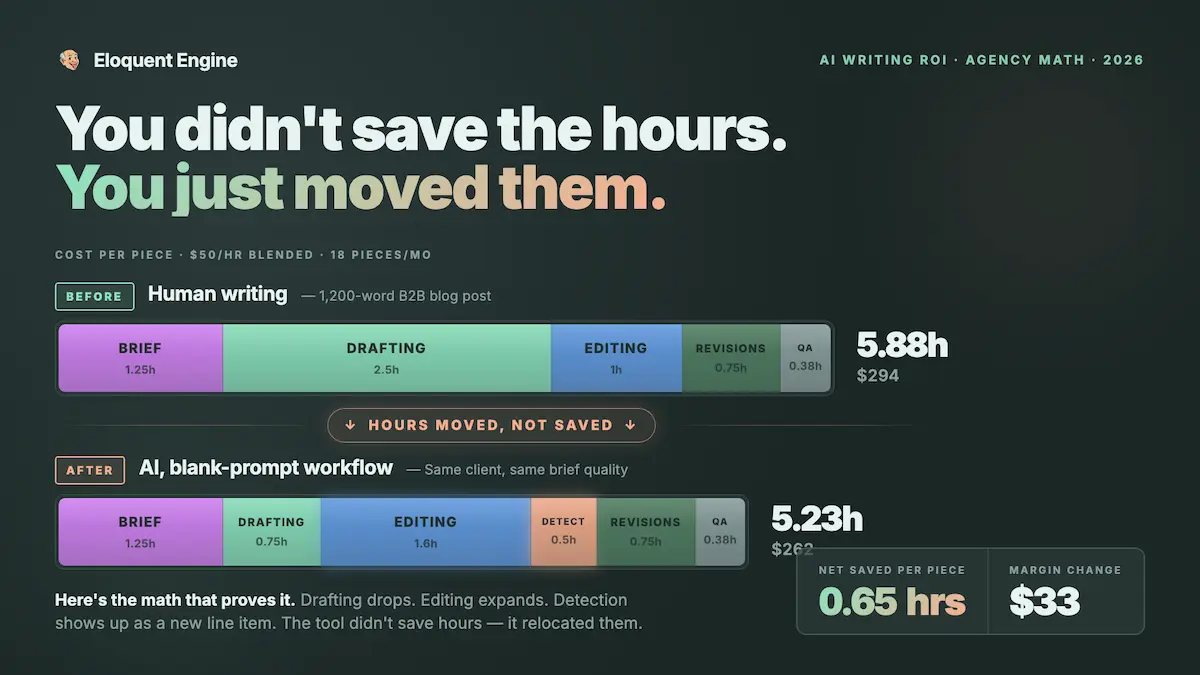
Drafting is 40-50% of total cost. That is the target an AI tool should attack. But you do not save the drafting hours. You save the drafting hours and lose some or all of them in editing. The tool did not save hours. It moved them. And the ROI paradox in the wider market reflects exactly this: enterprises report positive AI returns at high rates while most AI pilots fail to deliver measurable ROI. They are measuring drafting. They are not measuring what comes after.

A prompt library is not a content strategy. Encoding a brand voice document into the brief before the model generates is. The agencies that confuse those two things are the ones who bought a tool, ran it for ninety days, and are now back to freelancers. The ones that do not confuse them are building content architectures that survive model updates and client scrutiny.

The tool saved hours on drafting and cost hours in editing, so it moved the work rather than saving it.

What are the three costs no AI tool shows you in the demo?

AI content detection fires on pattern, and generic prompts produce predictable patterns. That is not an opinion. It is how tools like Originality.ai and GPTZero are built. The cost of ignoring that pattern shows up in three places that never appear in a vendor demo, because demos run clean briefs on open topics where any generator performs well. Your client work does not look like that.

Editing overhead that expands instead of shrinks

A content manager gets a draft from a tool running a blank prompt against a client in enterprise HR software. The structure is recognizable. The vocabulary is correct. The voice sounds like every other SaaS blog in the category. She spends ninety minutes rewriting individual sections because the draft argues like a generalist, not like the client’s brand. That ninety minutes is not editing. It is drafting with extra steps, done after the fact, at a higher stress level because the deadline is now closer.

If your output needs to be substantively rewritten for brand coherence, the system was broken before the first word. The root cause is that the model never had brand context to encode. Running AI generation with no brand context document and then correcting the output is a hollow loop that costs more than it saves.

Post-processors are selling a second product to fix the first product’s failure. How AI humanizer tools work and why they cannot fix this problem structurally is worth understanding before you add one to your stack. The humanizer pass is a symptom of broken generation input, not a solution to it.

Detection remediation time

Content scoring 65-80% AI probability on Originality.ai creates a binary choice: publish and carry the risk, or spend 30-45 minutes per piece bringing the score down. Neither option is free. The detection risk is not hypothetical. Production AI implementations surface systemic problems that weren’t visible in pilots, and agencies are learning this the same way enterprises are: after the client flags something.

Junior staff running free tools and nobody checking the output is exactly the scenario where detection risk compounds silently. One detectable piece is a conversation. A pattern of them is a relationship that ends without warning.

Brief development that nobody prices correctly

With human writers, brief development is roughly fixed overhead. With AI tools, brief quality determines output quality at every stage. A content brief that encodes tone, audience language, competitive framing, and E-E-A-T signals before the model generates is structurally different from a brief that names a topic and a word count. Building the right brief takes time. Most tools sell you generation and call brief development your problem. Why AI writing sounds fake is a brief design problem, not a model quality problem. The fix happens before prompting, not after.

The before and after math: what a brand research layer actually changes

Think of a content production workflow the way you think about a manufacturing line. The raw material goes in at one end; a finished product comes out the other. Every station on the line either adds value or compensates for a defect introduced upstream. When you run AI generation from a blank prompt, you are running a line with no quality control at the input stage. Every station downstream, including editing, QA, and detection remediation, is compensating for something that should never have left the first station broken. The line looks efficient because generation is fast. The finished product cost tells a different story.

The proxy scenario below is built from realistic agency cost structures. It reflects a 15-20 piece per month shop serving three to five B2B clients. No fabricated client names, no inflated results. Just the math that runs when you account for the full line.

Before: generation with no brand context layer

Generation is fast. Drafting time drops from 2.5 hours per piece to 45 minutes. That is real. What happens next is also real, and it is the part the vendor’s ROI calculator does not include.

Editing time climbs from 1.0 hour to 1.5-1.75 hours because the output does not hold the client’s voice at the section level. The content sounds like every other SaaS blog in the category because it was built from the same interchangeable blank prompt architecture every other agency is running. Detection scores on Originality.ai run 55-75% AI probability on average across a realistic mix of client briefs. That number requires either acceptance of detection risk or 30 minutes per piece in remediation. Brief development stays at 1.0-1.5 hours per piece because no brand context document exists to front-load that work.

Net math: drafting saves 1.75 hours. Editing adds 0.5-0.75 hours. Detection remediation adds 0.5 hours. Brief development stays flat. Total savings per piece: 0.5-0.75 hours. At $50 per hour blended rate and 18 pieces per month, that is $450-$675 in monthly labor savings before tool cost. If the tool costs $400 per month, the margin improvement is negligible. The line appeared faster, but the unit economics stayed flat.

Where the context enters the system determines output quality more than the AI technology itself. Tools evaluated on feature lists and pricing while actual output quality goes untested produce exactly this result. The mainstream consensus that “scalable workflows include content production pipelines” is technically accurate and operationally useless if the pipeline is producing detectable, interchangeable output that requires downstream compensation at every station.

After: generation with a brand research and context layer

When brand voice, audience language, competitive framing, and entity coverage targets are encoded into the system before generation, the first station on the line produces different raw material. The raw material is structurally different from what blank-prompt generation produces. Sentence rhythm varies. Vocabulary distribution reflects the client’s documented language, not the model’s defaults. Argument structure follows the client’s established positioning rather than the generic “here is a problem, here is a solution, here is a conclusion” scaffold that detection tools have learned to flag.

Drafting stays at 45 minutes. Editing drops to 30-40 minutes because the editor is refining a draft that already speaks the client’s language, not retraining a voice that was never encoded. Detection remediation is reduced or eliminated on content generated with genuine brand context, because pattern variance at the structural level changes the detection signal. Brief development shifts from per-piece overhead to a one-time brand context document built per client and maintained, not recreated for every assignment.

Net math: drafting saves 1.75 hours. Editing saves 0.5-0.75 hours. Detection remediation is reduced or eliminated. Brief development is front-loaded once per client. Total savings per piece: 2.0-2.5 hours. At $50 per hour and 18 pieces per month, that is $1,800-$2,250 in monthly labor savings before tool cost. That number justifies a tool cost of $400-$600 per month and leaves real margin on the table. How AI content writing for agencies can scale client output without scaling headcount depends entirely on whether the context enters the system before generation or gets patched in afterward.

The difference between those two scenarios is not model quality. It is where the brand context lives in the workflow.

What do realistic detection pass rates actually look like?

You have run Originality.ai on competitor content. You have seen what 80% AI probability looks like in a report and understood what it means for a client relationship. You know the difference between a claim and a score. So when a vendor says their tool “passes detection,” you know that claim is missing a context window, a content category, and a sample size.

AI content detection fires on pattern. Calibrate your expectations against that mechanism, not against marketing claims. Generic prompts produce predictable sentence rhythm, vocabulary distribution, and structural patterns. Detection tools index those patterns. A blank prompt run through any major generation platform on a competitive B2B topic will produce a score that reflects exactly how predictable the output was, regardless of what the interface calls itself.

Detection scores are a symptom. The disease is context-free generation. Encoding brand voice at the brief level, before the model generates, produces structurally distinct output because the inputs were structurally distinct. That is not a claim about detection evasion. How AI content detection works and what triggers it is worth reading before you benchmark any tool’s pass rate. The mechanism tells you what to measure. Pass rate claims are only meaningful when they specify the detection tool, the content category, and what the brief architecture looked like. Anything less is a deliberately vague number.

Ask for score distributions across realistic client briefs in your vertical. Not cherry-picked examples on open-ended topics where any well-prompted generator performs cleanly.

The client transparency decision is also a math problem

An agency produces twenty pieces per month for a SaaS client at a retainer that assumes human writing. The team switches to AI generation to protect margin. Nobody tells the client. The content passes a casual read. Three months later, the client’s marketing director runs a piece through Originality.ai because she saw something in an industry newsletter about AI detection. The score comes back at 71%. The conversation that follows is not about content quality. It is about whether the agency has been billing for work it did not do.

That conversation costs more than the margin the agency protected. Not hypothetically. In retainer replacement cost, in reference loss, in the internal time spent managing the fallout. The risk is real and it compounds as detection tools improve and clients become more familiar with running them.

The transparent path looks different. Framing AI-assisted content as a capacity and consistency advantage, backed by a documented brand research process, a detection benchmark, and human editorial oversight, is a conversation that clients who understand the system respond to differently than clients who discover it on their own. What the evidence actually shows about Google and AI content gives you the ranking argument. The client relationship argument is simpler: you can explain a system. You cannot explain a pattern of omission.

Billing agency rates for lightly edited output without disclosure is a risk you are carrying on behalf of the retainer. Choose your path deliberately.

The decision rule you can run before the next tool purchase

Apply this in sequence. The criteria narrow to a number you can act on.

Step 1: Calculate your real editing overhead on AI output

Take your most demanding active client brief. Generate a piece with the tool you are evaluating. Time the editing pass. Not on a demo brief. On that client. If editing time increases by more than 30 minutes per piece compared to your current process, the drafting savings are being consumed downstream. The tool does not improve your margin at that account.

Step 2: Benchmark detection before you scale

Run ten pieces through Originality.ai before you commit to volume. Score distributions across a realistic content mix tell you more than a single test. If scores cluster above 60% AI probability, the brief architecture needs work before the tool is production-ready. Scaling a prompt template without benchmarking detection scores first is how agencies build a detection problem at volume instead of catching it at sample size.

Step 3: Apply the threshold

If drafting savings minus editing overhead increase equals less than one hour per piece, a tool priced above $300 per month does not improve your unit economics at 15-20 pieces monthly. If a brand-encoded system reduces both drafting and editing time, savings of 2.0-2.5 hours per piece at that volume justify $400-$600 per month in tool cost with margin intact.

The agencies building content architectures that survive the next two years are encoding brand context before the model generates, clustering content around pillar pages before publishing individual articles, and auditing detection scores before scaling any new template. Why marketers are moving away from volume-first content systems is the structural shift underneath this math. The real decision is whether the tool supports a system worth building.

What Is Brand Voice? A Pattern System, Not a Trait List

Your AI Content Sounds Generic Because Your Voice Was Never Defined as a System

You get the feeling that your content is super generic. You read back the AI output and something is hollow. The sentences hold. The argument tracks. The content is technically correct. But it reads like it could have come from anyone, published on any site, about any product that does roughly what yours does.

Most people flag that feeling and move on. They run it through Quillbot. They tweak a few phrases. They tell themselves this is just how AI works, that the tool has limits, that maybe a better prompt would fix it next time.

That hollow quality signals a broken system: no brand voice was encoded upstream. The AI generated content with no voice architecture upstream. No brand context, no documented patterns, nothing to encode your specific way of writing before the first word appeared. So it defaulted. It averaged. It produced the most statistically common version of content about your topic, and that is exactly what it is supposed to do when no one gave it a reason to do otherwise.

A prompt library without voice architecture is not a content strategy. Personality adjectives in a style guide do not constitute a voice architecture. If your output needs to be humanized after generation, the system was wrong before the first word. This is a design problem, not an editing problem. And the only way to fix a design problem is to understand what was missing from the design.

What was missing is brand voice. Not as a feeling or a trait list, but as a system of specific, repeatable choices that a model can be trained against. That is what this piece explains.

What is brand voice, and why does the standard definition not get you there?

The consensus answer, honestly, is not wrong. Brand voice humanizes your business. It makes sure everyone writing for you is talking the same language. It sets you apart and builds trust. Experienced practitioners on r/copywriting and r/marketing will tell you to immerse yourself in the brand’s mission, create a persona with specific attributes, define three to five key traits that align with your positioning.

I believed this framework for longer than I should have. At the time, it seemed sufficient. You define the traits, you share them with the team, consistency follows. Then I watched a detection score come back at ninety percent AI on a piece where the prompt had included the voice guidelines. Bold, curious, direct. All three traits in the brief. The output was still detectable. Still flat. Still interchangeable with every other SaaS blog in the index.

That is when I realized the trait framework answers the wrong question. “What does your brand sound like?” is a different question from “What choices does your brand make at the word and sentence level, consistently, across every piece?” The first produces adjectives. The second produces a map.

Brand voice is a pattern system. Specifically, it is a set of repeatable decisions operating at three levels simultaneously. The words you reach for, the way you build and break sentences, and the relationship your writing assumes with the reader. Those decisions compound. Enough of them, applied consistently, produce something recognizable. Something a reader could identify without a byline.

The practitioners arguing that brand voice primarily serves internal alignment are not wrong. It does. But that framing undersells what is actually happening when voice works. Readers trust content that sounds like a specific person thought it through, not like a committee averaged it. Algorithms surface content with coherent entity signals and semantic density, not content that reads like every other page in the cluster. The real stakes are trust and authority, not just internal consistency. And you cannot get there with a trait list alone.

What you need is a brand context document: voice illustrated by real examples from founder communications and customer language, not described through adjectives. The difference between “we write with curiosity” and three annotated paragraphs showing what curiosity looks like in your sentence construction. That is the difference between a feeling and a system.

The three pattern elements that make voice visible in any piece of content

Here is where I probably overcorrected, in hindsight. I kept editing AI output instead of fixing the input. I built a whole prompt library and still got flagged. The prompts described voice. They did not map it. And the model, with no map to work from, kept churning out the same vanilla output.

What I missed was that voice is already visible in existing content, yours, a competitor’s, anyone’s, if you know what to look for. Three elements. Not a comprehensive audit, not a full brand voice document. Three things you can see right now.

Lexical choices: the words that keep reappearing

Every writer has a vocabulary fingerprint. When two words mean the same thing, one of them gets chosen more often. “Start” versus “begin.” “Show” versus “demonstrate.” “Build” versus “construct.” Individually, those choices feel arbitrary. Across fifty pieces, they are a signal.

There are also vocabulary domains. Some writers borrow consistently from engineering and systems language even when writing about marketing. Words like “architecture,” “encode,” “signal,” “map.” Others pull from cooking, from athletics, from design. That domain bleed is not random. It reflects how the writer actually thinks about their subject. It is one of the most distinctive fingerprints in any voice, and one of the first things a blank prompt strips out.

Structural choices: how sentences and paragraphs move

Sentence rhythm is probably the strongest voice signal most readers feel without being able to name. Some voices build long compound sentences that accumulate force before landing. Some write in short declarative punches. Some mix both deliberately. Some qualify a claim before making it; others assert first, qualify later, or not at all.

Paragraph shape matters too. Where does the main claim land. First sentence, last sentence, or distributed without ever being stated explicitly? How quickly does the writing move to the next point? These structural habits create the reading experience, and they are what AI generation dilutes first. The model moves toward structural averages across its training data. Your structural signature is not average.

The debate about whether voice needs formal documentation or can emerge through immersion has a practical answer here. Immersion might let a single writer reproduce a voice intuitively. A model cannot be immersed. SaaStr’s analysis of prompt portability in AI agents identifies the same structural problem across AI systems: consistency at scale requires explicit encoding, not intuition. Brand voice is no different. The structural patterns must be documented or they will not survive the generation process.

Narrative stance: the relationship the writing assumes with the reader

Every piece of writing carries an assumption about who the reader is and what they already know. Some voices treat the reader as a peer and skip the setup entirely. Some lead carefully through every step. Some create shared ground through “we” even when the writer is clearly one person. The distribution of certainty and uncertainty across a body of content is one of the most recognizable patterns in any experienced writer’s voice, and one of the first things that collapses in generic AI output. Models tend toward false confidence across everything. Real voices are uncertain in specific, documentable places.

These three elements compound. A consistent vocabulary domain plus a recognizable sentence rhythm plus a specific narrative stance produces something readers identify as a voice. Remove any one of them and the recognition fades. Remove all three, which is what running a blank prompt does, and you get content that sounds like every other SaaS blog in the index.

Why does the model keep generating the same kind of output no matter what you ask it?

I think this is where people get stuck. They assume the problem is the prompt. They refine the prompt. They build a prompt library. The output is still detectable, still thin, still interchangeable. The prompt was never the variable that mattered.

AI language models generate text by predicting what token comes next based on patterns in their training data. Without a voice map constraining those predictions, the model moves toward the statistical center. The most common choices across everything it has processed. That center is not anyone’s voice. It is the average of everyone’s voice, which means it belongs to no one.

The chiasmus worth sitting with: you cannot get a specific output from a generic input. A generic input gets you generic output. Specific input, voice mapped at the lexical, structural, and narrative levels, encoded in the content brief before a single instruction is written, gets you something else entirely.

Running the output through a humanizer tool after the fact does not change what happened at generation. Post-processors are selling a second product to fix the first product’s failure. The generation ran without context. No editing pass recovers context that was never there.

Brand voice fidelity starts in the brief, not in the edit pass. The practitioners who argue you can maintain voice through immersion alone, without documented patterns, without a brand context document built from real founder and customer language, are describing a process that works for one human writer who has spent months inside a brand. They are not describing a process that works for an AI system generating at scale.

Here is how to read your own voice in the content you have already published

Pull three pieces of content you wrote yourself. No AI assistance, just your own drafts. Then pull three recent AI-generated pieces on the same topics. Read them against each other.

Most people who do this have the same conversation with themselves:

“The AI version covers all the same points.”

“Right. Which words appear in yours that never appear in the AI’s?”

“I say ‘map’ a lot. And ‘encode.’ The AI says ‘optimize’ and ‘enhance.'”

“That’s your vocabulary domain. What about the sentences?”

“Mine are shorter. And I start a lot of paragraphs with observations before I make a claim. The AI leads with the claim every time.”

That conversation is a voice audit. Those specific observations, vocabulary domain, sentence rhythm, paragraph shape, are the beginning of a brand context document. Not the trait list (“bold, curious, direct”). The actual choices, illustrated by actual examples.

The brands building consistent AI-generated content at scale are not running better prompts. They are feeding the model a document that maps these patterns before any prompt is written. Sophisticated marketing operations build systems first, not assets. Brand voice encoding is the same principle applied to content generation.

You do not need to complete that document before you can see what is missing. Run the diagnostic. If you can name three consistent choices across those six pieces, you have a voice map beginning. If you cannot name them, your voice exists in your writing but has never been articulated. Both outcomes are useful. Both tell you exactly where the work is.

The output will keep defaulting until the input changes

Someone asks me every few weeks whether there is a prompt that finally fixes the generic problem. A template, a formula, a better tool. The question is understandable. It is also the wrong question.

Generic output stems from voice architecture absence, not tool limitations or prompt formulation. Specifically, the absence of one. The AI generated content with no brand context and produced exactly what it should produce under those conditions. Detectable. Hollow. Disposable.

Break that cycle at the input level. Build a brand context document before the model sees a single instruction. Encode your vocabulary domain, your structural habits, your narrative stance. With real examples, not trait adjectives. That document becomes the constraint that pulls generation away from the statistical average and toward something that sounds like you.

A prompt library without voice encoding is not a content strategy. Adjectives in a style guide do not constitute a voice architecture. If you cannot articulate your voice as a pattern system, you cannot teach it to anything. Human writer, new team member, or AI tool. The articulation is the prerequisite. Everything else follows from there.

Start with the six pieces. Name three choices. That is the first sentence of your brand context document.

How to Produce AI Content That Passes Detection Without Humanizers

Detection Tools Aren’t Catching Your AI Content. They’re Catching the Blank Prompt You Started With.

I spent a long time blaming the output. Built a whole prompt library, tested different temperature settings, watched the detection score come back at 90 percent and had no explanation for the client. I kept editing the output instead of fixing the input. And, at the time, that felt like the right instinct. The draft was the problem you could see.

It probably isn’t. I don’t think it is for most teams running into this. The draft is where the problem shows up. The content brief – or the absence of one – is where it starts.

What follows isn’t a tool recommendation. There’s no humanizer pass at the end of this. What’s here is the mechanical reason your AI content gets flagged, the three signals detection tools actually measure, and a generation approach that addresses those signals before the model produces a single word. Apply it this week. Explain it to a client on Friday. Both should be possible.

What is Originality.ai actually measuring in your drafts?

Detectable content. That phrase gets thrown around without much underneath it. “Sounds like AI.” “Too polished.” “Generic.” All true. All useless as a production signal. What the tools are actually measuring:

Perplexity: the cost of predictable word choices

Perplexity measures how surprising a piece of text is to a language model. Low perplexity means the text walks a predictable path. Common transitions, expected vocabulary, sentence structures the model assigns high probability. Every AI writing tool generates text by selecting the tokens most likely to follow the previous tokens. That’s the mechanism. The output feels coherent because it is coherent. GPTZero flags it because any other language model would have generated something nearly identical.

Running hollow output through Undetectable.ai nudges perplexity by substituting words and restructuring phrases. The score moves. The underlying problem doesn’t. Detection models are now trained on the patterns humanizers introduce. You’re not escaping the fingerprint. You’re swapping one fingerprint for another.

Burstiness: the rhythm that human writing has and AI generation doesn’t

Human writers break rhythm constantly. Short claim. Then a longer sentence that explains it from a different angle, builds toward something, earns its length. Then a fragment. AI models default toward uniform sentence length. Not always short, not always long, just steady. That steadiness is measurable. Burstiness quantifies the variation pattern in sentence length, and the variation pattern in human writing is distinctive enough that its absence is a signal.

This is fixable at the prompt level. Most teams don’t fix it because they don’t know it exists as a measured variable. The technical reason AI writing sounds fake is partly this: not the word choices, the rhythm.

Token probability and the generic content cluster

Detection models train on large corpora of both human-written and AI-generated content. They learn that AI output clusters around predictable topic-level vocabulary. The statistically common terms and framing for any subject. A model generating content about SaaS onboarding with no additional context produces the median take on SaaS onboarding. Correct. Topically coherent. Interchangeable with fifty other articles on the same keyword.

Content drawing from real brand context, specific product vocabulary, actual customer language, the framing a particular company uses internally, produces a different token probability distribution. That distribution doesn’t cluster where detection models expect AI content to cluster. Encode the brand before you prompt. Every other fix is downstream of that.

A prompt library is a collection of inputs that produce the same detectable output slightly faster – not a content strategy.

So why doesn’t running it through QuillBot actually solve this?

I used to think the humanizer tools were probably fine as a last step. A patch, sure, but functional. I overcorrected when I watched what they actually do to the text.

Practitioners are right that these tools are “band-aids that mask the underlying generation problem” – the reasoning matters. QuillBot and similar tools introduce lexical variation after generation. They shuffle syntax, substitute vocabulary, restructure phrases. Perplexity scores move. What doesn’t move is the absence of brand specificity, the hollow topical depth, the broken burstiness pattern underneath the word substitutions. The variation isn’t motivated by meaning. A human reader, and increasingly, a detection model trained on humanized output, can tell.

There’s a broader pattern here. SaaStr’s analysis of why SaaS companies ship 60% solutions applies cleanly: humanizer tools technically clear the bar (detection evasion) without solving the real constraint (content that earns readership trust and carries genuine brand voice). Post-processors are selling a second product to fix the first product’s failure.

Some practitioners are arriving at this from a different angle, arguing that “passing detection” is the wrong metric entirely, and that human readability and brand alignment are the actual constraints. I think that’s probably right, and I also think it’s compatible with caring about detection scores. They’re not competing goals. A generation process that encodes brand context, structural variation, and topical depth produces content that passes detection and earns readership trust, because those are the same inputs.

Running it through a humanizer tool addresses neither problem at its source. That’s the whole issue.

How do I actually produce AI content that passes detection without a post-processing step?

Three inputs. Each one addresses a specific detection signal. None requires new software. Every one requires doing something before the model sees a prompt.

Build a brand context document before you generate anything

Generic output is a system design problem. A model generating from a blank prompt has no source material for specific vocabulary, specific framing, or the language a real company uses with real customers. It defaults to the statistical average for the topic. That average is detectable because it’s what every other AI-generated piece on that topic also produced.

The fix is a brand context document that precedes every generation task. Not a style guide appended to a prompt after the fact. A document built from source material: founder communications, customer support language, sales call transcripts, customer reviews in the brand’s vertical. Pull the vocabulary that actually appears in those sources. Feed it to the model as context before any instruction. Token choices shift away from the generic cluster. The output carries specificity the model didn’t invent. It drew from the brand’s own language.

Agencies managing multiple client brands face a compounding version of this problem. Using a single generic prompt across all clients regardless of voice or vertical means every client’s content produces the same detectable signature. The brand context document is what breaks that. AI content at agency scale requires encoding voice differences before generation, not after.

Prompt explicitly for structural variation

Burstiness doesn’t happen without instruction. A content brief that covers topic, angle, and target keyword, and says nothing about sentence structure, produces consistently moderate sentence length. Every time. The model isn’t going to introduce rhythmic variation on its own. It optimizes for coherence, and coherence at the token level looks like steady, moderate length.

The prompt adjustment is specific: instruct the model to vary sentence length deliberately. Short declarative sentences alongside longer analytical ones. Explicit permission to fragment. The instruction changes the output in ways that affect burstiness scores. It also makes the content read better, which is the more durable argument. This is one of the few detection signals addressable at the brief level with minimal effort. The barrier was not knowing the signal existed.

For freelance marketers running content across multiple verticals, this is a template audit question: does your standard brief encode structural variation, or topic and angle only? If topic and angle only, every client’s output is producing the same rhythmic signature.

Build topical depth before generating individual pieces

A model prompted to write about email onboarding sequences with no additional context produces the median take on email onboarding sequences. Run a topical gap analysis against competing SaaS blogs first. Map which questions existing content leaves unanswered. Assign entity-level coverage targets before building a content calendar. Feed that depth into the generation context before a single article prompt.

The model’s output is only as differentiated as the context you fed it. Content briefs that encode coverage gaps, competitor angles, and specific unanswered questions shift the model toward territory it hasn’t averaged across thousands of training examples. Detection models have a harder time classifying that output as AI-generated because it doesn’t cluster where they expect AI content to cluster.

This is also the argument for clustering content around pillar pages before generating individual articles. Not purely as an SEO practice, but as a detection risk practice. Thin articles across hundreds of keywords with no depth or entity coverage poison the whole content system. Business owners publishing AI content in-house are especially exposed here: volume without topical coherence just means more detectable pages indexed faster.

Detection tools struggle with the middle ground. Content that’s been genuinely worked on, with specific sourcing and brand-encoded language. That’s the middle ground the generation design method is trying to produce from the start. No humanizer pass. The brief does the work the post-processor was patching.

Let’s be honest about what this approach cannot promise

Detection tools will keep evolving – any approach that works against today’s version of Originality.ai operates inside a moving target. Claiming otherwise would be the same oversell the humanizer category runs on.

The detectors are also inconsistent on edge cases. Practitioners are right about that. A piece of content that scores 78% on one run might score 61% on another. Treating those scores as gospel is a mistake. Ignoring them entirely until a client flags the content is also a mistake. Benchmark detection scores on a sample before scaling a new prompt template. That’s the practical position.

In highly specialized domains with limited source material to draw from, brand-encoded generation closes less of the gap. The method reduces detection risk. It doesn’t strip it to zero. Anyone claiming zero risk is churn-out marketing copy, not a content strategy.

The tools that claim to blend detection checking and humanizing into one workflow are consolidating two broken steps, not solving the underlying architecture. That’s worth understanding before evaluating any tool on its feature list versus actual output quality. One of those criteria matters. The other one is what vendors dilute with pricing tiers and interface updates.

We started chasing the score. We should have been building the brief.

We came in watching detection scores climb and reaching for the nearest tool that promised to bring them down. We’ve seen what that produces: interchangeable output that fools a detector and nobody else.

The generation process encodes what the output can contain. A blank prompt produces hollow, detectable content. A brand context document, a brief that specifies structural variation, a topical gap analysis run before a single article is assigned. Those inputs produce content that carries the signals human writing carries. Variation. Specificity. Depth.

That content passes detection because it was built to deserve to. The detector is not the point. The reader is the point. And a generation process built around brand context, structural variation, and topical depth serves both. Without a humanizer pass, without a second product bought to fix the first product’s failure.

Build the brief right. The score follows. Understand the full detection picture and you’ll stop optimizing for the wrong variable entirely.

How to Build a Content Strategy With AI: Start With the Map

Why does AI content underperform even when the output looks fine?

The failure is predictable. A team starts using AI generation. Publishing cadence doubles. The articles cover the right topics, the grammar is clean, the headings are structured. Then six months pass and traffic is flat, rankings are stagnant, and nobody can explain why.

The real constraint is architectural: defined content clusters, encoded brand voice, and clear positioning for each piece inside a larger structure. Teams are treating AI as a writing solution when the real constraint is architectural. Without a defined content cluster, without encoded brand voice, without a clear position for each piece inside a larger structure, AI produces topically plausible prose that goes nowhere. Each article is a standalone event instead of a signal that compounds.

Generic prompts produce predictable patterns that AI detection fires on. The deeper issue: output is only as differentiated as the context fed to the model. A blank prompt returns generic content because that is what blank prompts are designed to produce.

Here is what that looks like in practice, and how the consequences stack:

  • You publish without a cluster. Each article competes with the others for the same keyword territory. None of them earn internal link equity. The pillar page has no amplification, and the supporting articles have no authority to borrow from. Google sees unrelated pages, not a coherent topical signal.
  • You publish without a brand voice document. The model defaults to industry-average language, and every draft arrives sounding like every other SaaS blog. You spend an hour editing toward something distinct. The editing is never quite right because you are pushing against the model’s defaults rather than replacing them with something specific. The content looks polished. It sounds detectable.
  • You publish at volume without entity coverage. Hundreds of articles, thin across the board, no depth on any single subtopic. Google does not reward coverage breadth without coverage depth. The E-E-A-T signal stays hollow. Rankings stay flat. The content calendar kept moving. The authority was never built.

Topical authority is not built by volume. It is built by coverage depth inside a structurally sound architecture. That architecture has to exist before the first prompt. Everything else is just speed applied to the wrong problem.

A cluster map before the first prompt. That is the whole argument.

Right now, the standard workflow visible in practitioner discussions is: research tool plus AI generation plus editorial pass plus publish. Tools like Outrank sit in the research-and-generate layer. A human editor refines. The article goes live. This is the baseline, and it works well enough that most teams stop there.

Volume publication without structural architecture is not strategy – it’s reactive content churn. Junior staff running free tools and nobody checking the output. Tools evaluated on feature lists while the actual output is interchangeable with every competitor’s site. Treating AI generation as strategy instead of an execution layer inside one produces predictable underperformance.

SaaStr reported a 5x increase in search impressions over 12 months while most publishers were watching traffic decline. That result gets cited constantly as proof that AI content works. That result proves AI content works when operating inside deliberate, topically coherent architecture. SaaStr has domain authority, brand clarity, and an audience that returns. The tool executed within pre-existing conditions: domain authority, brand clarity, audience retention.

The depth-versus-breadth debate playing out in practitioner threads right now misses the point. Some teams are reinvesting AI’s time savings into deeper content on existing topics. Others are expanding coverage into less saturated niches. Both camps optimize the generation layer while the structural layer – the cluster architecture enabling compound returns – remains unbuilt.

A content cluster is a pillar page covering a broad topic in depth, surrounded by supporting articles that each answer one specific question within that topic. They link to each other. They all point back to the pillar. The whole signals topical coherence; the parts signal specificity. That is the structure that dilutes nothing, undercuts nothing, and does not weaponize volume against itself.

A cluster map documents that structure before any writing happens. Core topic. Five to seven supporting questions in sequence. Audience stage for each piece. Scope limits so adjacent questions get their own article instead of crowding into the wrong one. Internal linking plan. That document changes what you ask the model to do, and it changes what comes back.

A cluster map before the first prompt. Not a content calendar. Not a prompt library. A map.

The question is not which keywords have volume. The question is which questions your audience asks first.

Most keyword research produces a list. High volume, medium competition, topically adjacent. The list gets handed off to a writer or a generation tool, and the articles come back covering the same territory from slightly different angles, competing with each other for the same search terms. Keyword lists appear thorough; structural architecture is absent.

Practitioners talk about co-creating prompts with AI, including glossaries of domain terms and proper nouns before generating anything. That instinct is correct. But the glossary is not the foundation. The question progression is.

Think of it the way a good onboarding sequence works. You do not lead with your most advanced feature. You start where the user is: confused, skeptical, not yet convinced the problem is real. Then you move them forward, one answer at a time, until the advanced feature makes sense. A content cluster does exactly this. Each piece answers the question the reader is actually asking at that stage in their thinking, not the question that has the highest monthly search volume.

Volume versus relevance misses the actual architecture: sequence. Map the progression from first awareness to confident action, and build clusters around that arc.

How to surface the sequence

Start with your core topic and work backward. What does someone need to believe before this topic becomes relevant to them? Those are your awareness-stage pieces. What do they need to evaluate once they understand the problem? Consideration stage. What do they need to act confidently? Decision stage. Tools like AlsoAsked and Semrush’s Topic Research surface related question clusters. Treat that output as raw material, not a final answer.

The brands that own search in three years are building content architectures around this kind of audience progression, not publishing blog posts at scale. They are encoding the sequence into every brief before a model sees a single instruction. The output arrives structurally sound because the input was architecturally specific.

Cluster-level architecture builds topical authority; individual articles cannot. One well-written piece does not establish authority. A cluster of pieces that calibrate to each stage of the audience’s thinking does. That is the structure worth building before anything else.

A prompt library is not a content strategy. Neither is editing your way to brand voice.

Teams treating brand voice as a post-generation problem face endless rework. The draft arrives sounding hollow, interchangeable, like something produced on a blank prompt because it was produced on a blank prompt. Someone spends an hour reshaping it. The next draft needs the same hour. The editing never fully works because the model’s defaults are still there underneath the revisions, and they reassert themselves in every new piece.

The fix people reach for is a humanizer pass. Run it through a post-processor and strip the detectable patterns. Output needing humanization signals broken input, not broken prose. Post-processors address symptoms, not root causes.

Here is the honest part: encoding brand voice upfront takes work. Building a real brand context document, with documented tone parameters, audience language pulled from actual customer conversations, competitor differentiation written out explicitly, and a glossary of domain terms the model should treat as fixed, takes more time than opening a generation tool and writing a prompt. I am not pretending otherwise.

What it replaces is every editing hour, every hollow draft, every piece that sounds right but feels like it could belong to anyone. SaaStr’s shift to 3 humans and 20 AI agents tripled output. That number is striking. The output triple is striking; whether the brand signal strengthened remains unclear. Volume without trust encoding masquerades as growth until reader retention drops.

Flag the broken input, not the broken output. Build the brand context document. Encode tone, audience, and competitors into the brief before prompting. The question of whether AI’s value is in generation or in the foundational work that happens before writing has a clear answer: both, and in that order.

Brand voice fidelity starts in the brief. Not in the edit pass, and not in post-processing tools.

How to build a content strategy with AI when the structure is already in place

“My client is going to look at this brief and ask why we need all this upfront work before a single article goes live. They’re going to say we’re overthinking it. They’re going to point to the competitor publishing twice a week and ask why we’re not doing that yet. And honestly, I’m not sure I can defend the timeline without sounding like I’m stalling.”

That objection is real. Here is what the defense looks like.

Practitioners across forums are clear that AI saves at least 40 hours on front-end work: topical authority mapping, audience research, entity identification, topic selection. That time savings exists regardless of whether the output is structured or not. The question is what you do with it. Teams that reinvest that 40 hours into deeper cluster architecture are not publishing slower. They are publishing with compounding returns instead of isolated articles that each have to earn traffic on their own.

The brief for each piece in a structured cluster should encode: the specific question this article answers, the audience stage and what the reader already knows coming in, scope limits so adjacent questions stay in their own piece, the internal links this piece should reference, and voice parameters from the brand context document. That brief takes minutes to build once the cluster map exists. It is what makes AI writing tools work better, not more carefully reviewed. The structure changes the generation, not just the editing.

AI content detection fires on pattern. Brand-encoded briefs break the predictable patterns that generic prompts produce. Structurally sound output does not need a post-processing pass. Demonstrably authoritative content does not need to be explained to a skeptical client because the cluster architecture explains itself: here are the questions our audience asks, here is the sequence, here is how each piece connects. That explanation is the defense. A content calendar does not provide it.

You are not behind. You are building the thing that makes the volume matter.

Your competitors publishing twice a week are likely not building cluster architecture before each article goes live. They churn content and watch articles cannibalize each other. Volume signals progress; authority accumulation stalls.

You feel behind because the metric you are watching is publication frequency. That is the wrong metric. The right metric is cluster coherence: how many of your published pieces belong to a defined cluster, link to a pillar, and cover a specific audience-stage question without duplicating another piece in the set.

Audit what you already have. Flag everything that is not inside a cluster. Ungrouped pieces are piles of pages, not strategy – accumulation changes nothing. Break the reactive publishing habit. Build one cluster map this week. One core topic. Five to seven supporting questions in sequence. A pillar page outline at the center. That is the whole structure.

Then build the brand context document. Encode your tone, your audience’s language, your competitor differentiation. Validate your content briefs against E-E-A-T criteria before generation starts. Benchmark a detection score on a sample before scaling any new prompt template. These are not overhead steps that delay publishing. They are the steps that make everything you publish stop being disposable.

Prompt libraries and content calendars are execution tools, not strategy. The map is the strategy. Build it first, and the AI has something real to fill.

You Used Copy.ai and Got Flagged on Originality.ai. Here’s the Problem

The detection failure you had was not a skill issue

You ran the content through Originality.ai. The score came back at 85, 90, 92 percent AI. You rebuilt the prompt. You added tone instructions, audience parameters, a brand voice note at the top. You ran it again. Still flagged. At some point the conclusion started forming: you were probably just bad at this.

That feeling is legitimate. And the cause is specific. Copy.ai was architected for speed and low-friction output. AI content detection fires on pattern, and generic prompts produce predictable patterns. What you experienced was the tool performing exactly as designed. The mismatch was between what you needed and what the system was built to deliver.

If you feel like something is structurally broken in that workflow, you should. Every prompt you refined was working against an architectural constraint built into the system. The brands that own search in three years are building content architectures, not publishing blog posts at scale. Topical authority builds through coverage depth, not output volume. The detection problem is where that bigger issue first becomes visible.

Wait, what is Originality.ai actually measuring? Because I assumed it was simpler than this

I assumed, for longer than I should admit, that detection tools were scanning for something like a watermark. Some embedded AI signature in the output. Missing that distinction is probably why so many people rebuild prompts for months and wonder why nothing improves.

Originality.ai and GPTZero measure two statistical patterns. The first is perplexity: how predictable the word choices are. Human writers reach for unexpected phrasing; they break expected sentence patterns; they make choices a probability model would rank low. AI systems trained to complete sequences fluidly generate the most probable continuation at each step. The output reads smoothly because it is statistically smooth. That smoothness is the signal.

The second is burstiness: variation in sentence length and rhythm. Human writing is irregular in ways that feel natural. A long compound sentence, then a short one, then a fragment, then two medium ones. AI output clusters. Sentence lengths converge. The rhythm stays even. Detection tools clock that evenness as a pattern. For a deeper look at why AI writing produces these patterns at the generation level, the technical explanation goes further than most people expect.

The more you edit AI output to read smoothly, the worse the detection scores can get. I kept editing the output instead of fixing the input. Meanwhile, the whole conversation in practitioner forums was a feature comparison. Jasper versus WriteSonic versus Copy.ai, side by side, evaluated on templates and pricing tiers and unlimited-usage claims. The actual variable, what the model optimizes for during generation, was not in any of those threads. That pattern remains true today.

Copy.ai’s detection problem runs deeper than the prompt, and that matters before you look for a copy.ai alternative

The debate about whether specialized AI writing tools justify their cost over ChatGPT plus Grammarly is real. Practitioners are having it openly. Some are winning that argument. But the argument almost always stays at the wrong level: speed, cost, format-specific outputs, how many words per dollar.

The question nobody asks in those threads is what the system optimizes for during generation. That is where Copy.ai’s detectable output originates.

What prompt-responsive generation actually means

Copy.ai’s architecture is prompt-responsive. You submit instructions. The system generates against them. Brand context, tone parameters, and voice guidelines function as instructions the model tries to follow. The generation engine itself runs the same way regardless of what context you provide. It produces the most statistically probable continuation of each sequence, constrained by your prompt. That optimization target is speed and coherence, not perplexity variation. The output arrives fast. The detection score reflects how it was built.

Consider what running content through a humanizer tool signals. Post-processors are selling a second product to fix the first product’s failure. Output that requires humanization reveals the generation process was flawed from the start. The humanizer pass does not change the underlying generation process. It surfaces the signal, masks it imperfectly, and adds a step that erases the time savings the original tool was supposed to deliver.

The prompt library problem

A prompt library does not change what the model optimizes for. It changes the instructions. A well-constructed prompt inside Copy.ai produces better-structured output with closer tonal alignment. It does not change perplexity or burstiness scores in any durable way, because those scores reflect the generation mechanism, not the content of the instructions. Building a prompt library as a substitute for brand voice documentation is how detectable output scales. You end up with more of it, faster, flagged just as reliably.

The cheap-alternative arms race misses this entirely. Price is a legitimate evaluation dimension. Detection safety is a different one. They do not trade off against each other directly, and collapsing them into a single “value” comparison is how practitioners end up rebuilding workflows six months later. Read about how AI content detection actually works before evaluating any tool’s claims about it.

If the problem is architectural, what would a different architecture actually look like?

I used to think the difference between tools was mostly UX – that the same underlying models produced roughly equivalent output and the wrappers around them were what differentiated the experience. I missed this distinction for longer than I want to say.

The distinction that probably matters most is whether a system encodes brand context before generation begins or applies it after a prompt is received. These are mechanistically different things. Copy.ai is specifically good for marketing texts, ads, and short-form campaigns, and practitioners generally agree on that. The format-specific strength reflects the architecture: short, fast, prompt-responsive generation for defined output types. That works well until the use case becomes client-facing long-form content that needs to pass detection natively.

A brand-context-first architecture builds a representation of voice, audience, and style as constraints that shape the generation process before the first word is produced. Brand characteristics are not instructions layered on top of standard generation. They are part of the statistical context that determines word choice at every step. That changes the perplexity profile of the output in a way that prompt instructions alone cannot replicate.

I think I overcorrected when I first understood this, assuming the architecture gap explained every detection failure. Probably not. Implementation matters too. Running AI generation with no brand context document, using a single generic prompt across all clients regardless of vertical, publishing at volume without topical coherence. Those anti-patterns produce detectable output in any system. The architecture sets the ceiling. The implementation determines where you sit under it.

The ChatGPT plus Grammarly argument gets at this indirectly. ChatGPT with a well-constructed, brand-encoded prompt will outperform Copy.ai with a blank prompt on detection scores. The tool matters less than the context fed into it. A purpose-built system that encodes brand intelligence structurally takes that principle and removes the dependency on the practitioner doing it right every time. Agencies working at scale for clients need content systems that hold brand context at the architecture level, not at the prompt level.

Before you commit to any copy.ai alternative, ask these five questions

The fear underneath most alternative searches is reasonable. You burned time on Copy.ai. You built a prompt library and still got flagged. You watched the detection score come back at 90 percent and had no explanation for the client. Switching to another tool and hitting the same ceiling would be worse than staying put. That fear should inform how you evaluate any new system, not paralyze the evaluation.

Most tool comparisons stop at features, pricing, and format support. Those criteria will not tell you whether a different architecture will change your detection outcomes. These five questions will.

  1. Does brand context enter the system before generation begins, or after? Ask the vendor to describe, specifically, when and how brand voice parameters affect the generation process. “We support brand voice” is not an answer. “Brand voice is encoded into the generation context before the model produces output” is. If they cannot explain the mechanism, assume it is prompt-level styling.
  2. Does the output change detectably when brand context changes? Run the same brief through the system with two different brand profiles. If the output is substantively similar in both cases, the system is not encoding brand context as a generation constraint. Test this in any trial before committing.
  3. What are the baseline detection scores on a fresh sample, with no editing? Benchmark detection scores before scaling any new prompt template. Run five pieces of unedited output through Originality.ai and GPTZero. Consistent scores above 70 percent AI probability across that sample are a generation signature problem, not a prompting problem.
  4. Does the system treat detection safety as a first-order constraint or a downstream feature? Ask directly. Some tools have added “humanization” features as post-processing layers. Those are evidence that the generation layer was designed around a different constraint. Post-processing does not fix generation architecture.
  5. What does the tool optimize for in its training? Speed and volume optimization produces low-perplexity output. Detection safety as a first-order constraint requires the opposite trade-off. No tool optimizes equally for both. Understanding which trade-off a tool made tells you what its detection ceiling is, before you spend a trial period finding out the hard way.

The tool-stacking phenomenon, ChatGPT for drafts, Grammarly for edits, a humanizer pass before sending, reflects practitioners solving the architecture problem manually. It works until it doesn’t scale. A system built around the constraint eliminates the stack. How AI humanizer tools work explains exactly why the stack keeps breaking at the humanization step.

Copy.ai is genuinely good at specific things. Here is where it stops.

Remember when you first tested Copy.ai for a quick ad campaign? The output came fast. The variations were usable. You shipped the campaign and saved four hours. That experience was real. Copy.ai delivers on short-form marketing texts, ad copy, and email campaigns. Practitioners who use it for that use case are not wrong. The tool does what it was built to do.

The problem surfaces when client deliverables require brand-encoded, topically coherent long-form content that passes detection natively. That is a different constraint. Copy.ai was not designed around it. Stealth AI churn is already showing up in tools that built subscription models around one use case without solving the deeper constraint their users actually needed. The category is not broken. The mismatch between tool design and use case is.

Billing agency rates for lightly edited Copy.ai output and ignoring detection scores until a client flags them. That is the version of this workflow that damages trust. The responsibility lies with the practitioner making that choice.

The question was never which tool is better

Imagine hiring a contractor to renovate your kitchen and asking them, halfway through, to also diagnose a structural issue with the foundation. They might look at it. They might offer an opinion. But the foundation is not what they optimized for, and the tools they brought are not the right ones. Replacing them with a different kitchen contractor does not fix the foundation.

Copy.ai alternatives that compete on price, template count, or format support are kitchen contractors. The detection problem is a foundation problem.

The brands building content architectures that hold up are encoding brand voice before generation, calibrating content briefs against E-E-A-T criteria, clustering output around pillar pages with real entity coverage. AI content detection fires on pattern. Generic prompts produce predictable patterns. The conclusion that follows is architectural, not preferential: the system that encodes brand intelligence as a constraint before generation begins will produce measurably distinct output. That output indexes differently. It survives client scrutiny differently.

The right evaluation question is: which constraint does this tool design around? Answer that, and the comparison resolves itself. For freelance marketers navigating this for their own content, what that looks like in practice is a different starting point than another feature list.

Solutions

Your Plan

Business $60/mo

Everything you need to publish with confidence.

  • 1 project
  • 12 articles/month
  • 1 strategy run/quarter
  • Generation rollover
  • Full data access
Start free trial Compare all plans
Freelance Marketer $150/mo

More clients. Same hours. Higher income.

  • 5 projects
  • 30 articles/month
  • 5 strategy runs/quarter
  • Generation rollover
  • Full data access
Start free trial Compare all plans
Agency $600/mo

Scale content across every client without scaling headcount.

  • 25 projects
  • 150 articles/month
  • 25 strategy runs/quarter
  • Unlimited team members
  • Generation rollover
  • Full data access
Start free trial Compare all plans