Searching for a better Jasper alternative? Here’s why almost no one finds a better one.
You know the feeling: six months of Jasper output, and the edit cycles are longer than the writing. The content calendar is full. Every piece is technically correct, grammatically clean, and somehow identical in feeling to the piece from last week and the week before that.
A prospect ran your last post through ZeroGPT and sent you the screenshot of a super high AI detection score followed by the question no one wants to hear: “client asked, quietly, whether the articles were “”was this written by a real person?”
So the search starts. Jasper AI alternative. Cheaper. Just as good. ChatGPT underneath anyway. Unlimited usage. Haven’t been happier.
That is the whole problem right there.
The alternatives market is built around a comparison that flatlines the moment you pressure-test it: feature parity at lower cost. Copy.ai has better built-in scripts. Writesonic is much more budget-friendly. Orwell is great for blogs. Every one of these claims might be true. None of them address why Jasper stopped working for you. And if you don’t know why Jasper stopped working, you will burn through the next tool the same way.
The comparison everyone runs treats this as a tool problem. It is an architecture problem. The tool is just where you finally noticed it.
The output keeps sounding the same because the architecture keeps doing the same thing
Here is what most vendors will not say out loud: the sameness problem you’re experiencing with Jasper will follow you to Copy.ai and to Writesonic and to whatever comes next, because the sameness problem lives in the workflow structure, not the tool.
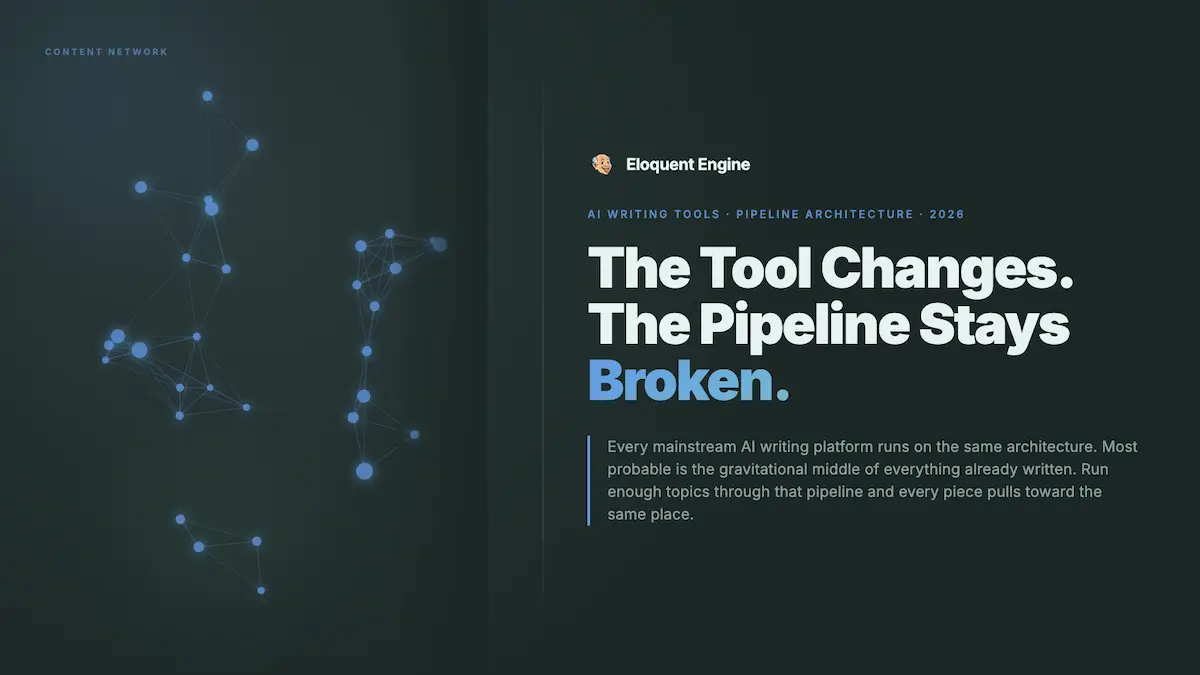
Every mainstream AI writing platform runs on a version of the same pipeline. A user provides a topic and a brief. The model generates text by predicting the most probable sequence of words given that input. And the output enters the world. That’s it. That is the entire architecture.
And it guarantees content convergence because “most probable” is definitionally the center of the distribution. It is the gravitational middle of everything that has already been written. Run enough topics through that pipeline and every piece pulls toward the same place, regardless of which tool is generating the prediction.
Now, a fair objection: couldn’t a better model make the output less generic? And the honest answer is yes. Partly, and temporarily. The AI SaaS pricing conversation happening right now is largely about this: vendors are trying to justify premium pricing against a market that has decided the underlying model is commoditized. The practitioners saying “ChatGPT-powered alternatives are just as good as Jasper” are probably right. Not because Jasper’s model is weak, but because model quality has stopped being the differentiator. The pipeline is the differentiator. And the pipeline across all these tools is the same.
Humanizers don’t fix this. They operate on surface features, synonym substitution, sentence length variation, burstiness adjustment, and they do move perplexity scores on older detection methods. What they don’t touch is the reasoning signature underneath: the way a paragraph sequences its evidence, the predictability of how a point resolves, the statistical coherence of the argument’s structure. Tools like GPTZero are measuring those patterns now. You can paraphrase AI output into oblivion and the detection signature is still there, in the shape of the logic.
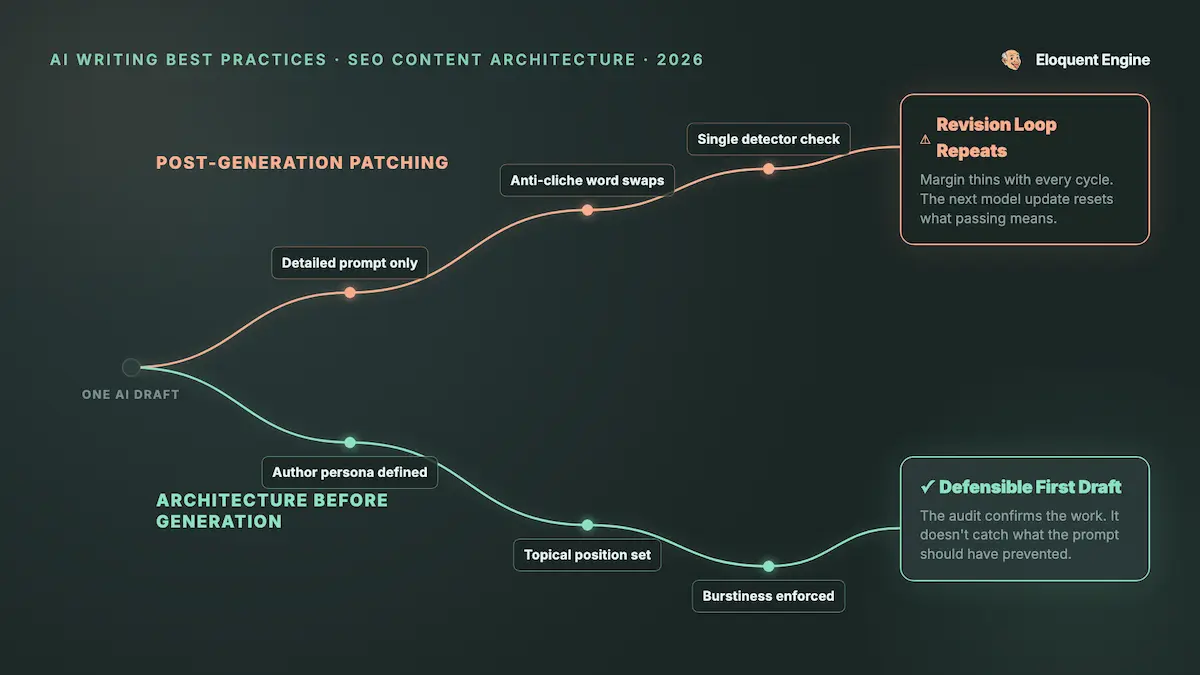
And this is where the self-undermining admission has to land. We looked at this problem for a long time and assumed a better prompting system was the answer. Better briefs. More specific inputs. Tighter templates. And those things helped, and the testing improved the output, and the detection scores moved in the right direction. And the content still flattened after sixty days. The brief was not the bottleneck. The pipeline was. No amount of volume fixes that. No amount of humanization fixes that. Fast mediocrity is still mediocrity.
The reason this matters before any tool comparison: if the sameness problem comes from the pipeline, then switching to a cheaper tool with the same pipeline structure is not progress. It is just a lower subscription fee for the same outcome.
Before you switch anything, run this diagnostic on your own workflow
The debate over which underlying model matters more, Jasper’s proprietary training versus GPT-4 versus Claude, is the wrong debate. Practitioners choosing ChatGPT-powered alternatives because “the core model is what matters” are making a reasonable guess that happens to miss the actual leverage point. The model is not where this breaks. The workflow is where this breaks.
Here is the diagnostic. Three questions. Answer them honestly before you sign up for anything.
First: where does brand voice live in your current system? If the answer is “in the brief” or “the writer knows it” or “we have a style guide somewhere,” your brand voice lives outside the tool. That means every generation starts from a generic baseline and you edit toward distinctiveness after the fact. That editing overhead is not a tool problem. A different tool produces the same baseline and requires the same editing.
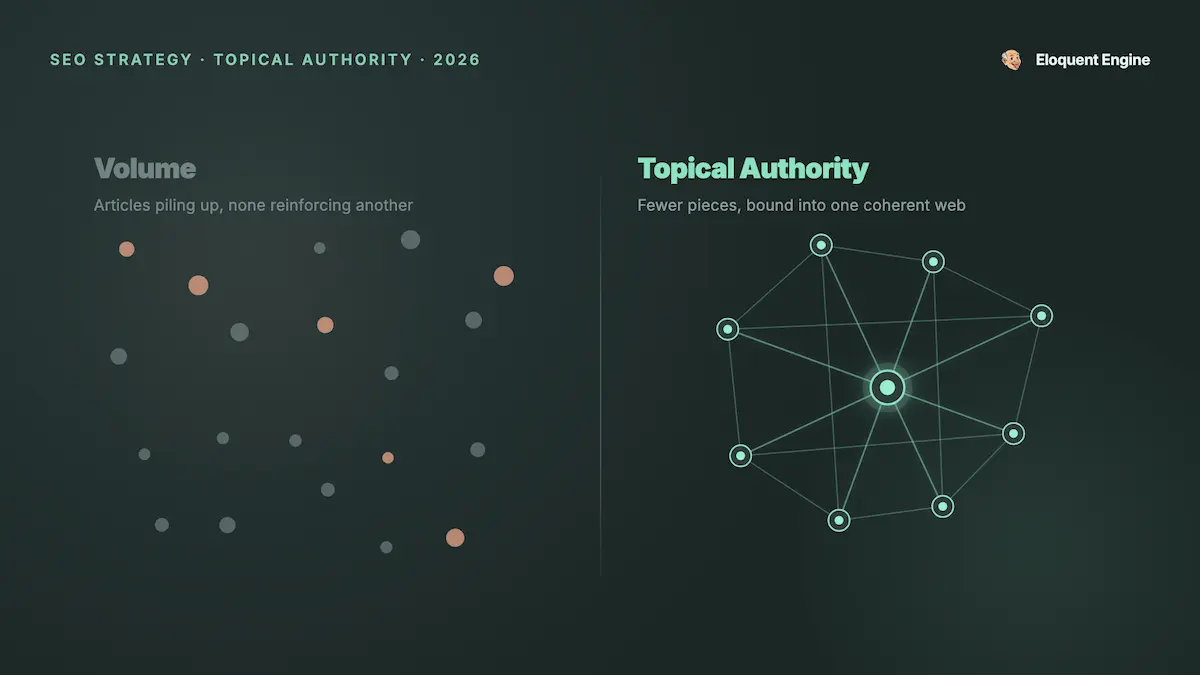
Second: does your content system have a structural reason for each piece to exist? If topics come from a keyword list without a pillar-cluster map, without a cannibalization audit, without a documented gap in your existing topical authority, then AI output fills arbitrary slots in an arbitrary calendar. Measurably, this produces content that flatlines on Google despite being well-written. Changing the tool does not change the strategy. The tool is not the strategy.
Third: what happens to the AI’s output before it publishes? If the answer is “we edit it,” the question is what you are editing toward and whether any tool shortens that distance. If the answer is “we run it through a humanizer,” you have already admitted the tool’s raw output fails your quality bar. A different tool’s raw output will fail in a similar way, because the failure is structural.
If brand voice is inside your generation system, if every piece has a structural reason to exist, if the output requires minimal editing because the inputs are architecturally complete. Then a tool switch might actually help. You are calibrating a working system. If those conditions don’t hold, you are shopping for a tool to fix a system that the tool cannot reach.
What you actually need a Jasper AI alternative to do differently
You searched for this comparison six months ago and found a roundup. Copy.ai, Writesonic, Rytr, maybe Anyword. The listicle said they were much more budget-friendly. You may have even tried one. The output was fine. The edit cycles were the same.
That is the circular structure of this problem: the tool changes, the workflow stays broken, the content flattens, the search starts again. Each lap through that cycle costs you time and detection risk and, eventually, client trust. The consequences escalate. A piece that sounds AI-generated embarrasses the individual writer. A pattern of AI-sounding content erodes the client relationship. A failed detection audit collapses the retainer.
So when you evaluate any alternative, including this one, evaluate it on criteria that actually map to the failure mode:
- Does brand voice live inside the generation process, or does it require post-generation editing to appear? Tools that take brand input as a parameter before generating are architecturally different from tools that generate first and let you adjust after.
- Does the tool have a strategy layer, or does it require you to bring strategy to it? The publish-more mentality is costing you rankings. A tool with no built-in pillar-cluster logic or cannibalization awareness makes that problem worse, not better.
- Does the output pass detection at the reasoning level, or only after humanization? Detectable AI content is a liability. If a tool requires a humanizer pass to be publishable, the architecture has already failed.
- Does content uniqueness come from the generation process, or from your editing? If you are the source of originality and the tool is the source of structure, you are doing the hard work and paying for the scaffolding.
Template libraries are not on that list. Unlimited usage is not on that list. “ChatGPT but with built-in scripts” is not on that list. Those are features. These are criteria.
Here is how the tools actually compare when price stops being the only criteria
Okay, but you have a vested interest here. This comparison is going to make Jasper look bad and Eloquent Engine look great. That’s what these pages do.
That’s fair. So let’s establish what the comparison is actually measuring before scoring anything. And let the criteria do the work.
The live disagreement in practitioner communities right now is between all-in-one platforms like Copy.ai and Writesonic versus specialized tools like Orwell for blog generation and Wilde for optimization. The emerging consensus is that specialized tools outperform generalists for specific use cases, despite being more budget-friendly. That claim is probably true at the task level. Orwell may generate a better blog draft than Jasper for a comparable input. The task-level comparison is real.
The problem is that no collection of specialized task-level tools addresses the system-level failure. You can have the best blog generator, the best optimizer, the best humanizer. And still produce content that cannibalizes your own keyword targets, ignores your brand differentiation, and flatlines at month three. The tools improved. The architecture stayed broken.
| Criteria | Jasper | Copy.ai / Writesonic | Specialized tools (Orwell, Wilde) | Eloquent Engine (THREAD) |
|---|---|---|---|---|
| Brand voice input | Post-generation style guide; requires editing toward brand | Limited voice parameters; primarily template-driven | Task-specific; no persistent brand layer | Encoded before generation; part of the mathematical input |
| Strategy layer | External; user brings topic and keyword | External; template selects format, not strategy | External; task is defined, strategy is not | Internal; pillar-cluster logic and topical gap analysis built into content architecture |
| Detection risk | Requires humanizer pass for reliable detection scores | Same pipeline; same detection signature; same humanizer dependency | Task output varies; detection risk varies by tool | Generation from a mathematical foundation rather than statistical text prediction; structurally different output signature |
| Content uniqueness | Depends on prompt quality and post-editing | Template-shaped output; uniqueness comes from user input quality | Better task-level output; no uniqueness at the reasoning level | Uniqueness from brand research and audience intelligence inputs; generated from a differentiated foundation |
| Cannibalization awareness | None built in | None built in | None built in | Structurally integrated into topic assignment |
I want to be genuinely honest about one cell in that table. Whether THREAD’s detection scores hold across all content types and all detection tools. I am not certain. The tools are moving. GPTZero updates its models. What passes today may not pass in six months. What I am confident in is the architectural reason why the approach is structurally different, not just cosmetically different. The generation starts from brand research and audience intelligence encoded mathematically, not from a topic prompt run through a prediction engine. That is a different kind of input producing a different kind of output. Whether that difference is large enough for your specific situation depends on what your specific situation actually is.
That uncertainty is not a disclaimer. It is the honest answer to a market that has been sold too many guarantees already.
The architecture rebuild is not as complicated as it sounds
Three years ago, the conversation about AI content was about speed. How many posts per week could a tool produce. How fast could a writer go from brief to published. The assumption underneath all of it: more output equals more results. We got burned on that assumption. Everyone did.
Now the conversation is about architecture. And the reversal that matters is this: the question was never what can AI produce for your content system. It was always what does your content system need to give AI before it can produce anything worth reading.
The rebuild has three concrete pieces, and none of them require a genius to implement.
Brand voice engineering before generation. Document not just tone but point of view. The positions your brand takes, the things it refuses to say, the specific knowledge it brings that no other brand in the category has. That becomes an input, not an editorial pass.
Topic architecture before the calendar fills up. Map your pillar clusters. Run a cannibalization audit on what you already have indexed. Every new topic assignment needs a structural reason to exist: a documented gap, a cluster connection, a SERP intent that isn’t already served by something you published. This is what building compounding topical authority actually looks like operationally.
Detection as a quality signal, not a final check. If content is running through ZeroGPT after publication, the workflow is checking the wrong thing at the wrong time. Detection risk surfaces during generation, at the architecture level. The fix is upstream, not at the end of the pipeline.
THREAD’s mathematical approach to content strategy operationalizes exactly these inputs, brand research, audience intelligence, and topical architecture, as the foundation before any content is generated. The architecture piece was not obvious at all when we were building it. Took longer than it should have to understand that the output problem was really an input problem.
So where does this leave you
Probably somewhere uncomfortable. You came here for a comparison and the comparison is in that table. But I am not sure the table is the thing you needed most.
Think about what happens when a business hires a faster printer because their marketing isn’t working. The printing gets faster. The marketing still isn’t working. The printer was never the constraint. Switching tools when your content system is the constraint produces the same outcome: the new tool runs faster through the same broken process.
If you ran the diagnostic in section three and your brand voice lives inside your generation process, your topics have structural reasons to exist, and your output passes detection without a humanizer. Then the comparison table tells you something actionable. You are choosing between real options.
If those conditions don’t hold, the honest question is: how long can you keep switching tools before a client runs a detection audit you can’t explain? That window is closing. The detectors are getting better and the clients are getting more aware, quietly, in ways they don’t always say out loud. The cost of staying in the current architecture is not zero. It is accumulating, probably faster than it feels right now.
I assumed good tools were enough for longer than I should have. Maybe that was just us.