ChatGPT Generates From Statistical Averages, Not Your Brand Spec
The draft you wrote with ChatGPT comes back fine. Competent.
But it reads like every other blog in your vertical – detectable, interchangeable, quietly embarrassing if you sit with it long enough. You fix the worst parts. Send a better prompt. The next version is slightly less hollow. You rewrite that one too.
Nobody mentions this part when they talk about how AI speeds up the content process. They cite the outlines, the meta descriptions, the FAQs. What gets skipped is the four hours of cleanup on a blog post that was churned out by a system with no idea who you are, what you believe, or why your readers keep coming back.
Remember the first time you published something that actually sounded like your brand? When the work had a specific point of view that nobody else in your vertical would have written?
That version of your content is still possible. The generic prompt just never gets you there. There is a technical reason AI writing sounds flat, and once you see it, the rewriting loop stops feeling like your fault.
Why ChatGPT generates what it generates when you use it for content marketing
I used to think the problem was the prompt. In hindsight, that assumption was probably the most expensive mistake I watched small operators make – and I made it myself, for longer than I want to admit.
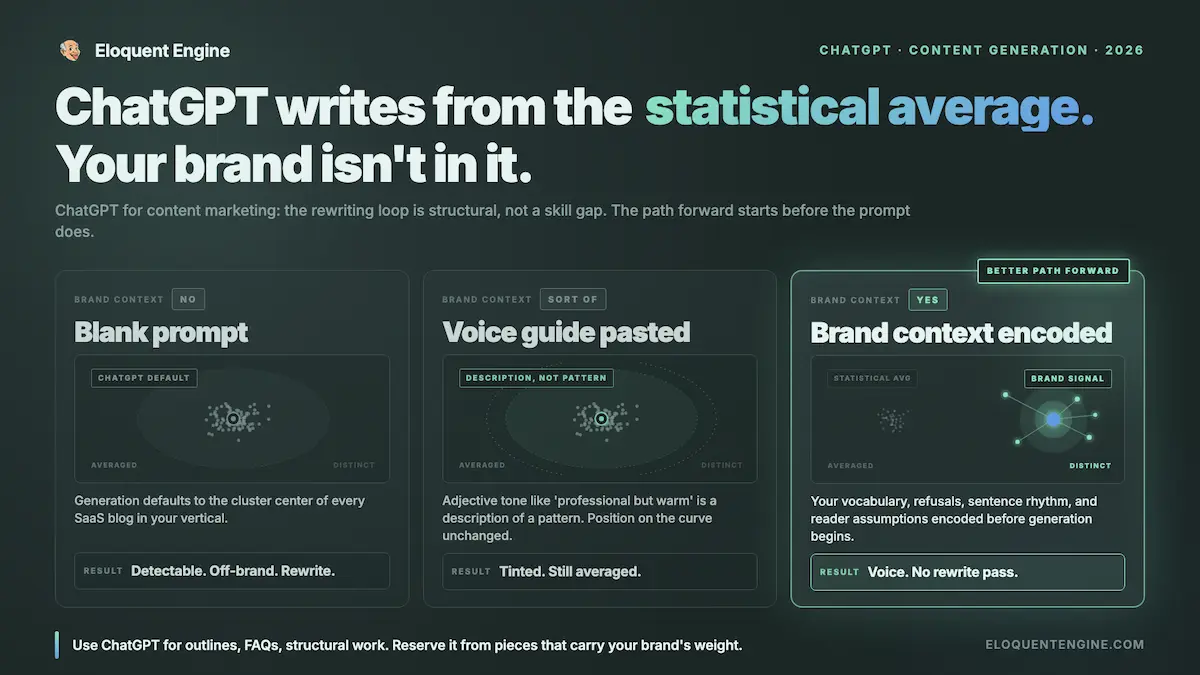
ChatGPT generates text by predicting the most statistically likely continuation of a sequence. Every word follows from every word before it, weighted against patterns in an enormous training corpus drawn from the broad internet. The patterns it learned are the patterns that appear most often across millions of documents. The averaged ones. The interchangeable ones. That is the output: fluent, coherent, and written the way most people write about your topic.
Which is exactly why practitioners keep landing on “not perfect, but…” when they describe what ChatGPT produces for content calendars and captions. They’ve noticed the gap. They’ve just accepted it as the cost of going faster – and that acceptance has a compounding cost that doesn’t show up until reader trust starts eroding quietly.
The detection piece follows directly from the generation process. Tools like GPTZero and Originality.ai score two specific signals, and most people assume AI detection is binary – caught or not caught. It isn’t.
Perplexity and burstiness
Perplexity measures how predictable the word choices are at the sentence level. Low perplexity means the model could have predicted most of those words – expected transitions, common phrasings, sequences that appear often in training data. Human writers make surprising choices, take syntactic detours, select vocabulary the model didn’t see coming. AI optimized for fluency stays in expected territory because that’s what fluency rewards.
Burstiness measures variation in sentence length and complexity across a passage. Human writers are naturally uneven – three short sentences, then a long subordinate structure, then a fragment, then something complex. AI generation trained for readability produces more consistent variation. Detectors catch that consistency as a signal, not the content of what’s said.
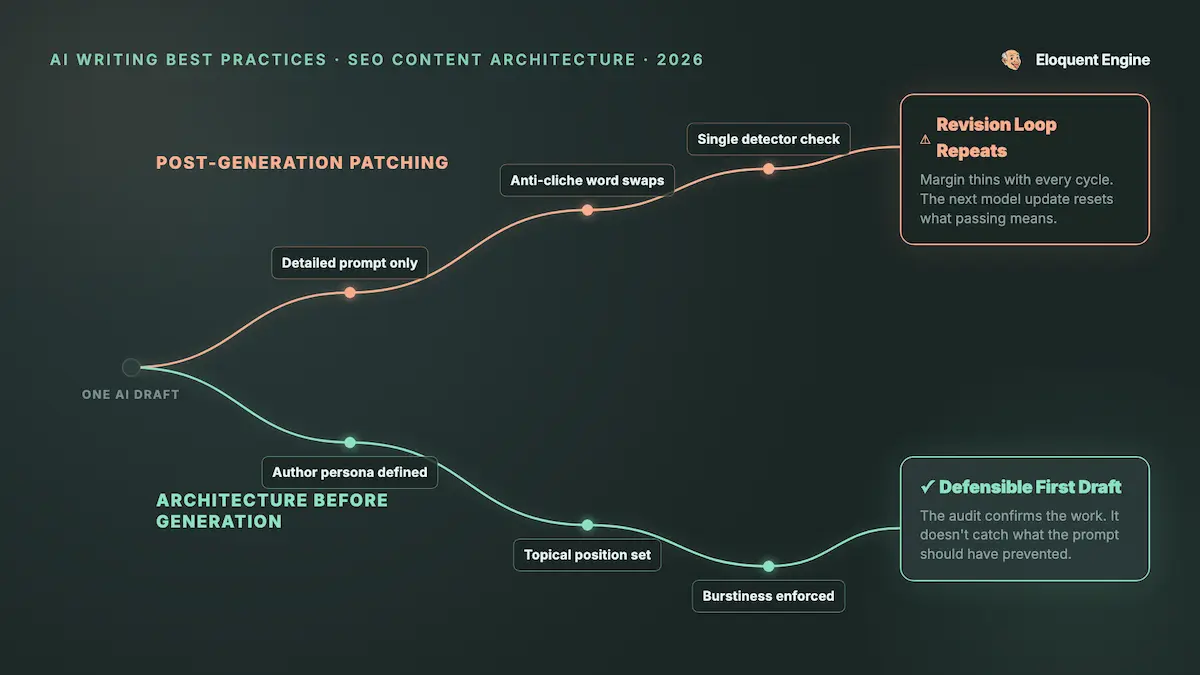
You cannot prompt your way out of this. I say that having watched people build elaborate prompt libraries, layer in custom instructions, try role-play setups with detailed persona briefs – and still have the AI detection score come back at 90 percent with nothing useful to tell a client. The generation process produces low perplexity and reduced burstiness because fluency is what it is optimized for. The two are not separable features you can dial independently.
ChatGPT saves real time on outlines, FAQs, and meta descriptions – practitioners who say so are right. Those tasks work because they don’t require a specific voice. Averaged patterns are fine when the output is structural scaffolding. The problem surfaces when that same process gets asked to produce content that needs to carry a brand’s weight. How AI detection actually fires on content comes down to this: detectors catch predictable writing, and a blank prompt produces exactly that.
Brand voice is an encoding problem
Remember when your content was something only you could have written? When a reader could strip the byline off and still know whose work it was?
Brand voice is an encoding problem. Treating it as a tone preference – “professional but approachable,” “direct but warm” – is why the brand voice guide you built inside ChatGPT keeps producing content that sounds like every other blog in your vertical.
Adjectives are a description of a pattern. The system needs the pattern itself: how your sentences break, which arguments you make that nobody in your space will touch, what your brand consistently declines to say. Those things live in your existing content, your founder communications, your customer language. They are documentable. A brand context document built from real examples – not mood words, but actual constructions – gives a generation system something real to encode against.
“I do most of the planning and let the AI handle specific tasks” is a sensible workflow at face value. The problem is that “specific tasks” expands. It expands until the AI is generating everything except the strategy deck, and the content coming out is detectable, disposable, and diluting a brand that used to mean something.
The live debate among practitioners right now – whether AI content needs substantial rewriting or can publish with a light edit – has a clear answer: substantial rewriting is a signal the generation input was wrong. Fixing the output is the wrong step. Building the brand context document before the first prompt runs is the right one. Document brand voice with real examples before prompting. Validate the content brief against E-E-A-T criteria before handing it to generation. That sequence produces content worth publishing without the four-hour cleanup pass.
SaaStr’s analysis of why B2B buyers are rejecting current AI tools makes the macro case: speed is present, brand signal is not, and the market is noticing. The tools evaluated on feature lists and pricing – without anyone testing whether the actual output is any good – are accumulating a trust deficit that prompt engineering cannot close. Whether Google penalizes AI content is the wrong question to lead with. The right question is whether the content deserves to rank independent of how it was produced. Generic output at scale is its own answer.
The humanizer pass is not a workflow
I’ll be honest – I kept editing the output instead of fixing the input for longer than made sense. At the time, that felt like diligence. In hindsight, it was probably just reluctance to admit that the generation step was broken before the first word appeared.
Tools like Undetectable.ai and QuillBot exist to modify AI-generated text after the fact, raising perplexity and burstiness scores enough to move detection results. They work, to a degree, on the metric. What they cannot do is give the content a coherent brand voice it never had, or restore the argument structure that makes your best pieces recognizable as yours. I won’t even get into what running thin content through a humanizer does to the semantic coherence that entity coverage depends on – that’s a separate problem sitting one layer below the detection question.
The humanizer tool category is a diagnostic, not a solution. Every tool in that category exists because the generation step sold a broken product and then the market sold the fix separately. Running output through a humanizer is admitting the generator failed. The whole category is probably the most expensive evidence that the real problem was the absence of brand context before generation. Building a prompt library as a substitute for a brand voice document is how you get there: the library grows, the output stays hollow, and the humanizer pass becomes a permanent line item nobody wants to acknowledge.
One question that cuts through every vendor claim
Here is the irony of this entire category. The market conversation about AI content tools is a pricing and feature checklist conversation. Storage limits. Integrations. Output speed. Tone sliders. Meanwhile the actual constraint – whether the system has access to anything specific about your brand before it generates – almost never appears on the comparison page.
One question replaces all of it:
Does this system have access to anything unique about my brand before it generates?
Three honest answers:
- No. Blank prompt, every time. The system generates from averaged patterns with no brand context. You will post-process generic output. The rewriting cost is structural, and no amount of prompt refinement closes it.
- Sort of. You have pasted in a voice guide or custom instructions. The system has a description of your brand. Better than nothing. Still has a ceiling – descriptions of patterns are not the patterns themselves.
- Yes. The system ingested your actual content, your research, your documented constructions before generation began. The output starts from your context. The detection score reflects a voice, not a statistical average.
Most operators who feel like they are doing something wrong are working in answer one or two and wondering why the output never quite fits. The gap is architecture, not effort. Evaluate AI writing tools on this question before anything else on the feature list. Tools that cannot answer this clearly are selling speed; tools that can are solving the actual problem. Those are different products, and the feature checklist will not show you which is which.
Use ChatGPT for tasks that don’t require your voice-outlines, FAQs, structural work. Reserve it from pieces that carry your brand’s weight. The rewriting you have been doing for months reflects a context gap, not a skill gap. Name it correctly and the next decision gets easier.