AI content detectors hit the market right when ChatGPT, Claude, and Gemini became mainstream. Before the humanizer tools, before the “AI-safe content” marketing, before the product categories built around evading scores. The detection came first.
The metrics being scored were defined, training distributions were built, scoring systems were calibrated. All of that existed before humanization became something you could buy.
That sequence is the whole problem right there. Humanizer tools were designed to address a measurement that already knew what it was looking for. Not to change what the measurement captures. To move the number. Those are not the same thing.
If you paid for a humanizer and felt like it might not be working. You were not wrong. You were measuring the right instinct with the wrong framework. The tool was not broken. The category has a structural limitation that does not appear in the pricing page. That is worth understanding before you buy another one, or before you explain your content strategy to a client who just asked about it.
What follows is the mechanics. What detection tools actually measure. Why AI-generated text has those properties in the first place. What humanizers can and cannot change about them. And what a genuinely different approach would need to do.
What AI content detection actually measures. And why the metrics matter
Detection tools are not performing editorial judgment. They are running statistical measurements and comparing results to distributions of known human and AI-generated text. Two metrics drive most of this: perplexity and burstiness. Not “AI patterns.” Not “robotic phrasing.” Measurable numbers.
Perplexity measures how predictable the text is relative to a language model’s probability distribution. At every step of generation, a model assigns probabilities to every possible next token and selects from the high-probability options. It is optimizing for coherent, contextually appropriate output. Which means it makes token choices that are statistically expected. Low perplexity means the text is predictable to a language model. High perplexity means the text contains choices the model would assign low probability to: an unexpected word with the right texture, a structure that is technically awkward but emotionally precise, a detour the model would never take because it does not optimize for effect. Human writers make those choices constantly. AI-generated text clusters around the high-probability selections, which produces measurably lower perplexity across the passage.
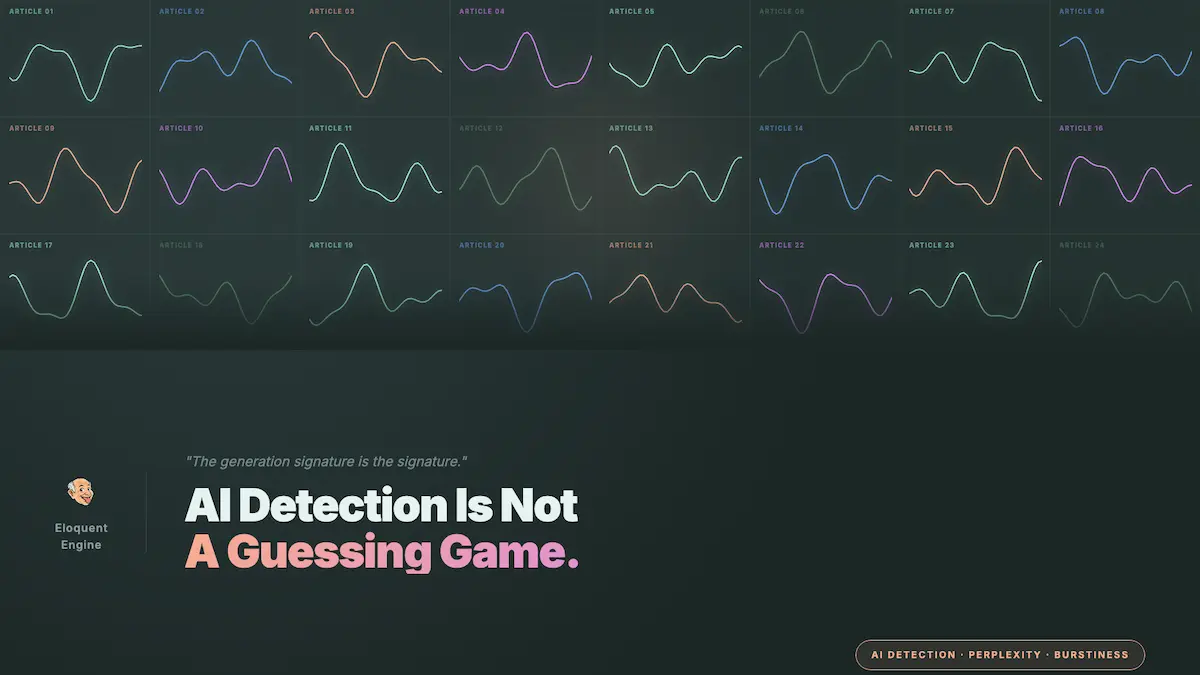
Burstiness measures variance in sentence length and complexity. Human writing is irregular. Short declarative next to a long subordinate clause, three tight sentences followed by one that runs long because the thought demands it. The rhythm follows the argument. AI-generated text tends toward regularity: sentences cluster in a similar length range, complexity distributes evenly, and the whole passage reads smoothly. That smoothness is not a quality signal. It is a detection signal.
Tools like GPTZero and Copyleaks are trained on corpora labeled as human or AI-generated. They learn what perplexity and burstiness distributions look like for each category, then score new text by running the same measurements and comparing results to those training distributions. The output is not a guess about whether the text sounds AI-generated. It is a measurement of where the text sits relative to two known statistical populations. The “accuracy doubts” and “serious accuracy concerns” practitioners discuss on Reddit are real. No tool is perfectly calibrated, and edited or hybrid content creates genuine classification challenges. But the underlying metrics are valid. The uncertainty is about implementation, not about whether perplexity and burstiness are real signals. They are.
One claim circulating among practitioners is worth addressing directly: that the correct response to detection anxiety is to stop obsessing over scores and focus on deploying AI at scale. That argument has real force at the strategic level , the practitioners building content systems are ahead of the ones still evaluating tools. But “stop worrying about detection” only works if the architecture of what you are deploying actually avoids the problem. Deploying at scale while ignoring the structural signature is not a deployment strategy. It is volume on top of a broken foundation.
Why the signature exists. And why this part is actually simpler than it sounds
The statistical signature in AI-generated text is not a flaw in the model. It is a direct product of how generation works, and I assumed for longer than I should have that this was complicated to explain. It is not.
A language model generates text token by token. At each step, it conditions on everything before it and selects the next token based on probability. The model is not deciding what it wants to say and then finding words for it. It is producing the statistically most coherent continuation of what it has already produced. That mechanism, repeated thousands of times across a piece of content, creates a specific statistical shape: smooth, predictable, uniform in complexity. Every sentence is appropriate. Every transition is clean. The whole thing reads well. And the underlying pattern is measurably different from what a human produces when actually thinking through a subject.
Human writers make decisions at multiple levels simultaneously. Argument, structure, word texture, sentence weight. Those decisions produce irregular patterns. The irregularity is the signal. It is not carelessness; it is the natural output of a mind working through something rather than optimizing for coherent continuation.
Some practitioners argue that detection tools are mostly solving a plagiarism problem, not a quality problem. And there is probably something to that framing. Detection and quality are different measurements. Organizations deploying AI at the systems level have figured out that the real challenge is architectural integration, not whether the output passes a score. But those are not competing concerns. The statistical signature matters because clients and platforms measure it. The quality problem matters because readers and search engines measure it. You can fail both tests with the same piece of content, and it is worth understanding them as separate mechanisms rather than assuming fixing one fixes the other.
What humanizer tools change. And the one thing they structurally cannot
A humanizer that claims to solve AI detection has to answer a specific question: which metrics does it actually change, and are those the metrics that detection tools measure? Most humanizer tools do not answer that question in their documentation, which is worth noticing.
Post-processing transformations are real. Synonym substitution, sentence restructuring, insertion of informal phrasing, variation of sentence length. These operations change surface metrics. Insert a two-word sentence after a long one, and measured burstiness rises. Substitute a low-frequency synonym for a high-frequency one, and the perplexity score nudges upward. A practitioner who runs content through a humanizer and then through a detection tool will often see the score move. That movement is not fabricated. It reflects real changes in measurable surface properties.
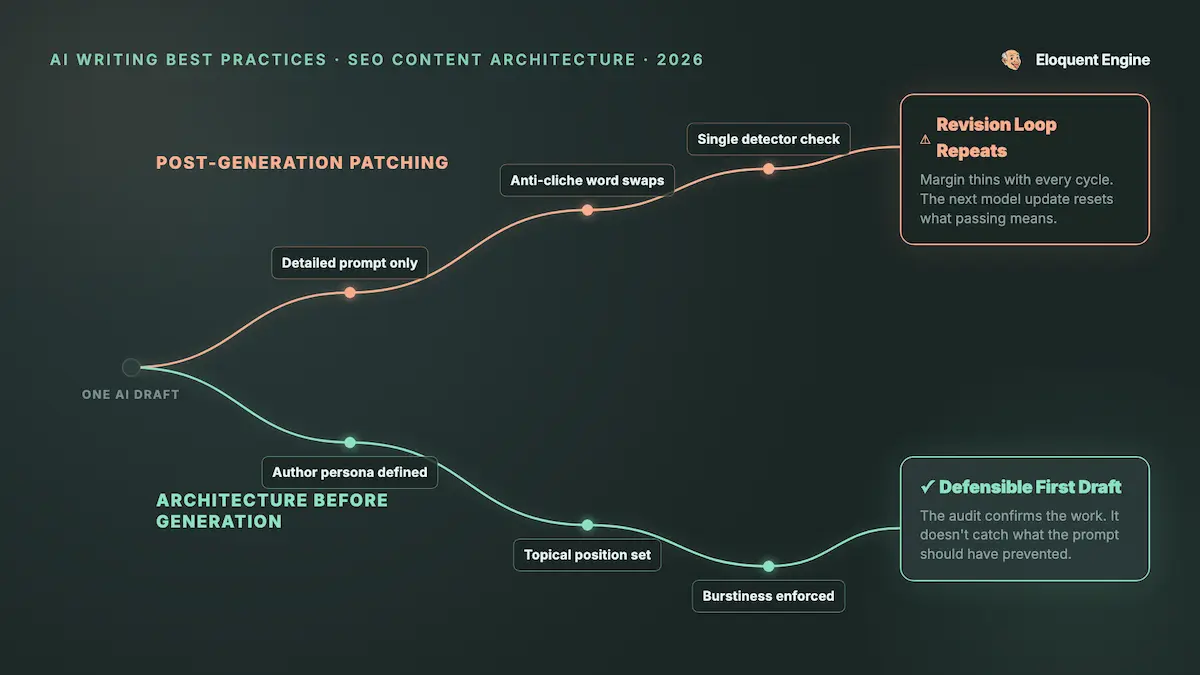
What it does not reflect is any change in the underlying token probability pattern. The statistical shape of how the content was constructed, token by token, probability-weighted, optimized for coherent continuation, is not touched by post-processing. Because post-processing is editing. Editing changes individual data points in a distribution. It does not change the shape of the distribution itself, which is what the detection model was trained to classify.
Consider what practitioners have already observed about Turnitin: it works correctly for content that is entirely AI-generated, working reliably in those cases, but performance degrades meaningfully when content is edited or run through additional tools. That observation reveals the detection mechanism more clearly than most vendor documentation does. The detection is reading a statistical shape. Editing perturbs individual points without restructuring the shape. Enough perturbation, particularly in heavily rewritten sections, can move a score substantially. But partial perturbation, which is what most humanizer workflows produce, leaves the underlying signature largely intact.
A freelancer billing content hours who runs everything through a humanizer is not building on a different foundation. The detection architecture is still there. The pattern is still classifiable. The score might look better today than it did last week. Whether it looks better than the detection models of six months from now is a different question. Systematically solving this problem requires changing what the content is made of, not applying a layer of variation to the surface of what was generated. The humanizer category addresses symptoms. The signature is structural.
What Google is actually doing. And why the answer is less satisfying than practitioners want
The mainstream claim is that Google has automatic AI detection built in and algorithmically penalizes AI content in rankings. A number of practitioners state this with confidence. The evidence for it, at the level of mechanism, is thin.
What Google has consistently documented is quality assessment through E-E-A-T signals: experience, expertise, authoritativeness, trustworthiness. These are not perplexity measurements. They are not burstiness scores. They are signals about whether content demonstrates real subject matter depth, original perspective, and the kind of specificity that comes from someone who actually knows what they are talking about. Google’s systems are trained to reward that. They are not trained to run content through GPTZero.
The nested point here matters: AI-generated content that was produced without genuine expertise, without editorial architecture, and without substantive human input tends to fail on E-E-A-T signals. Not because Google detected the generation mechanism. Because the content lacks the properties E-E-A-T rewards. The risk is real. The mechanism is different from what ZeroGPT measures, and conflating the two leads practitioners to optimize for the wrong thing. Chasing detection scores while the quality signal problems compound quietly in the background.
ZeroGPT having serious accuracy doubts, as the practitioner consensus acknowledges, should not be read as evidence that detection is irrelevant. It should be read as evidence that detection tool scores and actual search performance are measuring different things. A piece of content can pass ZeroGPT and still accumulate quality signal problems. It can flag as AI-generated and still rank well if it has genuine depth. Running detection scores as a quality proxy is the wrong diagnostic. Both things are worth addressing. They require different responses.
What ground-up construction actually changes
I spent longer than I should have thinking architecture was something you added after the first draft. That assumption flatlines the moment you understand what detection is measuring.
The signature is not in the words. It is in the construction process. Token-by-token probabilistic generation produces a specific statistical shape because the mechanism is always optimizing for coherent continuation from a blank context. The shape is a product of that mechanism. You cannot edit it away because the editing happens after the mechanism has already done its work.
Ground-up construction changes the conditions before generation begins. A topic framework built around documented expertise. An outline that reflects actual argument structure. Source synthesis and editorial direction that constrain what the model generates and how it generates it. When a language model writes within those constraints, the output reflects human decisions made at the structural level. The generation still uses probabilistic selection. That part does not change. But it is operating inside an architecture built by a person thinking through a subject, which produces different patterns than generation operating from nothing but a prompt.
The result is content that does not need to hide. Not because the tool is better at disguising the signature. Because the signature is different in the first place. That is the distinction worth understanding: disguise the output versus change the architecture. The former requires constant effort to stay ahead of improving detection models. The latter produces a different kind of content from the start.
If you want to understand what that looks like in practice, Eloquent Engine’s approach to content architecture starts with mathematical structure before any generation begins. The mechanism is what changes the signature. Not the post-processing.
The question worth asking before you evaluate any AI writing tool
Understanding perplexity and burstiness is useful. What you do with that understanding is what matters. Before evaluating any AI writing tool or humanizer service, one question cuts through the marketing: what metrics does this actually change, and are those the metrics that detection tools measure?
If the answer involves vocabulary frequency, sentence length variance, or readability scores. The tool is operating at the surface. Those changes are real. They are not sufficient to alter the underlying distribution that detection models classify.
If the answer involves how content is constructed before generation begins, the problem is addressed at the level where the signature originates.
The consequences of confusing these two answers escalate in a specific direction:
- Detection scores improve temporarily, because surface metrics shifted. But the underlying signature persists, and newer detection models close that gap because they are trained on increasingly edited and humanized content.
- Client relationships become exposed, because detection tools are already in active use by editorial teams, agencies, and clients running their own audits, and “we use a humanizer” does not hold up as a defense when the structural signature is still classifiable.
- Search performance erodes over time, because content produced by a generation process with no human architectural input tends to fail on E-E-A-T signals independently of any detection score. The quality problem and the detection problem compound each other, and volume accelerates the damage rather than diluting it.
The practitioners building durable content systems right now are the ones who diagnosed this as an architecture problem early and stopped treating it as a post-processing problem. That window is narrowing. Mechanistic clarity about what detection actually measures is the starting point for building on the right foundation.