
“Does Google penalize AI” is the wrong question. Not because the answer doesn’t matter, but because framing this as a Google detection problem lets you off the hook for a deeper one.
Here is what is actually happening. Thousands of sites are publishing AI-generated content every week. Some rank. Most flatline. The ones that rank are not winning because they fooled a detection system. They are winning because someone built them to win.
The tool didn’t do that. The content plan did.
You can gut-check any piece of content you’ve published in the last six months against four concrete criteria and know immediately whether it has a structural problem. No Google announcement required. No vendor take needed. The answer is in the content itself, and it has been there the whole time.
Audit, diagnose, fix, rebuild, publish. Most people never get past the first step because they are waiting for permission from the wrong source. The permission they are waiting for, official confirmation that AI content is safe, arrived years ago. Everyone missed it because it didn’t come with a checklist.
Does Google Penalize AI Content? Here Is What It Actually Measures.
“Google doesn’t care how content is made, as long as it’s helpful and not spammy.”
True. Also completely useless as guidance for anyone trying to make a publishing decision this week.
Google’s official documentation states that AI-generated content is not against their spam policies. That statement gets quoted everywhere, predictably, by people who want it to close the conversation. It doesn’t close anything. It relocates the question: if AI content as a category is not penalized, why does so much of it fail to rank?
The answer is E-E-A-T. Experience, Expertise, Authoritativeness, Trustworthiness. Google’s quality raters guidelines use this framework to evaluate whether a source has a genuine, developed relationship with its subject matter. None of these signals are evaluated at the sentence level. They compound across a site’s entire content record. The author’s publication history, the depth of coverage across a topic cluster, the relationships between pieces, the external sources that reference the domain as credible.
“It’s impossible to tell it’s AI anyway. How would Google even penalize it?”
That question misunderstands what Google is measuring. Consumer tools like GPTZero analyze perplexity and burstiness. Statistical variation in text patterns. Google’s systems are not running GPTZero on your blog posts. They are measuring something structurally harder to fake: whether your content, your author identity, and your site have a demonstrable relationship with the topic being addressed.
That relationship either exists or it doesn’t. Whether Google can reliably detect AI content is genuinely debatable. Some practitioners are right that AI content detection is unreliable, and penalties must therefore be pattern-based rather than origin-based. My position: that distinction doesn’t change the strategy at all. If Google is penalizing bulk production patterns rather than AI origin, the fix is identical. Build the authority signals that bulk production systematically omits.
The debate over whether poor AI content performance is algorithmic punishment or just bad content reaching the market at scale is worth noting. The honest answer is that it’s structural. The same content written by a human with no topic architecture fails the same evaluation. The tool is not the variable. The architecture is.
The Tool Is Not the Problem. The System It Was Built For Is.
Most AI writing tools are designed around one metric: throughput. Brief in, draft out, calendar filled. That is the value proposition. And it works, if filling a calendar is the goal. Building compounding topical authority requires something different entirely, and practitioners should be honest about that distinction rather than pretending the two objectives are compatible by default.
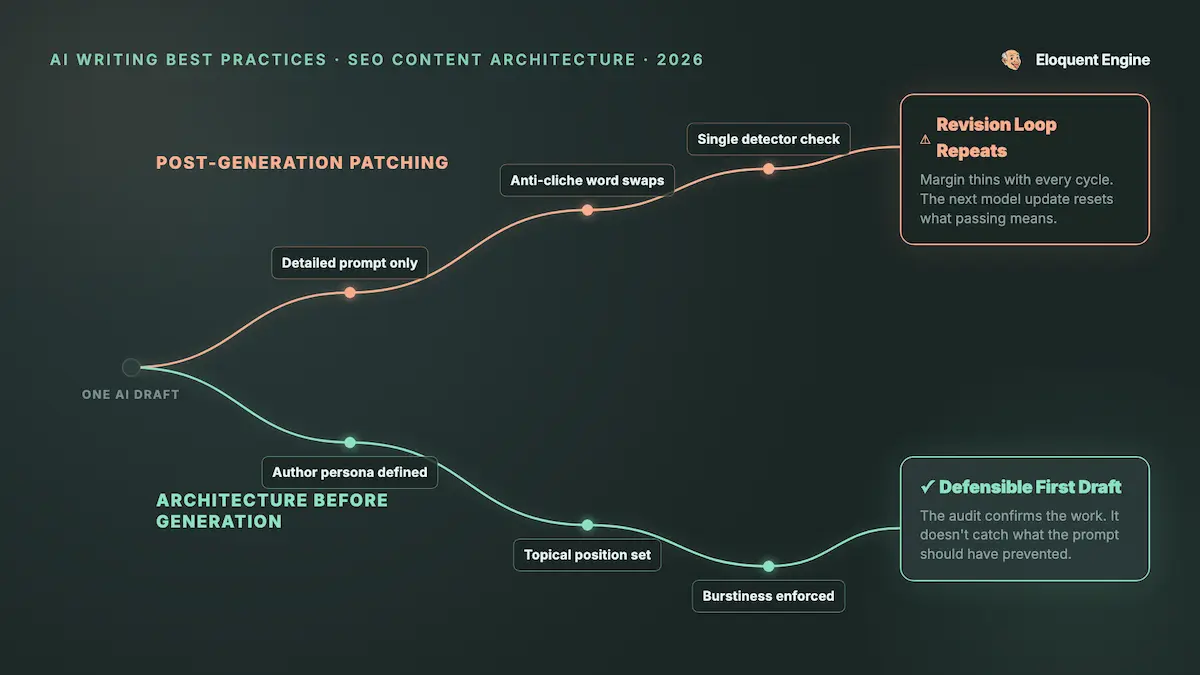
Thoughtfully-produced AI content ranks. Practitioners who say this are observing something real. The operative word is thoughtfully, which in practice means: the content was assigned a structural reason to exist before anyone opened a writing tool. It was mapped against an existing topic cluster. The keyword was checked for cannibalization risk against what the site already has indexed. The SERP intent was manually verified before a format was chosen. The author entity attached to the piece has a publication record that supports it.
Most teams using AI tools for content are not doing those things. The tools were not marketed to require them. Brief-to-publish pipelines got faster; the architecture layer never got built. What gets produced is technically competent, topically orphaned, and structurally indistinguishable from the other eleven articles ranking for the same term.
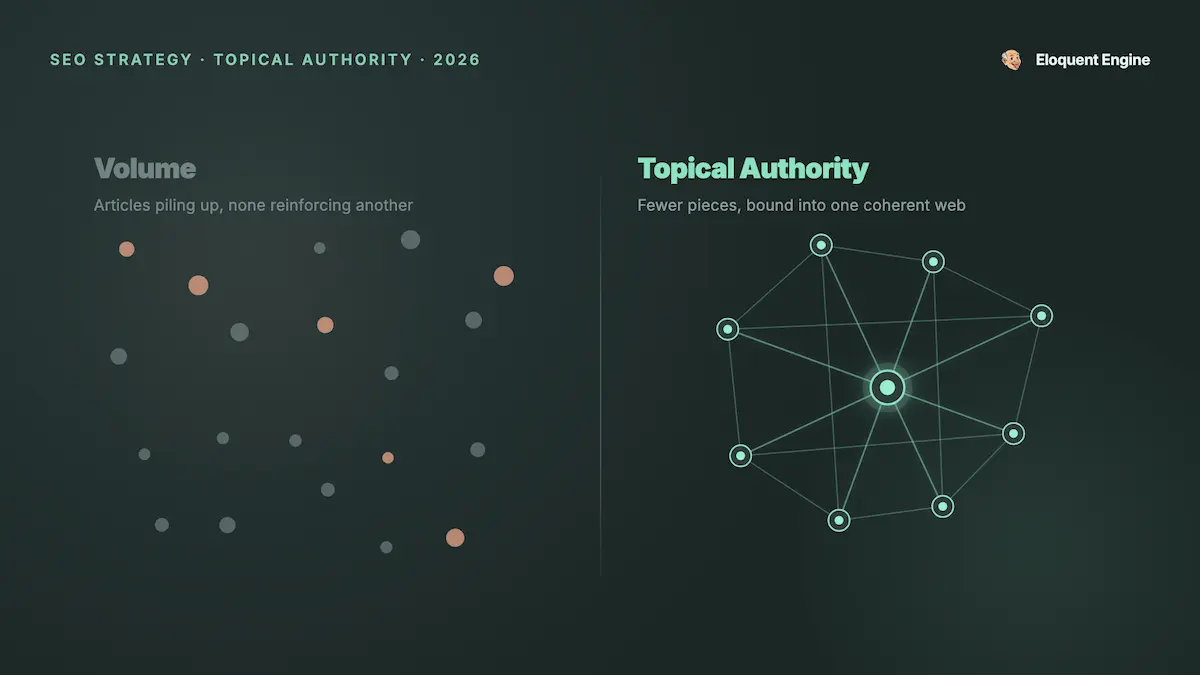
That is the whole problem right there. The publish-more mentality treats content velocity as the lever. Velocity without architecture is just faster content debt.
, The approach that separates topic architecture from content production starts before the first word gets written. That sequence matters more than the tool used to write it.
How to Audit Whether Your Content Has the Signals That Actually Matter
Your content either demonstrates authority or it doesn’t. That is not a style problem. It is a structure problem, and structure is checkable.
Run every published piece, or every piece scheduled for this month, against these four questions. They correspond directly to what E-E-A-T evaluates, translated into criteria a practitioner can apply without a technical audit tool.
Does this piece sit inside a topic cluster, or does it stand alone? A single article on a subject is a data point. A site with six interlinked pieces covering a topic from different angles, audience types, and use cases is a signal. Standalone content can rank for low-competition terms. It collapses under anything competitive. Check whether this piece links to and receives links from related content on your site. If you cannot trace a path from this article to at least two others on your domain that address related aspects of the same subject, you have an orphaned piece.
Does the author identity attached to this content have a visible publication record on this subject? Google’s quality raters guidelines evaluate authoritativeness in part by tracing the author’s relationship to their topic over time. An author bio with three sentences and a stock photo does not support a topical authority signal. An author entity with a consistent byline, accumulated content on the subject, and ideally some external citations. That builds. If your content publishes under no byline, or under a generic brand name with no individual attribution, you are missing a signal that survives contributor turnover.
Does this piece add something the twelve other articles on this keyword do not? Open the SERP for your target term and read the top five results. If your article covers the same structure, the same points, and the same depth, Google has no algorithmic reason to prefer it. The question is not whether your piece is well-written. The question is whether it is differentiated. Specificity, a distinct angle, a use case the others skip, a genuine disagreement with the consensus position. These are the properties that separate content that earns search equity from content that flatlines despite being readable.
Would this piece embarrass you in front of someone who knows the subject? This is the gut-check that catches what the technical criteria miss. If a practitioner in your vertical read this piece, would they learn something? Would they trust the source enough to share it? If the honest answer is no, no structural fix will compensate for the fundamental problem. The content collapses on its own weight.
Your content either demonstrates authority or it doesn’t. Four questions tell you which is true. The answer determines whether you publish, revise, or rebuild from a different architecture entirely.
What to Do Before Your Next Piece Goes Live
Three years ago, teams spent significant budget on exact-match anchor text and private blog networks because the path to rankings felt like a manipulation problem. Then Google updated, the sites collapsed, and the practitioners who had been building actual topical depth, methodically, without shortcuts, kept their rankings. The lesson was not subtle. It just arrived late for people who had been billing hours for the other approach.
The current moment rhymes. “Bulk-generated content” is today’s version of the same mistake: optimizing for a signal Google has already announced it will devalue, while the practitioners building structural authority watch and wait.
Before your next piece publishes, do this:
- Map the piece to an existing topic cluster on your site. If no cluster exists, build the cluster before publishing the piece.
- Check for keyword cannibalization against what you already have indexed. Two pieces chasing the same term cannibalize each other’s authority.
- Assign a real author entity with a consistent publication record, or begin building one now.
- Verify SERP intent manually before choosing a content format. A listicle targeting a keyword Google is answering with comparison pages will not rank regardless of quality.
- Ask the embarrassment question before you hit publish. If the answer is uncertain, the piece needs revision.
None of this requires a different AI tool. It requires architecture before output. The teams still asking whether AI content gets penalized are solving the wrong problem. The teams auditing their topic clusters, mapping their authority gaps, and building with structure first. Those teams already moved on.