Suppose you are a freelancer who just finished a 1,500-word blog post in ChatGPT. It reads fine. You run it through a humanizer, paste the result into ZeroGPT, and watch it flag as AI anyway. You edit, re-run, get a marginally better score. Try a different humanizer. Wonder if you are missing something obvious. Your instinct says this should be solvable with the right tool. That instinct is understandable. It is also pointed in the wrong direction.
The humanizer category was built on a specific assumption about how AI detection works. That assumption is wrong. Once you understand why it is wrong, you’ll see that the tools look like products architected against the wrong problem from the start. Understanding the gap between what humanizers change and what detectors measure is the only way to evaluate anything in this space with any confidence.
What AI detection tools are actually measuring
Perplexity. Burstiness. Two properties. Neither one is a fingerprint.
Tools like GPTZero and ZeroGPT do not maintain a library of known AI outputs and check yours against it. They measure how statistically predictable your word choices are and how rhythmically even your sentence structure runs. That is the whole mechanism. There is no proprietary ChatGPT signature to disguise. There is no model-specific tell to spoof. Detection is mathematical, not encyclopedic, and that distinction matters more than most humanizer vendors want to acknowledge.
Perplexity Defined
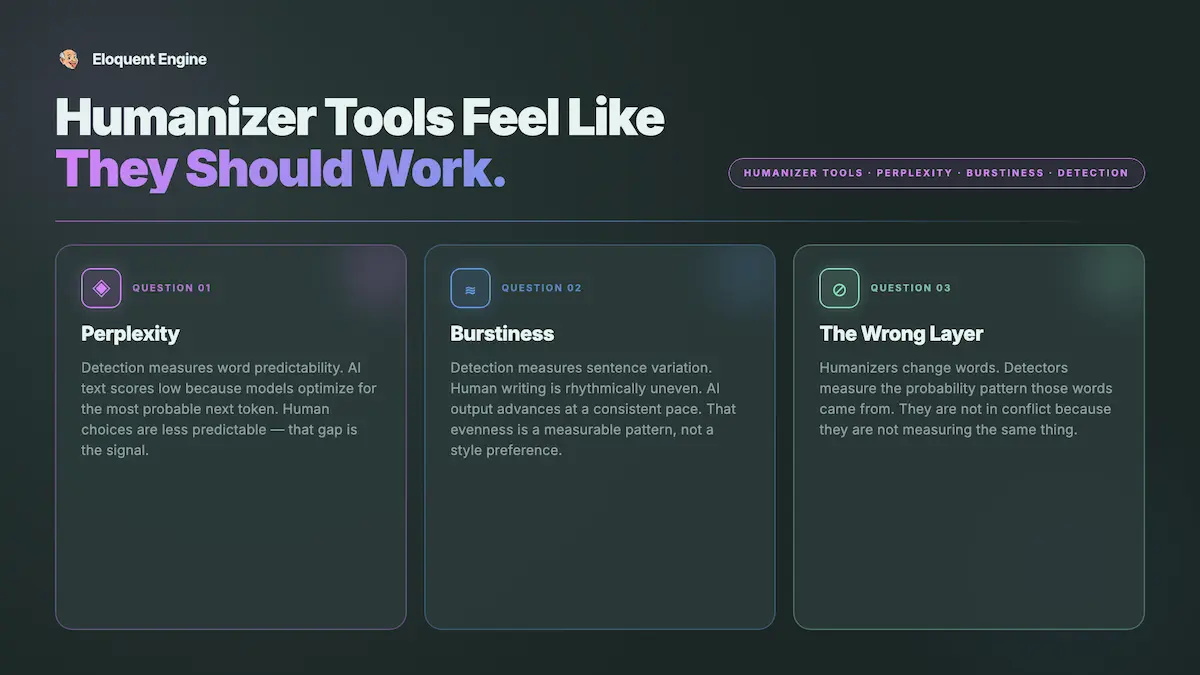
Perplexity measures word predictability.
A language model generates text by selecting the most probable next token given everything before it. The result is text with low perplexity: every word choice is the obvious one, the statistically comfortable one. Human writers make choices based on meaning, rhythm, instinct, and domain knowledge accumulated over years. Those choices score higher on perplexity because a language model would not have predicted them. Detection tools measure that gap and flag text that consistently sits in low-perplexity territory.
Bustiness Defined
Burstiness measures sentence variation.
Human writing is rhythmically uneven in a specific way: a long sentence working through a difficult idea, then a short one, then a fragment, then two medium sentences before another long one. AI output runs at a consistent pace. Similar lengths, similar complexity, advancing evenly in a way that no human writer actually does. Detectors read that evenness as a pattern.
A practitioner on Reddit ran through sixteen humanizer tools – StealthGPT, WriteHuman, Twixify, Walter Writes AI, HIX.AI, Smodin, Monica AI Humanizer, and a dozen others – and found that only two cleared detectors reliably.
The surface conclusion was “find the right tool.”
The real conclusion is that the other fourteen were doing exactly what all humanizer tools do: changing words on top of a statistical signature those words cannot actually change.
Another practitioner’s fix was to pair the humanizer with prompts that “emphasize human writing patterns.” That instinct is closer to right. But it still assumes the solution lives in post-processing. It does not.
What a humanizer actually changes when it runs your text
When you run AI output through Quillbot or Undetectable.ai, something real does happen. Vocabulary shifts. Sentence openings vary. A passive construction becomes active. The text reads differently. For a while I assumed that these changes were sufficient. If the writing sounded less robotic to me, I guessed it would score differently on a detector.
That assumption missed something kind of fundamental.
The perplexity score of a piece of text is set during generation, when each word is chosen through a probability distribution. When a humanizer swaps “utilize” for “use” or restructures a clause, it changes the words. The statistical residue of how those words were originally selected does not change with them. The generation signature is still present. The detector is still measuring it. The humanizer won the surface contest. The detector was not watching the surface.
Here is what I am not entirely sure how to explain simply: the humanizer and the detector are not really in conflict because they are not measuring the same thing. The humanizer revises the text a reader sees. The detector examines the probability pattern underneath that text. They are operating on different layers, and a change on the surface layer does not propagate down.
Which raises a question worth sitting with. If a humanizer cannot change what a detector measures, what would actually have to change for the statistical signature to shift? That question points somewhere the humanizer industry would prefer you not look too closely.
The detector improves. The humanizer updates. The content stays detectable.
Call it tone polishing. Call it detection evasion. Supposedly these are different use cases for the same tool, and tone polishing is the legitimate one. Nobody wants to say it plainly, but “tone polishing” and “bypasses AI detectors” appear in the same marketing copy, on the same landing pages, for the same products. The distinction is convenient framing, not a product difference.
The arms race framing is the tell. Detectors improve, humanizers update, you find what works right now in 2025. What that framing predictably buries is that “working right now” means the text temporarily escapes a score threshold. The statistical signature did not change. The content did not get better. The detector just has not caught up yet.
You are not beating the detector. You are scheduling the next time it beats you.
The tool does not solve the problem. The tool postpones the problem. Fast mediocrity is still mediocrity, and a lower score on today’s threshold is not the same operation as producing content that earns search equity over time. Pretending otherwise is how agencies bill hours on content that would collapse under a basic detection audit.
The one question every ai humanizer tool should have to answer
Here is the claim humanizer vendors make: the output is undetectable because it sounds more human. A human reader found it acceptable. GPTZero does not care about human readers. GPTZero measures perplexity and burstiness, and a human reader’s approval does not change either one.
The question that separates tools solving the actual problem from tools adding another cleanup layer:
Does this system produce text with human-range perplexity and burstiness during generation, or does it modify surface features after generation?
Those are different operations. One addresses the statistical signature at its source. The other revises words the signature already produced. The table below shows what each approach actually touches.
| Approach | What it changes | What detectors measure | Does it close the gap? |
|---|---|---|---|
| Humanizer tool (post-processing) | Vocabulary, sentence structure, phrasing, tone at the surface level | Perplexity and burstiness set during original generation | No. Different layers. |
| Architectural generation (built-in variation) | The probability distribution and structural variation used during generation itself | Perplexity and burstiness set during generation | Yes. Same layer. |
Most tools on the market, free and paid, operate in the first row. The free versus paid debate is a distraction. A paid humanizer operating on the wrong layer is still operating on the wrong layer.
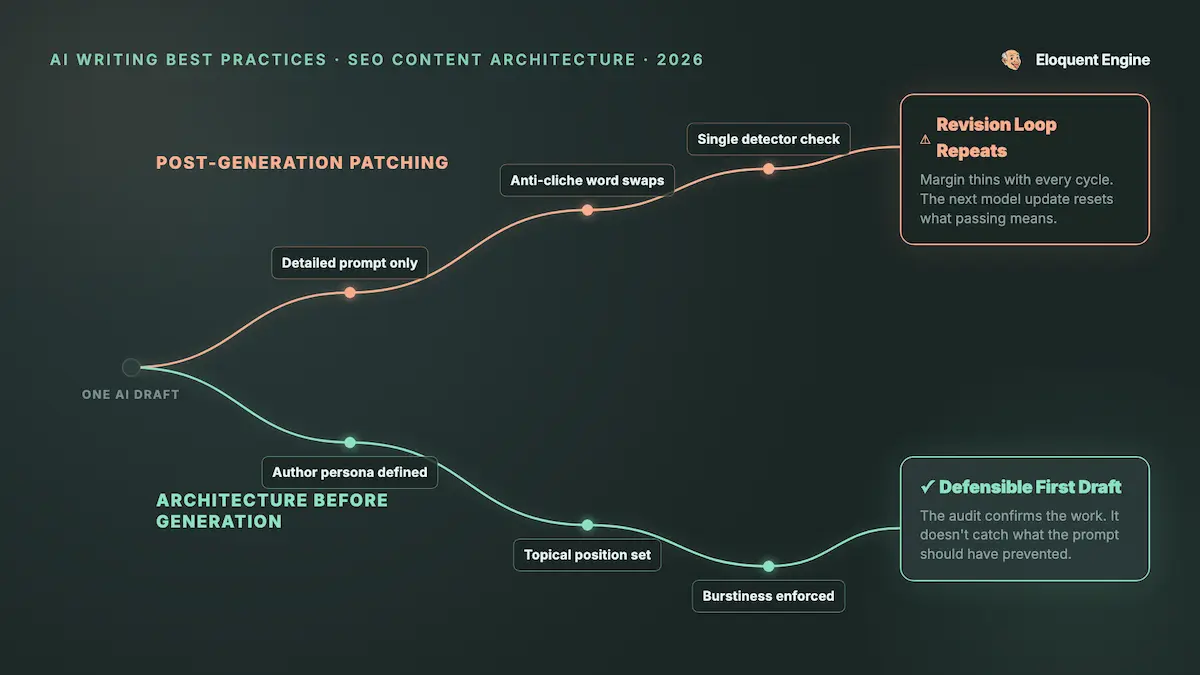
The practitioner who pairs a humanizer with prompts that emphasize human writing patterns is groping toward the second row without a clear framework for it. Prompt engineering that intentionally introduces structural variation before generation begins is closer to an architectural approach than anything a post-processing humanizer can do. THREAD builds that variation into the mathematical structure of content planning before a word is generated, which is a categorically different starting point than generating detectable text and patching it afterward.
When a vendor claims their tool is undetectable, ask which row they are in. If they cannot answer that directly, you already know.
Stop auditing humanizer tools. Start auditing generation architecture.
I will not even get into the detection audits sitting in client queues right now, the ones that will surface content that was supposedly humanized and cleared.
The architecture produces the signature. Change the signature by changing the architecture. Everything else is maintenance on a system that was broken at the foundation.
The concrete step: ask your current AI writing tool one question before you run another word through a humanizer. Does this system encode structural variation during generation, or does it rely on post-processing to change what it already produced? That question has a binary answer. Tools in the first category are solving the right problem. Tools in the second category are the humanizer problem wearing a different name.
No amount of polish fixes a fundamentally broken foundation. The reader who understands perplexity and burstiness does not need to test sixteen tools to know which two work. They know why none of them can.