Why does AI content underperform even when the output looks fine?
The failure is predictable. A team starts using AI generation. Publishing cadence doubles. The articles cover the right topics, the grammar is clean, the headings are structured. Then six months pass and traffic is flat, rankings are stagnant, and nobody can explain why.
The real constraint is architectural: defined content clusters, encoded brand voice, and clear positioning for each piece inside a larger structure. Teams are treating AI as a writing solution when the real constraint is architectural. Without a defined content cluster, without encoded brand voice, without a clear position for each piece inside a larger structure, AI produces topically plausible prose that goes nowhere. Each article is a standalone event instead of a signal that compounds.
Generic prompts produce predictable patterns that AI detection fires on. The deeper issue: output is only as differentiated as the context fed to the model. A blank prompt returns generic content because that is what blank prompts are designed to produce.
Here is what that looks like in practice, and how the consequences stack:
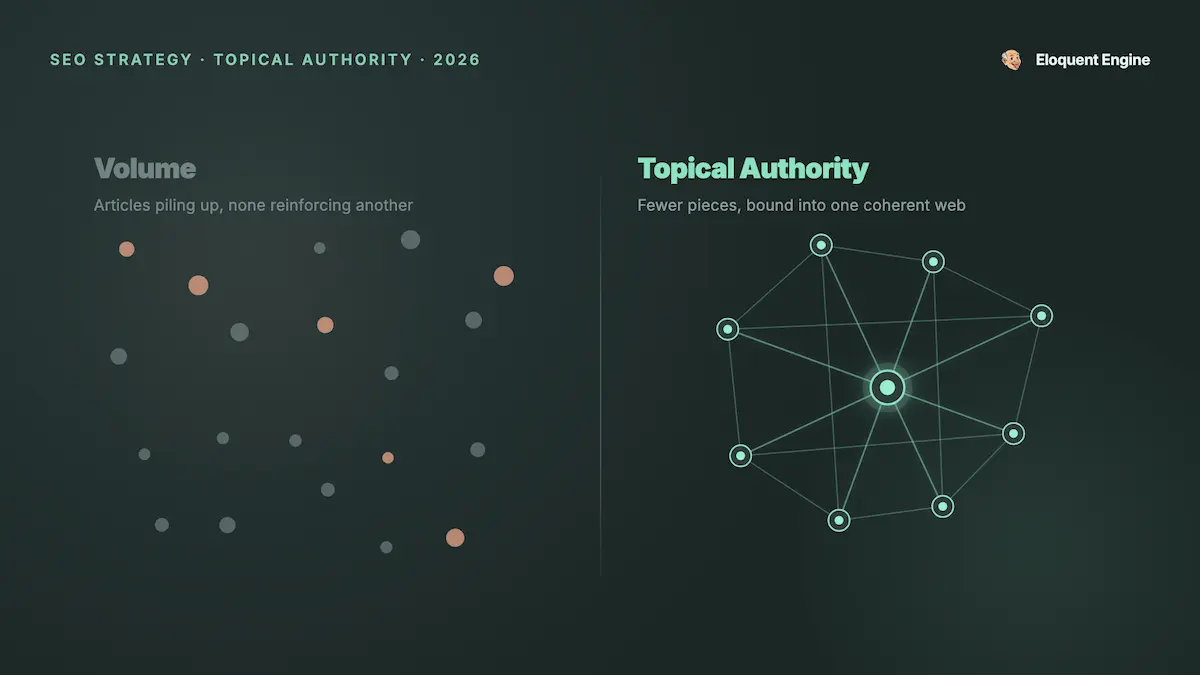
- You publish without a cluster. Each article competes with the others for the same keyword territory. None of them earn internal link equity. The pillar page has no amplification, and the supporting articles have no authority to borrow from. Google sees unrelated pages, not a coherent topical signal.
- You publish without a brand voice document. The model defaults to industry-average language, and every draft arrives sounding like every other SaaS blog. You spend an hour editing toward something distinct. The editing is never quite right because you are pushing against the model’s defaults rather than replacing them with something specific. The content looks polished. It sounds detectable.
- You publish at volume without entity coverage. Hundreds of articles, thin across the board, no depth on any single subtopic. Google does not reward coverage breadth without coverage depth. The E-E-A-T signal stays hollow. Rankings stay flat. The content calendar kept moving. The authority was never built.
Topical authority is not built by volume. It is built by coverage depth inside a structurally sound architecture. That architecture has to exist before the first prompt. Everything else is just speed applied to the wrong problem.
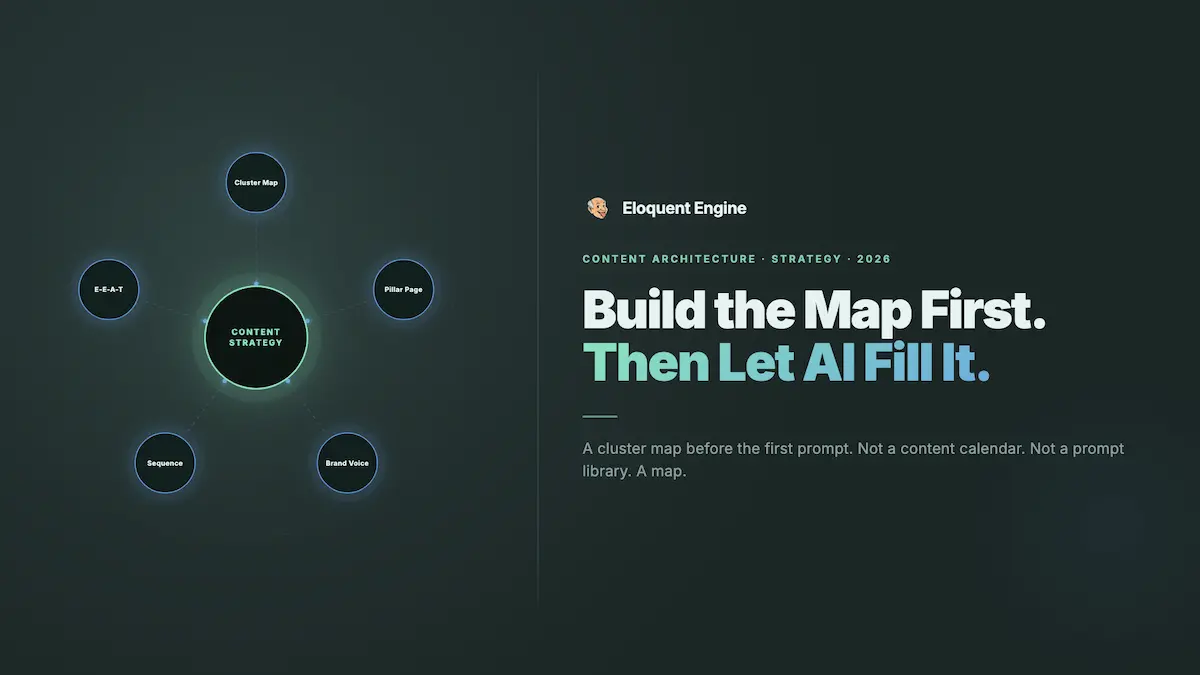
A cluster map before the first prompt. That is the whole argument.
Right now, the standard workflow visible in practitioner discussions is: research tool plus AI generation plus editorial pass plus publish. Tools like Outrank sit in the research-and-generate layer. A human editor refines. The article goes live. This is the baseline, and it works well enough that most teams stop there.
Volume publication without structural architecture is not strategy – it’s reactive content churn. Junior staff running free tools and nobody checking the output. Tools evaluated on feature lists while the actual output is interchangeable with every competitor’s site. Treating AI generation as strategy instead of an execution layer inside one produces predictable underperformance.
SaaStr reported a 5x increase in search impressions over 12 months while most publishers were watching traffic decline. That result gets cited constantly as proof that AI content works. That result proves AI content works when operating inside deliberate, topically coherent architecture. SaaStr has domain authority, brand clarity, and an audience that returns. The tool executed within pre-existing conditions: domain authority, brand clarity, audience retention.
The depth-versus-breadth debate playing out in practitioner threads right now misses the point. Some teams are reinvesting AI’s time savings into deeper content on existing topics. Others are expanding coverage into less saturated niches. Both camps optimize the generation layer while the structural layer – the cluster architecture enabling compound returns – remains unbuilt.
A content cluster is a pillar page covering a broad topic in depth, surrounded by supporting articles that each answer one specific question within that topic. They link to each other. They all point back to the pillar. The whole signals topical coherence; the parts signal specificity. That is the structure that dilutes nothing, undercuts nothing, and does not weaponize volume against itself.
A cluster map documents that structure before any writing happens. Core topic. Five to seven supporting questions in sequence. Audience stage for each piece. Scope limits so adjacent questions get their own article instead of crowding into the wrong one. Internal linking plan. That document changes what you ask the model to do, and it changes what comes back.
A cluster map before the first prompt. Not a content calendar. Not a prompt library. A map.
The question is not which keywords have volume. The question is which questions your audience asks first.
Most keyword research produces a list. High volume, medium competition, topically adjacent. The list gets handed off to a writer or a generation tool, and the articles come back covering the same territory from slightly different angles, competing with each other for the same search terms. Keyword lists appear thorough; structural architecture is absent.
Practitioners talk about co-creating prompts with AI, including glossaries of domain terms and proper nouns before generating anything. That instinct is correct. But the glossary is not the foundation. The question progression is.
Think of it the way a good onboarding sequence works. You do not lead with your most advanced feature. You start where the user is: confused, skeptical, not yet convinced the problem is real. Then you move them forward, one answer at a time, until the advanced feature makes sense. A content cluster does exactly this. Each piece answers the question the reader is actually asking at that stage in their thinking, not the question that has the highest monthly search volume.
Volume versus relevance misses the actual architecture: sequence. Map the progression from first awareness to confident action, and build clusters around that arc.
How to surface the sequence
Start with your core topic and work backward. What does someone need to believe before this topic becomes relevant to them? Those are your awareness-stage pieces. What do they need to evaluate once they understand the problem? Consideration stage. What do they need to act confidently? Decision stage. Tools like AlsoAsked and Semrush’s Topic Research surface related question clusters. Treat that output as raw material, not a final answer.
The brands that own search in three years are building content architectures around this kind of audience progression, not publishing blog posts at scale. They are encoding the sequence into every brief before a model sees a single instruction. The output arrives structurally sound because the input was architecturally specific.
Cluster-level architecture builds topical authority; individual articles cannot. One well-written piece does not establish authority. A cluster of pieces that calibrate to each stage of the audience’s thinking does. That is the structure worth building before anything else.
A prompt library is not a content strategy. Neither is editing your way to brand voice.
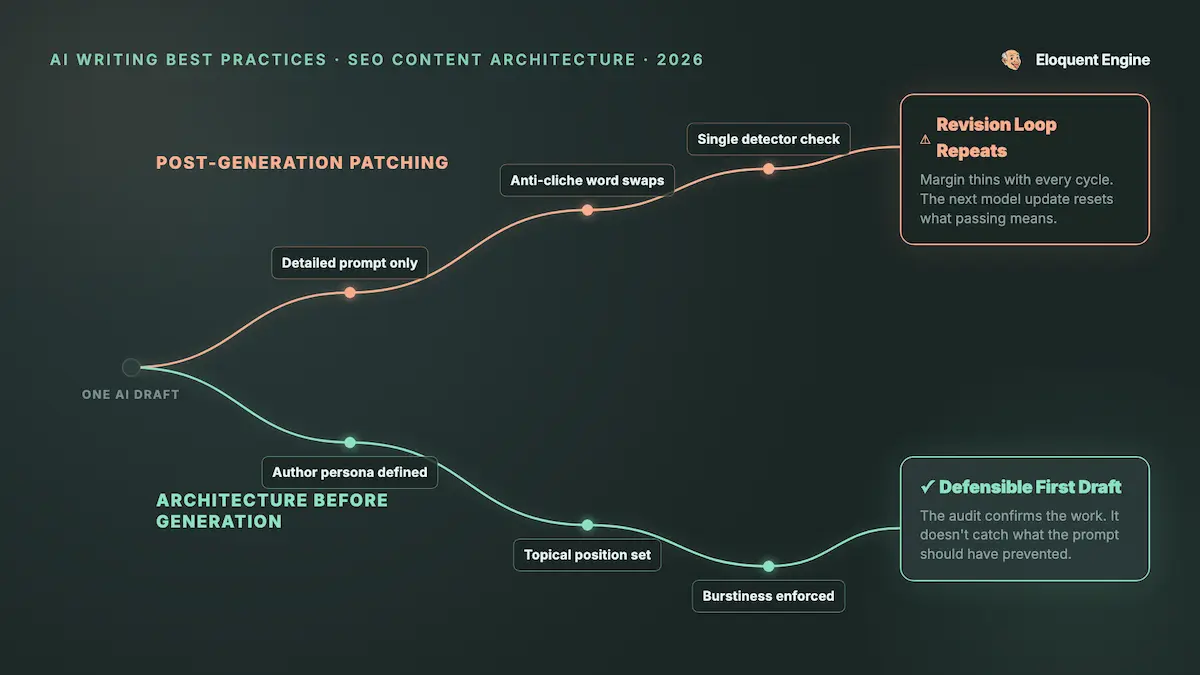
Teams treating brand voice as a post-generation problem face endless rework. The draft arrives sounding hollow, interchangeable, like something produced on a blank prompt because it was produced on a blank prompt. Someone spends an hour reshaping it. The next draft needs the same hour. The editing never fully works because the model’s defaults are still there underneath the revisions, and they reassert themselves in every new piece.
The fix people reach for is a humanizer pass. Run it through a post-processor and strip the detectable patterns. Output needing humanization signals broken input, not broken prose. Post-processors address symptoms, not root causes.
Here is the honest part: encoding brand voice upfront takes work. Building a real brand context document, with documented tone parameters, audience language pulled from actual customer conversations, competitor differentiation written out explicitly, and a glossary of domain terms the model should treat as fixed, takes more time than opening a generation tool and writing a prompt. I am not pretending otherwise.
What it replaces is every editing hour, every hollow draft, every piece that sounds right but feels like it could belong to anyone. SaaStr’s shift to 3 humans and 20 AI agents tripled output. That number is striking. The output triple is striking; whether the brand signal strengthened remains unclear. Volume without trust encoding masquerades as growth until reader retention drops.
Flag the broken input, not the broken output. Build the brand context document. Encode tone, audience, and competitors into the brief before prompting. The question of whether AI’s value is in generation or in the foundational work that happens before writing has a clear answer: both, and in that order.
Brand voice fidelity starts in the brief. Not in the edit pass, and not in post-processing tools.
How to build a content strategy with AI when the structure is already in place
“My client is going to look at this brief and ask why we need all this upfront work before a single article goes live. They’re going to say we’re overthinking it. They’re going to point to the competitor publishing twice a week and ask why we’re not doing that yet. And honestly, I’m not sure I can defend the timeline without sounding like I’m stalling.”
That objection is real. Here is what the defense looks like.
Practitioners across forums are clear that AI saves at least 40 hours on front-end work: topical authority mapping, audience research, entity identification, topic selection. That time savings exists regardless of whether the output is structured or not. The question is what you do with it. Teams that reinvest that 40 hours into deeper cluster architecture are not publishing slower. They are publishing with compounding returns instead of isolated articles that each have to earn traffic on their own.
The brief for each piece in a structured cluster should encode: the specific question this article answers, the audience stage and what the reader already knows coming in, scope limits so adjacent questions stay in their own piece, the internal links this piece should reference, and voice parameters from the brand context document. That brief takes minutes to build once the cluster map exists. It is what makes AI writing tools work better, not more carefully reviewed. The structure changes the generation, not just the editing.
AI content detection fires on pattern. Brand-encoded briefs break the predictable patterns that generic prompts produce. Structurally sound output does not need a post-processing pass. Demonstrably authoritative content does not need to be explained to a skeptical client because the cluster architecture explains itself: here are the questions our audience asks, here is the sequence, here is how each piece connects. That explanation is the defense. A content calendar does not provide it.
You are not behind. You are building the thing that makes the volume matter.
Your competitors publishing twice a week are likely not building cluster architecture before each article goes live. They churn content and watch articles cannibalize each other. Volume signals progress; authority accumulation stalls.
You feel behind because the metric you are watching is publication frequency. That is the wrong metric. The right metric is cluster coherence: how many of your published pieces belong to a defined cluster, link to a pillar, and cover a specific audience-stage question without duplicating another piece in the set.
Audit what you already have. Flag everything that is not inside a cluster. Ungrouped pieces are piles of pages, not strategy – accumulation changes nothing. Break the reactive publishing habit. Build one cluster map this week. One core topic. Five to seven supporting questions in sequence. A pillar page outline at the center. That is the whole structure.
Then build the brand context document. Encode your tone, your audience’s language, your competitor differentiation. Validate your content briefs against E-E-A-T criteria before generation starts. Benchmark a detection score on a sample before scaling any new prompt template. These are not overhead steps that delay publishing. They are the steps that make everything you publish stop being disposable.
Prompt libraries and content calendars are execution tools, not strategy. The map is the strategy. Build it first, and the AI has something real to fill.