
You know that feeling deep down when you know you’ve prompted an awful article using ChatGPT. It never sits well, does it?
You publish a piece, maybe ten pieces, and something is just…off. Not wrong exactly, but hollow in a way that is hard to articulate to yourself, let alone to a client watching their blog fill up and seeing zero gains to show for it.
I’ve been there. I assumed, for a while, that the problem was me. That I needed better prompts. That my editing pass was not thorough enough. That the brief was too loose.
Probably most people using these tools go through the same thing, though I am not entirely sure this is universal. You push the content out, watch the analytics, and wait for something to happen that does not happen. The pieces look fine. They cover the topic. They hit the keyword. They do what the tool said they would do. And yet they flatline.
What is strange is that a writer from fifteen years ago would have looked at this moment and recognized the problem immediately: generic copy. The kind that filled content farms and article directories in 2009, churned out fast and forgotten fast.
The same hollow quality, the same predictable arc, the same phrases that technically convey information without actually saying anything. The tools are different now. The underlying output is recognizable from that era.
I missed this connection for longer than I should have, maybe because I kept hoping the problem was fixable at the surface level. Run it through a humanizer. Edit the transitions. Swap the opening paragraph. Try the detection tool again. The scores shifted a little. The content still felt like nobody in particular wrote it. Not entirely sure when I realized that the feeling was accurate. That it was pointing at something structural, not something I had done wrong in the prompt.
That structural thing has a name. Several names, actually, depending on whether you are thinking about it from the generation side or the detection side. Understanding it does not require a background in machine learning. It requires knowing what the model is actually doing when it produces a sentence, which turns out to be quite different from what the marketing copy for every AI writing tool implies.
That gap, between what the tools claim to do and what they mechanically do, is where the hollow feeling comes from. Once you can see it, the inconsistent detection scores make sense. The humanizer failure makes sense. And you stop trying to fix the symptom when the system is what is broken.
What the model is actually doing when it writes
The mechanical reality that tool vendors conveniently omit from their onboarding sequences: a language model does not write. It predicts. Given every token that has appeared in a sequence, every word fragment, punctuation mark, and space, the model calculates a probability distribution over what should come next and selects from the high-probability candidates. Then it does it again. Token by token, for the entire output. No plan. No argument. No sentence conceived before it was assembled.
The training data is where the industry quietly buries the real answer. The model was trained on an enormous corpus. Blog posts, documentation, marketing copy, forum threads, Wikipedia entries, scraped web content of wildly uneven quality. It learned which sequences appear most frequently across that corpus. So predictably, when it generates content, it gravitates toward the word combinations that appeared most often in its training set. The most common writing. Not the best writing. The mean of everything.
(This is why “it’s more important than ever” appears in AI output constantly. The phrase pattern is statistically dominant in the text the model trained on. It learned that this sequence is what follows an opening claim in professional-sounding content. The model does not believe the phrase. It selected it because the probability said to.)
Practitioners have landed on a useful shorthand: AI defaults to sounding like nobody in particular. That is not a creative limitation. That is what happens when you train a system on everything and ask it to produce something. It learns to sound like the average of everything it absorbed, regardless of whether that writing was good. Tolerate that framing for a moment. The model was trained on all the writing, which means it learned to sound like the statistical center of all the writing. Averaged. Homogenized. Unplaceable.
There is a development here that the prompting-optimization crowd glosses over. People who write heavily with AI tools are now finding their own independent writing flagged as AI by detectors. The saturation of AI-influenced text across the web has become the baseline. So content that sounds like the statistical mean of the internet reads as AI-generated even when a human authored it. The problem has spread beyond “this tool produces generic output” to “generic is now the fingerprint.” Prompts can push the model toward less predictable token selections at the margins. But the model still starts from the same probability space. Prompt engineering refines an assembly process. It does not replace that process with something structurally different, and that distinction is what most of the “just learn to prompt better” advice misses entirely.
So why does AI writing sound fake at the pattern level
The detection tool just flagged your piece at 96%. You edited it for forty minutes. It is now at 64%.
That number moved because you changed words. The underlying pattern did not move, because changing words and changing a pattern are different operations on different layers of the same content. Tools like GPTZero and ZeroGPT are not scanning for specific phrases. They are not flagging you because of passive voice or because you left in the word “delve.” They are measuring perplexity and burstiness across the entire token sequence.
Perplexity tracks how predictable the text is at the token level. Assembly-based generation produces low-perplexity sequences because the model pulls from the same high-probability neighborhoods across the full piece. Burstiness tracks variance in sentence complexity: human writing alternates between complex and simple constructions in irregular patterns, while assembled content produces more uniform complexity distribution because the token selection process is consistent throughout. Changing a dozen surface words nudges the perplexity metric slightly. It does not touch burstiness. The detection tool reads the whole distribution. That is why the score moved six points and stopped.
There is a position circulating right now that the AI smell is a temporary detection problem, that as prompting gets more sophisticated, the output will pass. Dead wrong. The detection result is a symptom. The structural issue is that assembly-based generation cannot maintain the narrative continuity that makes content feel argued rather than assembled. A language model does not remember what it said in paragraph two when it writes paragraph six. It has context window, but it does not have intent. Each token selection is a local probability decision. The piece does not build toward a conclusion. It accumulates toward one.
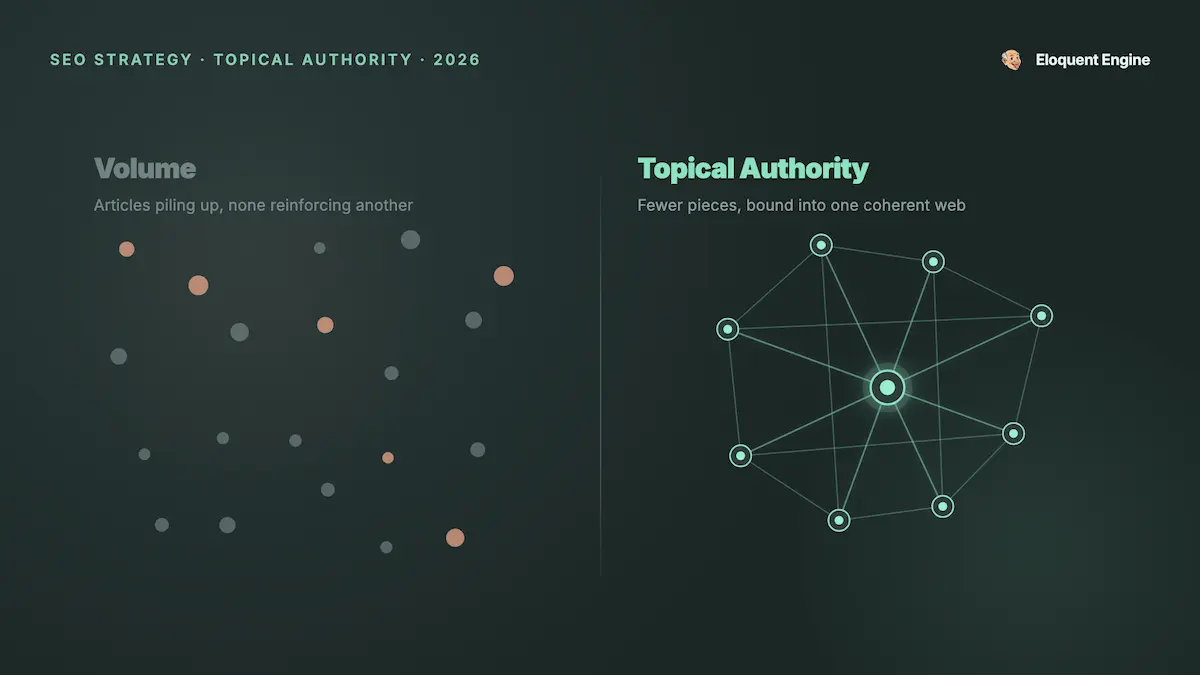
That distinction embarrasses a lot of content strategies built on volume. Publish more posts, generate more traffic, fill the topic map. No amount of volume fixes a broken foundation. A hundred pieces that accumulate instead of argue do not create topical authority. They cannibalize each other’s keyword signals. They plateau. They flatline. The “narrative continuity” conversation has been in practitioner circles for a while, framed mostly as a quality complaint. That framing undersells the structural problem. Assembly-based content is fundamentally incapable of producing what search authority actually requires: a coherent body of content that demonstrates a singular, durable point of view across every piece it contains.
Why humanizer tools do not fix this
A brand sends over their analytics. Eight months of AI-assisted content, humanizer-processed, carefully keyword-mapped, structurally clean at the brief level. The traffic curve looks like a plateau that became a cliff at the four-month mark. Solid, systematic effort. Structurally sound briefs. Completely useless result.
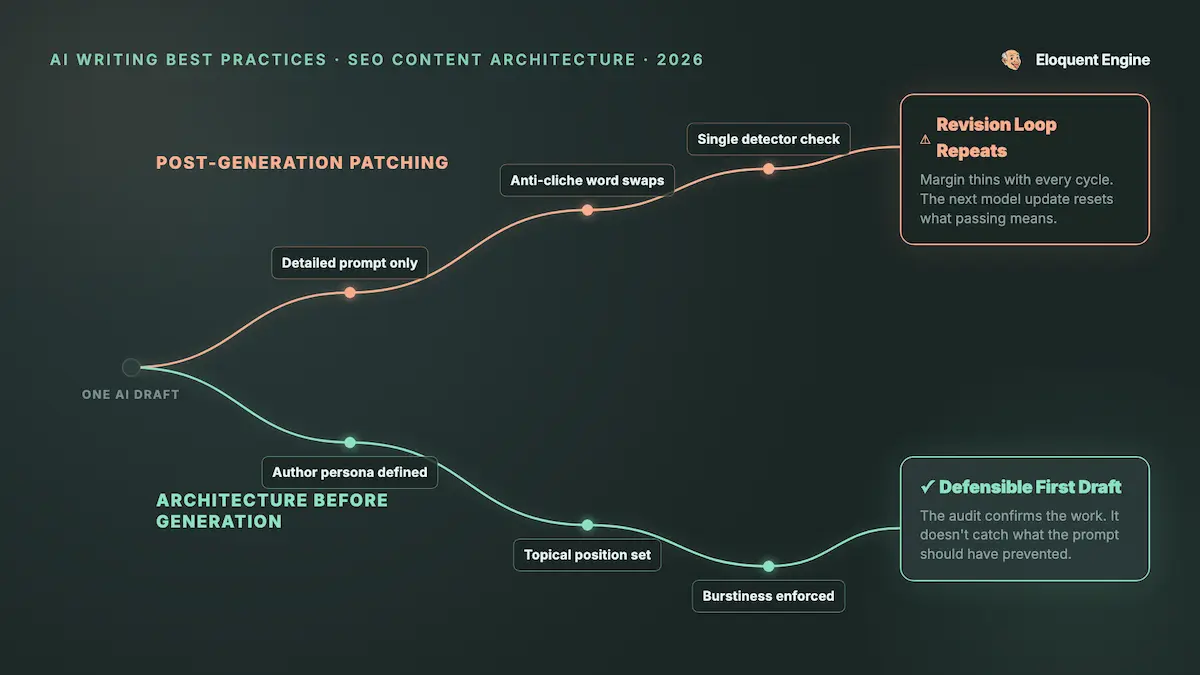
The humanizer did what humanizers do. It audited output for statistically AI-like tokens and substituted alternatives at the word and occasional sentence level. The burstiness pattern of the original assembly remained intact across the full content corpus. It had to. No humanizer operates at that layer because no humanizer was present during generation. It arrives at the end of a process that has already produced its pattern signature and patches the visible surface of decisions it never touched.
The appeal of humanizer platforms is structurally predictable. They offer a contained, completable action. Run the piece through the tool, receive a new detection score, feel the problem resolved. The score changes. The sunk cost of the original generation is preserved. The admission that the process was wrong from the start is avoided. What these tools exploit, and the vendors know this, is that detection results are inconsistent. One piece flags at 80%, another passes at 22%. That variance creates uncertainty. The uncertainty creates demand for a product that promises to resolve it. Intentionally or not, the humanizer category has built its market on that uncertainty while doing nothing to address the architectural source of it.
The broader saturation problem compounds this further. If human writing is now being flagged as AI because AI-influenced text has become the internet’s statistical baseline, humanizer tools are calibrating toward a moving target they did not set and cannot control. They are methodically chasing a problem that their own category helped produce.
The tools are not badly engineered. The problem is that they are solving a cosmetic problem while the content architecture underneath remains broken. Diagnosing content performance issues as a detection problem is like auditing your tax return when the issue is the accounting system. The surface review produces a number. The underlying system produces the same problem next quarter.
There is a different order of operations, and it changes what the model produces
Something different is happening with content that earns search equity over time. Different in the order of operations that produced it, not in how it looks on the page.
Before a word was chosen, the structure existed. The specific claim. The sequence of reasoning that supports it. The transitions that are not filler transitions but logical connectives, present because the argument required them, not because the model defaulted to “with that in mind” or “building on this.” The argument was built before it was written. That sequence reversal is the whole problem right there.
The New York Times ran a piece explaining why AI writing sounds generic, centering the explanation on vocabulary patterns: the bloated language, the canned transitions, the phrases AI defaults to because they are statistically dominant in its training data. That explanation is accurate as far as it goes. It frames the problem as a word-choice problem, which is where most advice about “editing AI content more carefully” comes from. Swap the bloated language for less common synonyms. The token-level pattern signature persists. The narrative flatline persists. The piece had no architecture before it had words, and no vocabulary substitution reconstructs an architecture that was never built.
Construction-first content generation starts with the argument, not the prompt. What specific claim does this piece make? What is the minimum logical sequence required to support it? What does the reader need to understand in section two before section four makes sense? Those answers exist before the model generates a single token. The model is then constrained by an argument structure, not released into a probability space to find its own way there.
The pattern signature of construction-first output measures differently because the model was pushed off its statistical defaults at every structural level. Perplexity is higher because the argument required specific word choices the model would not have selected probabilistically. Burstiness is more human in its distribution because sentence construction was governed by logical necessity, not token-level probability averaging. The THREAD methodology builds content this way, establishing the logical architecture before generation begins, which is why the resulting output measures differently on detection tools from the start rather than requiring remediation after the fact.
You can gut-check your own approach before the next piece. Does the specific argument structure exist before you open the tool? Not the topic. Not the keyword. The claim, the support, the sequence. If those are determined inside the tool as you prompt it, you are assembling. The output will carry the signature of that assembly regardless of how well you edit it afterward.
The question to audit before your next piece goes live
The publish-more mentality is costing sites rankings in ways that were not obvious when the volume strategies launched. The evidence is accumulating methodically: programs that published aggressively on AI-assisted volume in 2023 are watching traffic erode, while programs with thinner but architecturally coherent content are holding position. The brands that moved fastest on content velocity have, in several documented cases, done the most measurable damage to their own content moats. Speed was the promise. Content cannibalization and topic overlap were the delivery.
Diagnosing where your program sits requires auditing at the architectural level before touching individual pieces. Check for keyword cannibalization across your existing indexed content before assigning new topics. Audit for topic cluster coherence: do your pieces build toward a demonstrable point of view on a subject, or do they cover adjacent ground without connecting? Evaluate your internal link architecture. Posts without deliberate internal link context contribute less to topical authority than posts with explicit structural relationships to the cluster they belong to. These are decisions that happen before any AI tool opens, and they determine whether your content earns compounding search equity or accumulates into a plateau.
The detection question, will this piece pass a GPTZero scan, is downstream of the architecture question. Content built from an argument structure that constrained generation carries a different pattern signature from the start. Content assembled from probability distributions and humanized afterward carries the original signature regardless of what the humanizer returns. Calibrating your diagnostic priorities around detection scores is solving at the wrong layer.
The concrete action before the next piece: write the argument before you write the prompt. The specific claim this piece makes. The specific reasoning that supports it. The specific sequence the reader needs to follow to arrive at the conclusion. Write those down first. Then open the tool. Generation constrained by a pre-existing logical structure will behave differently at the token level, measure differently against detection benchmarks, and read differently to an audience that has been exposed to enough assembled content to recognize the absence of an actual point of view.
Publishing at speed remains a viable operational choice. Publishing at speed without architectural clarity is the specific practice that is failing systematically now, and the evidence for that failure is in the analytics of anyone willing to audit it honestly.