Brand Voice Is Not a Feeling. It Is a Set of Choices You Have Not Written Down Yet.
The most durable piece of brand voice advice in the marketing community is to pick three to five adjectives.
- “Witty but not snarky.”
- “Helpful without being condescending.”
- “Casual but not unprofessional.”
These pairs appear in agency decks, Reddit threads, and marketing blogs with enough regularity that they have achieved the status of received wisdom.
They survive as advice because they are easy to agree with. They fail as tools because they describe the effect of your writing, not the cause. “Witty but not snarky” does not tell you whether to open a paragraph with a claim or a question. It does not tell you how long to let a sentence run before landing it, which qualifiers to cut, or what you assume the reader already understands. Those choices generate voice. The adjectives float above all of them.
Practitioners in marketing communities have started naming this frustration directly. The consensus position now is that you cannot follow something that is not defined. Which is correct. The problem is that adjective pairs are definition by analogy. They describe what your brand is like, not what it does on the page. So most teams publish the document, feel briefly more organized, and then write the same way they always did.
Which is fine, right up until someone asks you to brief a freelancer, prompt an AI tool at any meaningful volume, or onboard a team member without months of context. At that point, “witty but not snarky” does not resolve into a sentence. The document was never instruction. It was aspiration.
Brand voice is a construction system. The choices that generate your voice consistently, the words you reach for, the sentences you build, the things you assume the reader knows, the qualifications you cut, these are documentable. They already exist in your best content. The work is extraction, not invention.
You can do this in an afternoon.
Why does your content sound like everyone else’s?
Generic output starts before the first word. A blank prompt fed into ChatGPT has no constraints. No constraints means the model defaults to the statistical average of everything it has seen, which is exactly what most SaaS content sounds like. Originality.ai and GPTZero flag that output not because AI generated it, but because nothing specific was encoded before generation began. Running it through a humanizer pass afterward treats the symptom. The input was the problem.
A prompt library does not fix this either. A collection of templates built on adjective-based voice guidance produces different output every time because the guidance is too abstract to resolve into specific decisions. “Casual but not unprofessional” means something different to every writer, every tool, every Tuesday.
Most teams spend weeks defining brand voice and then wonder why the output still sounds hollow. The content inside the document is the failure. Your writing needs a route, not just a destination.
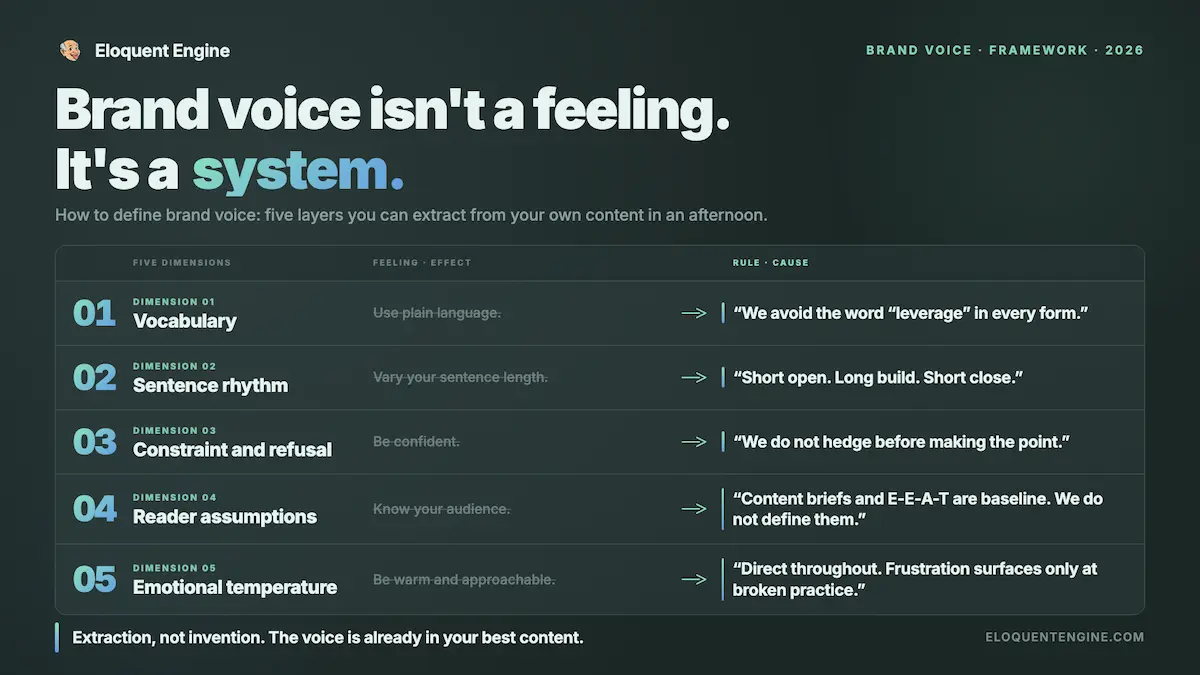
Voice lives in five specific layers: vocabulary, sentence rhythm, constraint and refusal, what you assume about the reader, and emotional temperature. None of those is captured by an adjective pair. Each one can be written down with enough precision that someone who has never read your content could apply it without a follow-up call.
The debate over whether voice should be defined top-down through a guidelines document or discovered bottom-up through audience research is real, but it mistakes the question. Top-down definitions drift from how you actually write. Bottom-up research tells you who the reader is, not how you address them. Extraction, reading your existing content and naming what you find, is where both converge. Your voice is already there. You have just never clocked it systematically.
That changes now. For freelance marketers who need content that sounds genuinely theirs, and for business owners who need consistency without a full team, the process is the same. Five dimensions. One sitting.
How to define brand voice: the five dimensions
Pull three to five pieces of your own content where the draft felt right. Not the best-performing posts. Not the rewrites. The ones you read back and recognized as yours. Those are your source material.
Vocabulary and refusal
Read for two things at once: the words that keep appearing, and the words that never do. Both define your voice. The terms your industry uses constantly that never appear in your writing are as revealing as the ones you reach for. Write the rule for each side. “We avoid the word ‘leverage’ in every form” is useful. “We use plain language” tells a writer nothing. Specific enough that a freelancer could immediately name two words to cut. That is the bar.
Sentence rhythm
Read a section of your best content aloud. You are listening for the pattern your sentences follow. Do you open paragraphs with a short declarative and then expand? Do you build through a long clause and drop something short to close? Do you vary that pattern, or does every paragraph run the same shape?
Rhythm is not aesthetic. It is structural. Document the pattern you actually use, and name one construction you almost never reach for. That gap is as useful as the pattern itself. A technically correct sentence can still feel wrong because the rhythm breaks the contract the rest of your writing established.
Constraint and refusal
This dimension lives in absence, which makes it the hardest to extract and the most differentiating once you do. Look for moments where you could have hedged and did not, could have qualified and did not, could have presented both sides and chose one. Write those as rules. “We do not validate the reader’s skepticism before making the point.” “We do not qualify a claim with ‘it depends’ unless the dependency is named in the same sentence.” Nobody else’s constraint rules will look exactly like yours. That is the point.
Reader assumptions
Every piece of content models a reader. The level of intelligence and familiarity you credit that reader is visible in how you handle terminology, how quickly you move through foundational concepts, and whether you define a term or simply use it. Look at what you explain and what you skip. Document that model explicitly. “We treat content briefs, topical authority, and E-E-A-T as baseline knowledge. We do not define them.” That assumption shapes every sentence that follows it.
Emotional temperature
The brands that feel most consistent usually shift temperature deliberately, not holding one note throughout. Warmth throughout reads as undifferentiated. Consistent dryness with moments of genuine frustration reads as a point of view.
Look at how your content handles industry failures, client mistakes, or genuinely bad advice. Does the temperature stay flat? Does it sharpen? Document where it holds and where it moves, and what triggers the shift. “We stay direct throughout but let frustration surface when naming broken practices.” That is encodable. “We are warm and approachable” is not.
What does a finished voice document actually give you?
The prevailing assumption in most content operations is that a voice document’s job is done once it exists. The guidelines cascade from there. Any writer, any tool, any prompt can execute them.
That assumption is worth examining. SaaStr’s analysis of prompt portability across AI systems identifies a consistent pattern: systems that maintain performance across contexts are those with encoded constraints, not abstract principles. The same logic applies here. A vague voice document produces vague output regardless of who executes it. A constraint-based document changes what the model, or the writer, has available to reach for.
The “voice should stay consistent but adapt to platform” debate points to something real. Voice does shift between a LinkedIn post and a long-form article. The way to manage that shift without losing coherence is to encode the invariant layer, vocabulary, constraints, reader assumptions, separately from the variable layer, temperature, rhythm, format weight. The first stays fixed. The second calibrates to context. That distinction is what makes AI content detection less relevant: detection fires on pattern, and a brand-encoded brief changes what patterns are available.
Three tests tell you whether your document is working:
- Writing test. Draft something with the document open. Each sentence-level decision should be checkable against a rule. If the rules do not guide decisions at the draft level, they are too abstract.
- Critique test. Read a draft that does not feel right against your five dimensions. You should be able to name which dimension it breaks. “This doesn’t sound like us” is a feeling. “This assumes the reader does not know what a content brief is, and we treat that as baseline knowledge” is a diagnosis.
- Brief test. Paste the document into a content brief before generating anything. If the first draft is closer to your voice than it would have been without it, the document is functioning as a constraint set. That is what it should be doing.
So what do you actually leave with?
Probably two to four pages. Maybe five if your constraint rules are detailed. That is it, and I think that surprises people who expected something more substantial.
I used to build the other version, the one with workshops and research phases and weeks of internal review. Those documents were thorough. In hindsight, they were also unusable on a Tuesday afternoon when someone needed to post something and had twenty minutes. Scope was the problem. A process that takes months produces an artifact nobody has time to apply under deadline.
The version that works is faster and, to be honest, messier. You read your own content, name what you find, write the rules specifically enough that someone else could apply them. The document is short enough to read before you start drafting. Short enough to paste into a prompt. Short enough that it actually gets used.
The open question, and I think it is worth leaving open, is how often to update it. Voice shifts. I kept editing output instead of fixing the input for longer than I want to admit, and part of what was happening is that my writing had moved and my document had not. The document should describe the voice you have now. When the output starts feeling wrong again, that is usually the signal to revisit the extraction, not the generation.
Build it. Use it. When the output stops sounding like you, go back to the source content and run the process again. What you are building, underneath all of it, is a constraint set specific enough to generate output that sounds like yours. Not a checklist. A system. One that holds when you are rushing, when you are handing the brief to someone who has never read your content, or when you are evaluating whether an AI writing tool is actually a fit for how your brand works.
The constraint is not the tool. The constraint was never having context in the first place.