This article is about the specific practices that separate AI writing that works in SEO from AI writing that erodes your reputation, burns revision hours, and quietly loses rankings.
We are not here to provide prompting tips. This is the full system: what to build before generation, what to enforce during it, how to audit detection risk before anything publishes, and why all three connect to the same underlying failure.
Most practitioners have run this experiment already. They opened ChatGPT, dropped in a keyword, maybe added a persona line, and got something technically coherent and completely indistinct. Every sentence calibrated to the statistical center of the topic. Every piece of advice already on six other pages. The draft needed rewriting before it could publish, which means the time math collapsed.
Voice training is everything, and most AI writing workflows have none.
If the first draft requires cleanup, it functions as a liability and you have to assume that the system upstream of the output is the problem.
Here’s what the “AI writing best practices” conversation keeps getting wrong
The dominant advice right now tells you to use detailed prompts, review the generated content carefully, add contractions, include personal details, replace vague emotional phrases with specific actions. This is Ruben Hassid’s anti-AI-writing prompt framework in a nutshell, circulating on X and reshared by practitioners who are desperate for something that actually works at scale.
- Anti-cliche style guides.
- Stop asking AI to write X.
- Give it a framework instead.
All of it is insufficient.
Every hour cleaning up AI copy is an hour you are not billing a client. Every revision cycle that traces back to a sloppy prompt is wasted margin.
Spending more time editing AI content than it would take to just write it is not a tool problem – it is a system problem, and a detailed prompt does not solve a system problem.
Three more clients doesn’t mean anything if output quality degrades across all of them because the prompt infrastructure was never built to enforce consistency at scale.
The live debate right now is whether detailed prompting and post-generation humanization can solve detection at scale, or whether the problem requires changes at the model and training level. That debate is the right question. The community is still mostly arguing for the prompting side.
But I’m here to tell you that the evidence points elsewhere.
Build the author persona before the first prompt exists
Flat lazy prompts from every business in your niche produce the same article. AI writing tools are only as good as the prompt system built around it, and the system starts with who is writing, not what is being written.
An author persona built for AI prompting is not a bio or a brand voice descriptor. It is a belief system documented for generative use.
Before a single prompt is written, this document captures the opinions the author holds that someone in the same field would push back on. The failure patterns they have watched repeat. The advice they will not give because they have seen it not work. And the vocabulary they reach for because of how they actually think about the domain.
Building a dedicated brand voice document before any LLM prompt is written is documented as the single highest-leverage pre-generation practice. It constrains the output space before the model generates anything. That constraint is the work.
Defining that voice with enough precision to fuel prompt infrastructure is harder than most practitioners expect.
“Conversational but professional” is not a constraint. “This author believes content calendars are a coping mechanism for teams that haven’t solved ideation, and they’ll say so directly” is a constraint.
One produces identically generic output. The other produces something the model cannot generate without the context you gave it.
Assign a topical position, not a topical assignment
Training the LLM on author opinions and known biases before generating content means every piece starts from a position.
The difference is structural.
A position tells the model where the author stands on it – not just what to cover. An article generated from a position has stakes – it acknowledges what the opposing view gets right, arrives at a conclusion, and says something a competitor could not publish without contradiction.
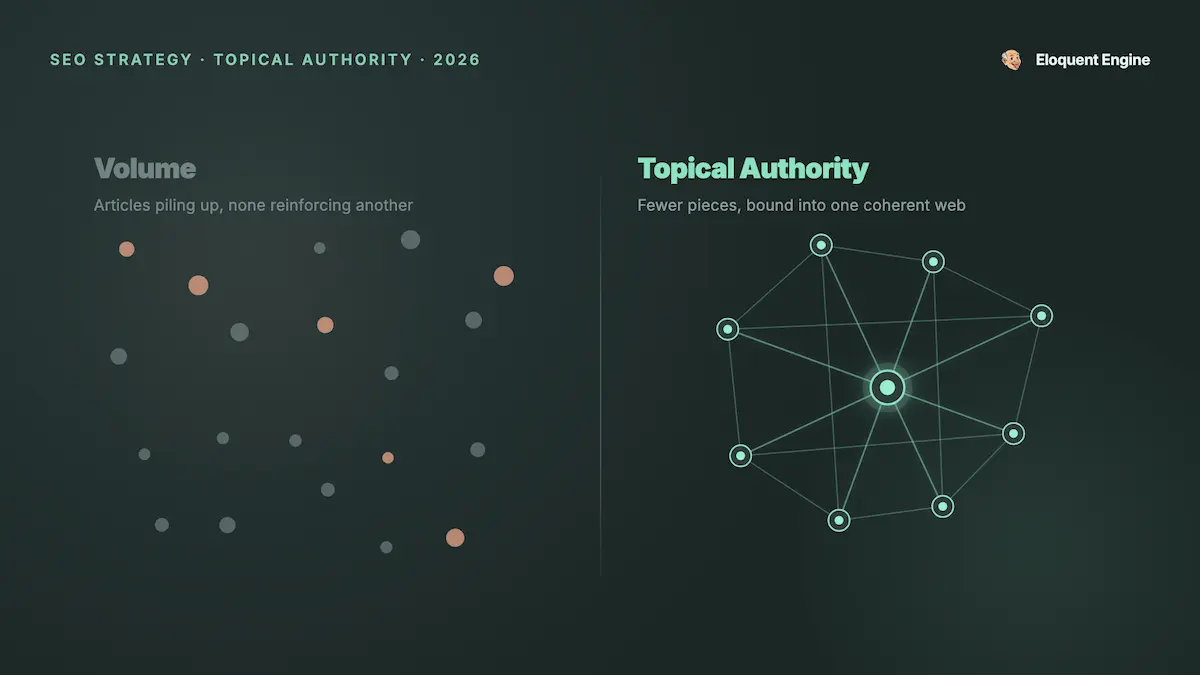
Volume without that consistency erodes topical authority instead of building it.
The emerging consensus that “the approach to prompting matters more than the tool” is half right. The approach matters enormously. But the approach has to be built into prompt infrastructure, not improvised per piece by whoever happens to be generating content that week.
Outsourcing prompt management to a junior team member with no background in how language models interpret context produces identical interchangeable output at scale, quietly, across every client asset.
Building content clusters around a single topic before targeting competitive keywords compounds the return on a strong author persona. The persona creates signal consistency. The cluster creates topical depth. Together, they produce the E-E-A-T signals that volume alone never will.
Enforce structure during generation rather than editing it in afterward
One path costs you the revision time you were trying to save by requiring specific decisions before generation begins. Careful review alone doesn’t create structure the prompt failed to build.
The current mainstream approach – contractions, personal details, specific nouns, replacing vague emotional phrases with concrete actions – treats brand voice and style consistency as stylistic preferences applied after the draft lands.
That framing is the problem.
Brand voice consistency is a technical mechanism that determines whether content gets flagged by detection systems and whether it reads as authored by someone with a real perspective. It functions at sentence level and paragraph level simultaneously. Applying it post-generation means patching what the prompt architecture should have prevented.
Burstiness as a structural requirement, not a style suggestion
Burstiness (the variation in sentence length and rhythm across a piece of text) is one of the two primary signals that AI detection classifiers score. Human writers vary it naturally. LLM defaults produce uniform sentence length, which is structurally detectable regardless of vocabulary choices.
Using burstiness variation deliberately means building rhythm instructions into the prompt itself: short declarative sentences following complex analytical constructions, fragments used intentionally, not appended as an afterthought during editing.
Brand voice consistency enforced at the prompt level produces this variation as a byproduct of genuine perspective. Using the same prompt template across every client without brand customization produces uniform rhythm across every piece, for every client, every time.
That sameness is detectable and reads flat to human readers before any classifier touches it.
Validating first drafts against the author position before editing anything surfaces the deeper problem. If the draft would be equally true without the stated position – if it reads like content generated from no perspective at all – the prompt failed. Edit that upstream, before the language-level fixes.
The practices that consistently produce content that passes detection without sacrificing quality all trace back to the same place: structure enforced before generation, not corrected after.
Detection risk is specific, measurable, and mostly misaudited
I have watched practitioners run a single piece through GPTZero, get a yellowish-green result, and publish. That is not a detection audit.
A single classifier result is one data point trained on one distribution of text. Originality.ai uses different training data and scoring weights – it flags content that GPTZero passes routinely. Running AI-written content through a single detector and calling it safe is one of the most consistently documented failure patterns in this domain.
Detection classifiers score two primary signals.
The first is perplexity – a measure of how predictable each word choice is given the words that came before it. When a model generates text by selecting statistically expected tokens at each step, the output scores low on perplexity variance. Human writers deviate from the statistical center more often, making less predictable word choices that lower the document’s overall perplexity score.
The second signal is burstiness, already covered above. Both are measured at sentence level and paragraph level, not just across the full document.
Auditing detection scores at sentence and paragraph level, not just document level, is the practice that catches what document-level scans miss. A piece can pass at the document level and still contain sections that trigger classifier flags at paragraph level – which is exactly what clients running their own audits will find, because Originality.ai reports at paragraph granularity by default.
And know that what clears Originality.ai today may not clear it after the next training cycle. Tracking which prompt structures trigger high perplexity scores and iterating on those structures is how detection risk becomes a manageable constraint rather than a recurring surprise.
Understanding how GPTZero and Originality.ai differ in what they flag is the starting point for building an audit process that actually holds up across both.
The consensus view – that detailed prompting and humanization tactics reduce AI-like characteristics – is accurate up to a point.
The ceiling is real, and practitioners are starting to reach it.
At scale, post-generation fixes are too variable and too dependent on individual execution to be reliable. The architectural question is whether the tool itself was built to produce low-perplexity, high-burstiness output from the start, or whether that burden falls entirely on the operator’s prompting skill.
E-E-A-T is where all three failures converge
I’ll say this plainly: if a piece of content could have been generated by any business in your niche from the same topic brief, it fails E-E-A-T signals by definition (and this is arguably more offensive to your SEO rankings that content with some AI detection percentage).
Experience, Expertise, Authoritativeness, Trustworthiness – Google’s framework for assessing whether content comes from a credible source – rewards signal consistency across a body of work.
Generic output that needs a full rewrite produces no such signal, no matter how many pieces get published.
As AI-native workflows become standard across SaaS and content operations by 2026, the question is no longer whether to use AI writing tools. It is whether the tool was built with detectability and brand voice as architectural priorities, or whether those problems were left for the operator to patch. The market is correcting toward that question.
| Approach | Voice Consistency | Detection Risk | E-E-A-T Signal | First Draft Quality |
|---|---|---|---|---|
| Post-generation humanization (contractions, personal details, anti-cliche edits) | Variable. Depends on editor skill per piece. | Reduces surface signals. Perplexity and burstiness often unchanged at paragraph level. | Weak. No authored position baked into generation. | Requires rewriting. Revision cost absorbed per piece. |
| Architecture-first (author persona, topical position, prompt infrastructure) | Consistent. Enforced at generation, not corrected after. | Lower. Perplexity variance and burstiness built into output structure. | Strong. Authored perspective present from first draft. | Defensible on delivery. Revision minimal. |
Where you actually are after reading this
Honestly, document-level detection is still a hard problem. What passes Originality.ai today might not pass after the next model update. Every detector is trained on different data, so a clean score on one tool is still mostly a partial answer. Perplexity variance and burstiness at the sentence level are where it gets tricky, and that is where most practitioners have not looked yet.
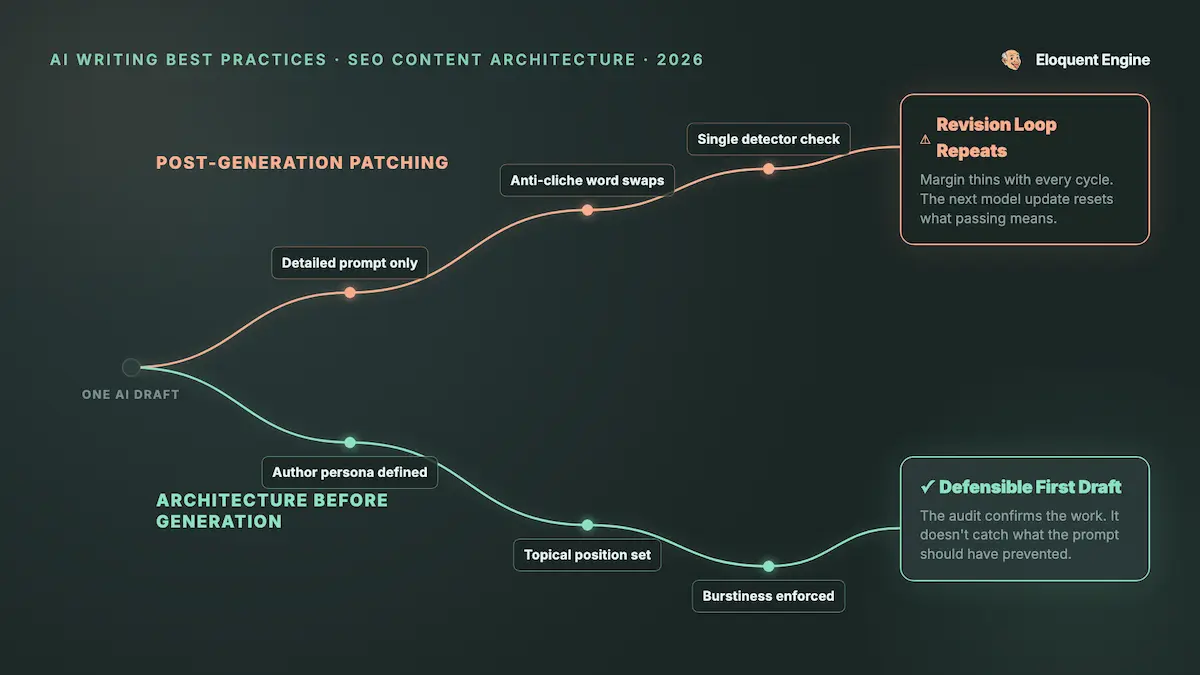
One path: keep patching. Add contractions, re-evaluate the emotional phrases, run the piece through GPTZero, publish and hope. The revision cycles compound. The margin thins. The next model update resets what “passing” means.
Another path: build the system before the prompt. Author persona, topical position, prompt architecture that enforces burstiness and perplexity variance from generation rather than correcting for them afterward. The first draft arrives defensible. The audit confirms rather than catches.
You came here because the output wasn’t working. The output was the last place to look…
How Eloquent Engine approaches this architecturally is worth understanding if you’re deciding whether to rebuild your current workflow or find a system built for this from the start. And the best place to get started is with a free account where you can generate a full brand spec, content strategy and write your first piece of undetectable AI content.