Detection Tools Aren’t Catching Your AI Content. They’re Catching the Blank Prompt You Started With.
I spent a long time blaming the output. Built a whole prompt library, tested different temperature settings, watched the detection score come back at 90 percent and had no explanation for the client. I kept editing the output instead of fixing the input. And, at the time, that felt like the right instinct. The draft was the problem you could see.
It probably isn’t. I don’t think it is for most teams running into this. The draft is where the problem shows up. The content brief – or the absence of one – is where it starts.
What follows isn’t a tool recommendation. There’s no humanizer pass at the end of this. What’s here is the mechanical reason your AI content gets flagged, the three signals detection tools actually measure, and a generation approach that addresses those signals before the model produces a single word. Apply it this week. Explain it to a client on Friday. Both should be possible.
What is Originality.ai actually measuring in your drafts?
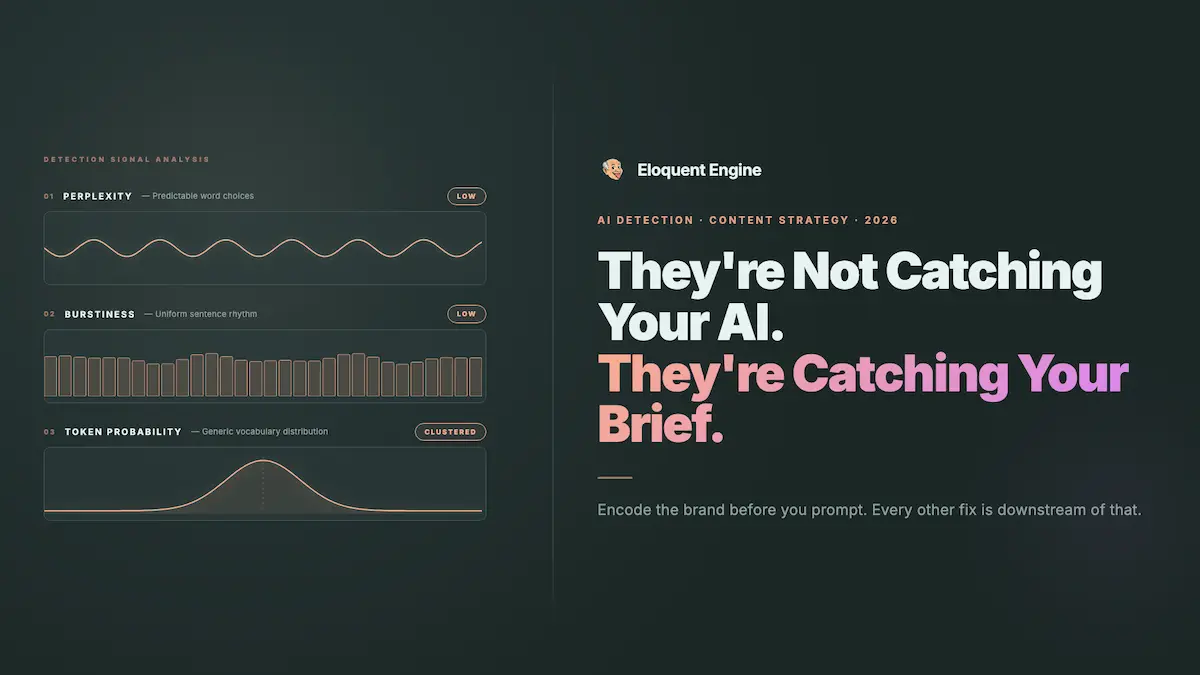
Detectable content. That phrase gets thrown around without much underneath it. “Sounds like AI.” “Too polished.” “Generic.” All true. All useless as a production signal. What the tools are actually measuring:
Perplexity: the cost of predictable word choices
Perplexity measures how surprising a piece of text is to a language model. Low perplexity means the text walks a predictable path. Common transitions, expected vocabulary, sentence structures the model assigns high probability. Every AI writing tool generates text by selecting the tokens most likely to follow the previous tokens. That’s the mechanism. The output feels coherent because it is coherent. GPTZero flags it because any other language model would have generated something nearly identical.
Running hollow output through Undetectable.ai nudges perplexity by substituting words and restructuring phrases. The score moves. The underlying problem doesn’t. Detection models are now trained on the patterns humanizers introduce. You’re not escaping the fingerprint. You’re swapping one fingerprint for another.
Burstiness: the rhythm that human writing has and AI generation doesn’t
Human writers break rhythm constantly. Short claim. Then a longer sentence that explains it from a different angle, builds toward something, earns its length. Then a fragment. AI models default toward uniform sentence length. Not always short, not always long, just steady. That steadiness is measurable. Burstiness quantifies the variation pattern in sentence length, and the variation pattern in human writing is distinctive enough that its absence is a signal.
This is fixable at the prompt level. Most teams don’t fix it because they don’t know it exists as a measured variable. The technical reason AI writing sounds fake is partly this: not the word choices, the rhythm.
Token probability and the generic content cluster
Detection models train on large corpora of both human-written and AI-generated content. They learn that AI output clusters around predictable topic-level vocabulary. The statistically common terms and framing for any subject. A model generating content about SaaS onboarding with no additional context produces the median take on SaaS onboarding. Correct. Topically coherent. Interchangeable with fifty other articles on the same keyword.
Content drawing from real brand context, specific product vocabulary, actual customer language, the framing a particular company uses internally, produces a different token probability distribution. That distribution doesn’t cluster where detection models expect AI content to cluster. Encode the brand before you prompt. Every other fix is downstream of that.
A prompt library is a collection of inputs that produce the same detectable output slightly faster – not a content strategy.
So why doesn’t running it through QuillBot actually solve this?
I used to think the humanizer tools were probably fine as a last step. A patch, sure, but functional. I overcorrected when I watched what they actually do to the text.
Practitioners are right that these tools are “band-aids that mask the underlying generation problem” – the reasoning matters. QuillBot and similar tools introduce lexical variation after generation. They shuffle syntax, substitute vocabulary, restructure phrases. Perplexity scores move. What doesn’t move is the absence of brand specificity, the hollow topical depth, the broken burstiness pattern underneath the word substitutions. The variation isn’t motivated by meaning. A human reader, and increasingly, a detection model trained on humanized output, can tell.
There’s a broader pattern here. SaaStr’s analysis of why SaaS companies ship 60% solutions applies cleanly: humanizer tools technically clear the bar (detection evasion) without solving the real constraint (content that earns readership trust and carries genuine brand voice). Post-processors are selling a second product to fix the first product’s failure.
Some practitioners are arriving at this from a different angle, arguing that “passing detection” is the wrong metric entirely, and that human readability and brand alignment are the actual constraints. I think that’s probably right, and I also think it’s compatible with caring about detection scores. They’re not competing goals. A generation process that encodes brand context, structural variation, and topical depth produces content that passes detection and earns readership trust, because those are the same inputs.
Running it through a humanizer tool addresses neither problem at its source. That’s the whole issue.
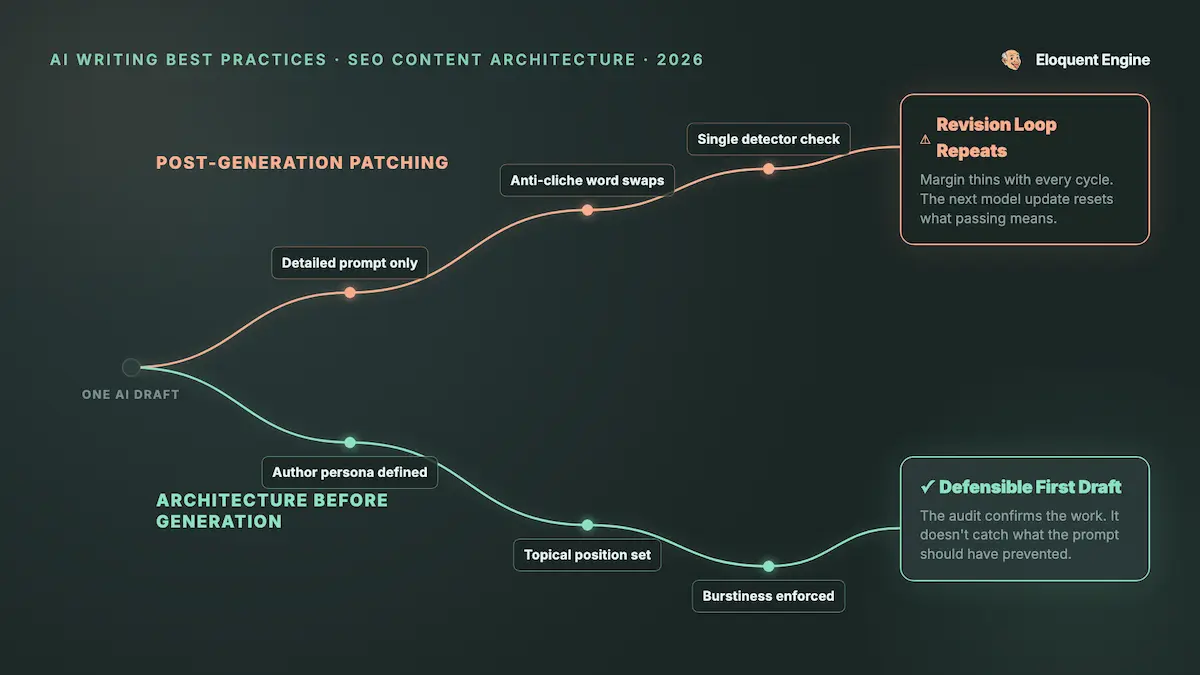
How do I actually produce AI content that passes detection without a post-processing step?
Three inputs. Each one addresses a specific detection signal. None requires new software. Every one requires doing something before the model sees a prompt.
Build a brand context document before you generate anything
Generic output is a system design problem. A model generating from a blank prompt has no source material for specific vocabulary, specific framing, or the language a real company uses with real customers. It defaults to the statistical average for the topic. That average is detectable because it’s what every other AI-generated piece on that topic also produced.
The fix is a brand context document that precedes every generation task. Not a style guide appended to a prompt after the fact. A document built from source material: founder communications, customer support language, sales call transcripts, customer reviews in the brand’s vertical. Pull the vocabulary that actually appears in those sources. Feed it to the model as context before any instruction. Token choices shift away from the generic cluster. The output carries specificity the model didn’t invent. It drew from the brand’s own language.
Agencies managing multiple client brands face a compounding version of this problem. Using a single generic prompt across all clients regardless of voice or vertical means every client’s content produces the same detectable signature. The brand context document is what breaks that. AI content at agency scale requires encoding voice differences before generation, not after.
Prompt explicitly for structural variation
Burstiness doesn’t happen without instruction. A content brief that covers topic, angle, and target keyword, and says nothing about sentence structure, produces consistently moderate sentence length. Every time. The model isn’t going to introduce rhythmic variation on its own. It optimizes for coherence, and coherence at the token level looks like steady, moderate length.
The prompt adjustment is specific: instruct the model to vary sentence length deliberately. Short declarative sentences alongside longer analytical ones. Explicit permission to fragment. The instruction changes the output in ways that affect burstiness scores. It also makes the content read better, which is the more durable argument. This is one of the few detection signals addressable at the brief level with minimal effort. The barrier was not knowing the signal existed.
For freelance marketers running content across multiple verticals, this is a template audit question: does your standard brief encode structural variation, or topic and angle only? If topic and angle only, every client’s output is producing the same rhythmic signature.
Build topical depth before generating individual pieces
A model prompted to write about email onboarding sequences with no additional context produces the median take on email onboarding sequences. Run a topical gap analysis against competing SaaS blogs first. Map which questions existing content leaves unanswered. Assign entity-level coverage targets before building a content calendar. Feed that depth into the generation context before a single article prompt.
The model’s output is only as differentiated as the context you fed it. Content briefs that encode coverage gaps, competitor angles, and specific unanswered questions shift the model toward territory it hasn’t averaged across thousands of training examples. Detection models have a harder time classifying that output as AI-generated because it doesn’t cluster where they expect AI content to cluster.
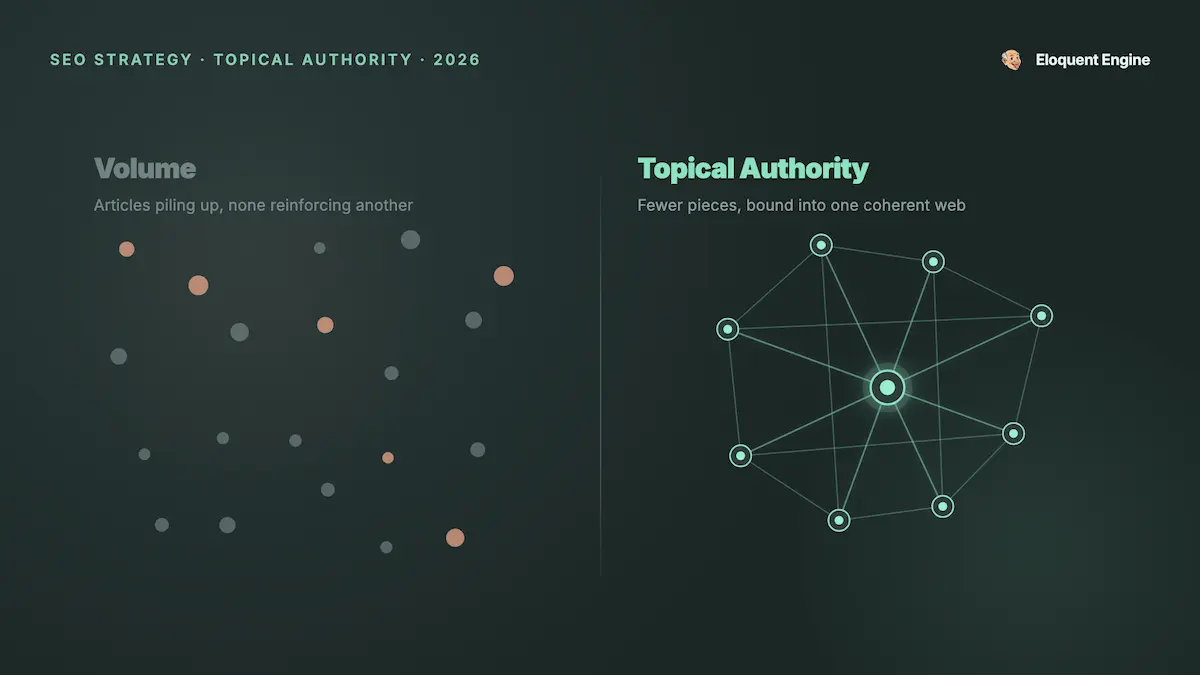
This is also the argument for clustering content around pillar pages before generating individual articles. Not purely as an SEO practice, but as a detection risk practice. Thin articles across hundreds of keywords with no depth or entity coverage poison the whole content system. Business owners publishing AI content in-house are especially exposed here: volume without topical coherence just means more detectable pages indexed faster.
Detection tools struggle with the middle ground. Content that’s been genuinely worked on, with specific sourcing and brand-encoded language. That’s the middle ground the generation design method is trying to produce from the start. No humanizer pass. The brief does the work the post-processor was patching.
Let’s be honest about what this approach cannot promise
Detection tools will keep evolving – any approach that works against today’s version of Originality.ai operates inside a moving target. Claiming otherwise would be the same oversell the humanizer category runs on.
The detectors are also inconsistent on edge cases. Practitioners are right about that. A piece of content that scores 78% on one run might score 61% on another. Treating those scores as gospel is a mistake. Ignoring them entirely until a client flags the content is also a mistake. Benchmark detection scores on a sample before scaling a new prompt template. That’s the practical position.
In highly specialized domains with limited source material to draw from, brand-encoded generation closes less of the gap. The method reduces detection risk. It doesn’t strip it to zero. Anyone claiming zero risk is churn-out marketing copy, not a content strategy.
The tools that claim to blend detection checking and humanizing into one workflow are consolidating two broken steps, not solving the underlying architecture. That’s worth understanding before evaluating any tool on its feature list versus actual output quality. One of those criteria matters. The other one is what vendors dilute with pricing tiers and interface updates.
We started chasing the score. We should have been building the brief.
We came in watching detection scores climb and reaching for the nearest tool that promised to bring them down. We’ve seen what that produces: interchangeable output that fools a detector and nobody else.
The generation process encodes what the output can contain. A blank prompt produces hollow, detectable content. A brand context document, a brief that specifies structural variation, a topical gap analysis run before a single article is assigned. Those inputs produce content that carries the signals human writing carries. Variation. Specificity. Depth.
That content passes detection because it was built to deserve to. The detector is not the point. The reader is the point. And a generation process built around brand context, structural variation, and topical depth serves both. Without a humanizer pass, without a second product bought to fix the first product’s failure.
Build the brief right. The score follows. Understand the full detection picture and you’ll stop optimizing for the wrong variable entirely.