When your content gets flagged by an AI detection tool, software that scans writing to determine whether a human or a language model produced it, the report names two things: perplexity and burstiness.
Most people read those terms and assume they mean “sounds robotic.” They don’t. They’re specific, measurable linguistic properties. Properties that large language models produce by default. Properties that detection classifiers are explicitly trained to identify.
Tools like GPTZero and Originality.ai aren’t guessing. They’re scoring. Understanding what each metric measures is the only path from “my content keeps getting flagged” to knowing which signal broke and what upstream change fixes it.
What does perplexity mean as an AI writing metric?
Perplexity is not the most intuitive name for what it measures. In natural language processing – the field of computer science that studies how machines understand text – perplexity is a measure of predictability.
Specifically, it measures how surprised a language model would be by a given sequence of words.
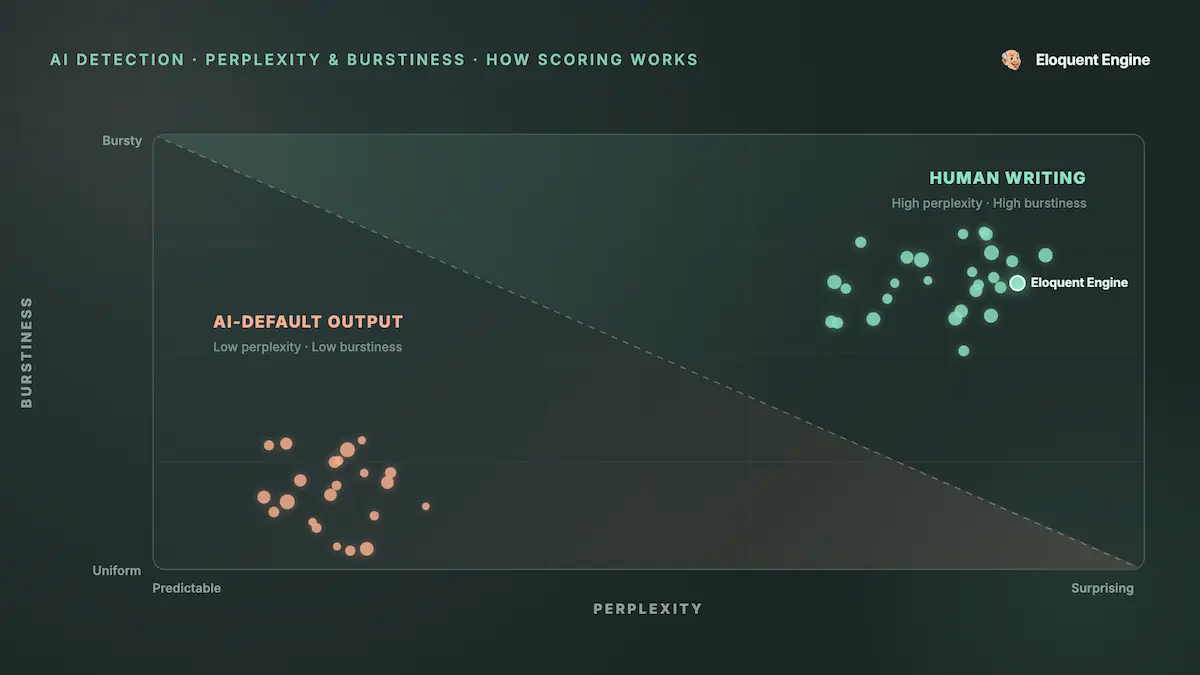
Low perplexity means the text was statistically expected. High perplexity means the text was surprising, word by word, relative to what the model would have predicted.
This is where people underestimate the mechanic.
AI detectors don’t check whether a chatbot could have written your text. They score how closely your word choices follow the highest-probability paths through the language distribution. When a model like Claude or GPT generates output, it selects each next token by leaning toward the center of the probability distribution. The result is smooth. Fluent. Correct. And deeply predictable to any classifier trained to recognize exactly that pattern.
The gap between human writing and AI writing is significant
Human writers make unexpected word choices constantly. They’re drawing from memory, opinion, specific context, and personal syntax habits. A detection classifier scoring your text against a reference model will find that most of those human choices land at lower probabilities than the AI-generated alternatives would have. That variance is what keeps the perplexity score elevated.
Human-written text is harder to predict. Generative AI text, by design, mostly isn’t.
This is why the active practitioner debate around Perplexity AI, the research tool, points toward something real about AI writing in general. Users consistently report using Perplexity for research and switching to Claude or Gemini for actual content production. The emerging consensus that model choice is the primary variable for writing quality reflects an intuition that’s mostly correct: different models sit at different points on the predictability curve.
But the underlying linguistic problem travels with all of them. Switching from the latest GPT model to Claude Sonnet 5 doesn’t change the fact that both models default to low-perplexity output unless the prompt explicitly overrides it. The engine changes. The behavior doesn’t.
What passes a detection audit today might still struggle tomorrow, because detection models update quietly and without warning. The perplexity score that cleared Originality.ai last quarter may not clear it next quarter. That’s not a reason to give up on the metric. It’s a reason to understand it at the generation level rather than patching it after the fact.
What about burstiness? Is that just sentence length?
Burstiness does measure sentence-length variance, but the variance distribution is what detection classifiers actually track.
So, yes, burstiness does measure sentence-length variance, but calling it “just sentence length” undersells the mechanism. What detection classifiers actually track is the distribution pattern of that variance across a document.
Human writers don’t distribute short and long sentences evenly. They cluster them. Three short punchy sentences land in a row, then a long subordinate construction pulls the reader through a complex idea, then short again.
The clustering is the signal. Strip that clustering and you’ve stripped the burstiness, even if the average sentence length stays the same.
Deep Research mode in Perplexity AI illustrates this problem from the other direction. It produces structured, thorough output. But structured and thorough tends to mean uniform. Each analytical point gets roughly the same sentence weight. Each section develops at roughly the same cadence. That’s low burstiness variance, and it’s detectable regardless of the underlying model generating it.
Claude Sonnet inside Perplexity has the same metronomic rhythm problem as GPT inside Perplexity, because the problem lives in how the output is structured, not which model generated it.
To be fair: document-level detection is still a genuinely hard problem, and burstiness is easier to pass at the sentence level than at the document level. A paragraph can be made bursty with mechanical editing. A 2,000-word piece is harder to save because the rhythm failure is cumulative. It reads as flat over time in a way that’s hard to reverse without reconstructing large sections. The right move is building burstiness variation deliberately into the generation prompt, not chasing it in revision.
So detectors just score both signals and combine them?
Essentially, yes. Classifiers score perplexity, score burstiness variance, combine those with other signals, vocabulary distribution, semantic coherence patterns, structural regularity, and compare the result against trained distributions of human-written and AI-generated text. Content that sits far inside the AI-generated distribution on both dimensions fails. Content that sits ambiguously between distributions often passes.
The creative writing use case confirms this from a different angle.
Practitioners using AI for fiction and roleplay report more variable detection results than those using it for business copy. Fiction prompts tend to produce more unusual word choices and more varied rhythm by nature of the task.
The perplexity score rises. Burstiness variance increases. Detection classifiers struggle more. The content type changes the output’s linguistic profile, not just the style.
Academic writing sits at the opposite end. Formal structure, consistent register, predictable argument progression. Low perplexity, low burstiness, high detection risk.
Deep Research mode doesn’t solve this. It often makes it worse by producing systematically organized output that classifiers find easy to score. One tool cannot own every writing use case. Detectors, whether Originality.ai, GPTZero, or anything else, are measuring real linguistic differences between use cases, not applying a single blanket test.
How do I figure out which signal my content actually failed on?
Some readers will push back here: “I ran my content through the detector, it said AI, that’s all I need to know.” That’s a reasonable instinct. The score is right there. Why dig deeper?
Because the fix is different depending on which signal drove the flag.
Content failing on perplexity needs more unexpected word choices. Specific vocabulary, concrete details, sentences that deviate from the most probable construction.
Content failing on burstiness needs rhythm reconstruction: shorter sentences clustered after longer ones, deliberate breaks in cadence, sections that develop their own tempo before shifting.
Treating both failures with the same edit produces mediocre results on both dimensions.
You can test this by pasting your flagged content into GPTZero or Originality.ai and looking at the sentence-level highlighting, not just the document score. Most tools will surface which sentences triggered the flag.
If the highlighted sentences are all similar in length and structure, burstiness is your primary failure. If the highlighted sentences use smooth, generic vocabulary that could have been written by any model on any topic, perplexity is the primary failure. If both patterns appear, uniform rhythm and forgettable word choices, you’re looking at unedited zero-shot output and the problem starts at the prompt.
Auditing at sentence and paragraph level rather than document level is the only way to build a real diagnosis. Running content through a single detector and calling it safe is how people end up surprised when the same content fails on a different platform. Every detector is trained on different data, so it’s genuinely hard to beat all of them with a single pass. Audit at the most granular level available. The pattern will surface.
What actually changes these metrics instead of just patching them?
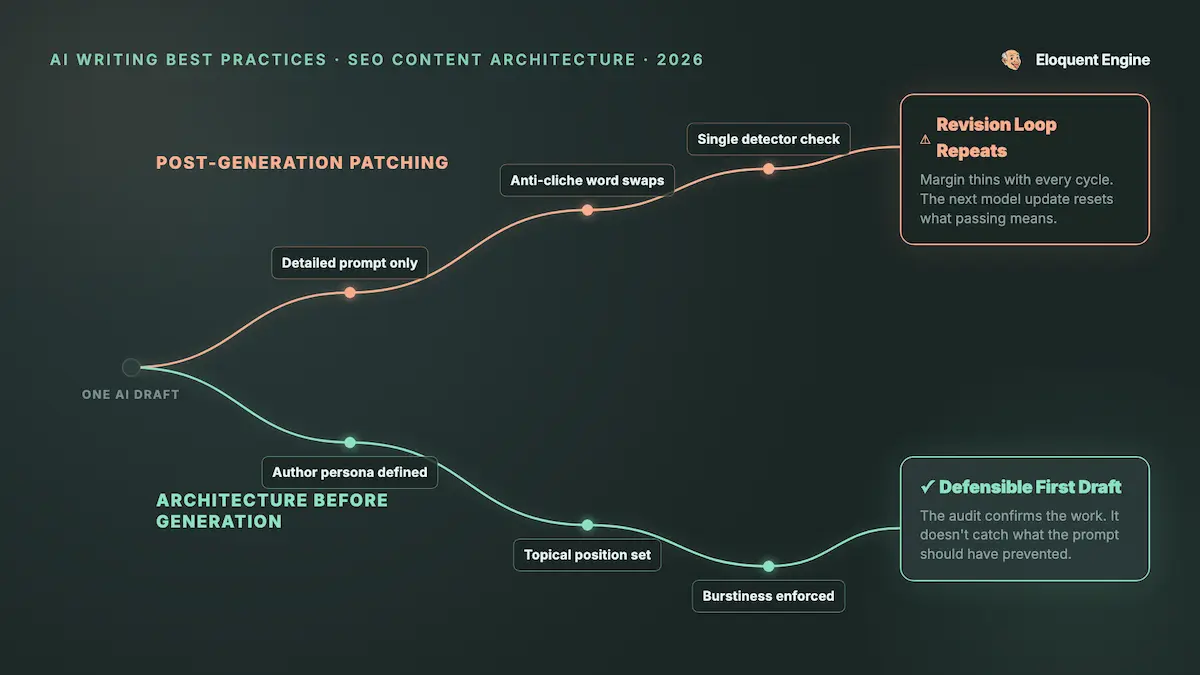
Think of your prompt as a mold. The LLM is liquid. Whatever shape the mold has, the output fills it. A lazy mold, no author voice, no specified rhythm, no documented opinions, produces the same flat shape every time. Every other business using the same zero-shot prompt is pouring liquid into the same mold. The output is identical not because AI is the problem, but because the mold is.
Practitioners on Reddit’s r/perplexity_ai report using Perplexity for research and switching to Claude or Gemini for writing. That’s a reasonable workflow split, but it doesn’t solve the mold problem. Moving the generation step to Claude still produces low-perplexity output if the prompt doesn’t override the default behavior. The tool is only as good as the system built around it. Switching tools without changing the prompt architecture changes nothing that matters to a detection classifier.
What actually moves the needle is prompting the model to behave differently at the sentence level before generation begins, not editing afterward. Specifically:
- Build a brand voice document before any prompt is written. Feed the LLM named opinions, known biases, and documented stylistic preferences for the author persona assigned to the content. An author persona with actual positions produces more specific, less predictable word choices than a generic “write a blog post about X” prompt.
- Specify rhythm explicitly. Instruct the model to vary sentence length with deliberate clustering. Short sentences after long ones. Three-word stops after complex subordinate constructions. Name the pattern you want instead of letting the LLM default to its metronomic average.
- Train the model on the author’s actual vocabulary before generating. Paste in examples of writing you want to replicate. The model will pull from that distribution instead of the generic center. Perplexity scores rise when the word choices reflect a specific person rather than an average output profile.
- Update your prompt templates after major model version releases. What worked against GPT-4o’s default behavior may not work against a subsequent version. Prompt rot is real. The mold degrades if you never revisit it.
A half-baked prompt will flatten anything into something forgettable. The research-to-output gap that practitioners keep describing, gathering information in one tool, then generating copy in another, persists not because the tools are wrong but because neither step includes prompt architecture that controls for detection metrics. The gap closes when the generation prompt carries a real author persona with documented opinions and explicit rhythm instructions. Not before.
One check to run before you publish
Most people still underestimate how much diagnostic information a sentence-level detection audit actually gives you. Run your draft through GPTZero or Originality.ai. Look at the highlighted sentences. Note whether the pattern is rhythm-based (similar lengths clustering together) or vocabulary-based (smooth, generic phrasing). That single observation tells you whether to fix the mold or fix the word choices. And those are different problems with different solutions.
Document-level detection is still not fully solved. What passes today might not pass tomorrow. But the sentence-level pattern almost always reveals a correctable failure. Most flagged content fails on something specific. Once you can see the specific thing, you can address it upstream instead of patching it with a humanizer tool that doesn’t touch the root cause. That’s the framework. Diagnosis first, then the fix that matches the diagnosis.