The output is the last place to look for the problem
The output came back flat. You spent an hour editing it into something usable. You published it, watched it sit there, and quietly wondered whether the tool was worth the subscription.
That specific feeling – the dull weight of editing content you did not write, into a shape you cannot quite name, toward a result that keeps moving – is not a prompt problem. You have tried better prompts. The output is still interchangeable with every other article on the same topic. It still sounds like every other SaaS blog.
The problem is earlier. Before the prompt opens, before the tool is chosen, before a single brief is written, a set of decisions should already exist. Which topics your brand has the authority to cover. How those topics connect. What expertise lives in your brand that no generator can invent.
When those decisions are missing, the generator fills the gap with the statistical average of everything it has trained on. A prompt library is not a content strategy. Strategy comes before generation, or the generation produces nothing worth keeping.
What does “ai content strategy” actually mean, and what it isn’t
The consensus has settled into a comfortable framing: AI is best used to speed up the boring parts. Research, outlines, first drafts, repurposing. Humans own the creative work. AI handles the mechanical work. This framing is mostly right, and it’s the reason most AI content implementations still fail.
What it misses is that the boring parts were never where the content value came from. Speed without direction produces detectable output faster – a pyrrhic win. A first draft without a brand context document is a blank prompt with extra steps. The question practitioners should be asking is not “how do I use AI to go faster?” The question is “what architecture does the generator execute against when it writes?”
Agencies have started answering this through tool stacks: ChatGPT for drafts, Perplexity for research, Surfer or Semrush for SEO structure. This is smarter than a single platform. It is not a strategy. The tools are different but the missing layer is the same: a coherent content architecture that exists before any tool opens.
AI content strategy is that architecture. Which topic domains your brand has the credibility to own. How those domains connect semantically. What your brand knows that a generator cannot invent. These are strategic decisions. A brand voice dropdown in a tool interface is a generation feature. The two are not the same problem.
On the question of where content gets found: users asking ChatGPT instead of Google has shifted the conversation about whether SEO still matters. SaaStr’s search impressions grew 5x in twelve months despite the same predictions of Google’s irrelevance. The channel question is real. The underlying question stays constant: does this content deserve to exist? Generic output fails in search results and in AI-generated answers for the same reason. Neither surface rewards hollow content.
If your output needs to be humanized before it publishes, the system was broken before the first word. Post-processors are selling a second product to fix the first product’s failure. Post-processors are selling a second product to fix the first product’s failure.
What gets decided before the prompt, and how I got this wrong for longer than I should have
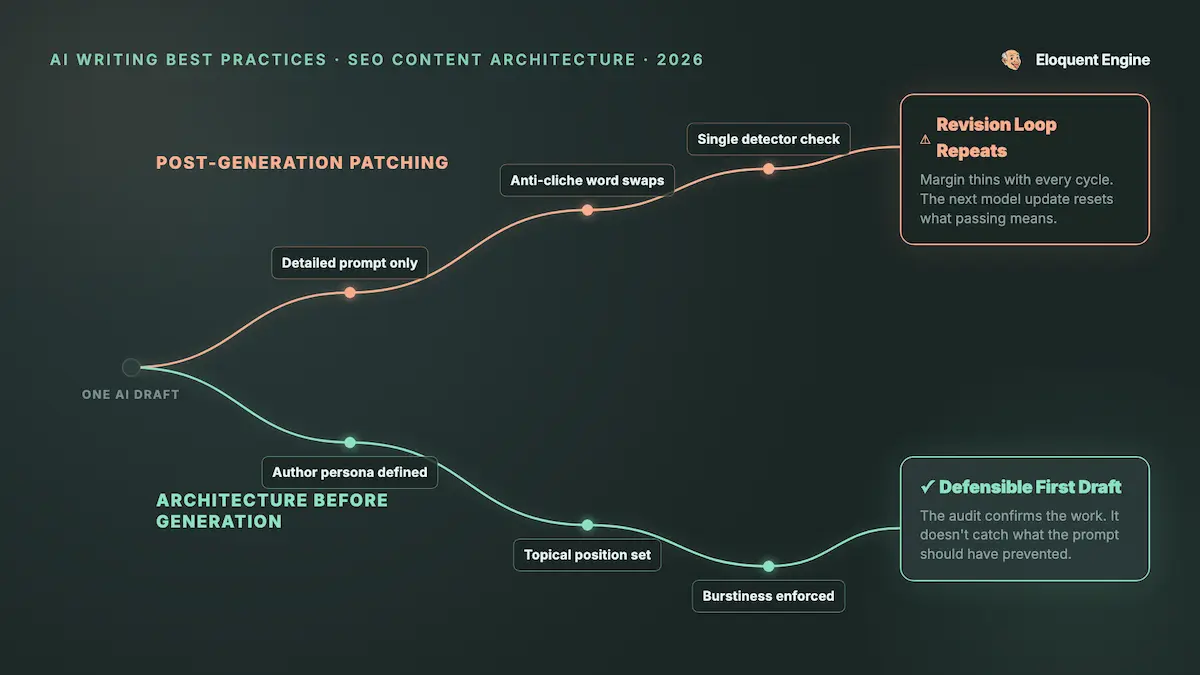
Honestly, I assumed for too long that prompt quality was the primary lever. I built prompt libraries. I refined templates. I watched detection scores come back at 90 percent and had no explanation for the client – because at the time, I was editing the output instead of fixing the input. The generation looked like the problem. In hindsight, the generation was just where the problem became visible.
Here is the question that eventually reorganized how I think about this:
“What does the AI know about your brand before it writes?”
“Whatever is in the prompt.”
“And what was in the prompt?”
“The topic and the word count.”
That exchange – I have had some version of it with almost every practitioner who comes to me frustrated with their output. The generator produced vanilla content because vanilla context is all it received. The prompt was the full extent of the brand intelligence encoded into the system. Which means the output could only be as differentiated as that prompt.
Content architecture changes what that prompt carries. A brand context document – built before any generation begins, containing actual examples from founder communications, customer language, competitor positioning, and the specific problems your audience brings to your content – encodes real intelligence into the brief. The generator executes against your perspective instead of inventing one.
In practice, content architecture involves decisions in three areas before a prompt is written:
- Topical scope: Which domains your brand will cover, how deeply, and what the connective logic is between them. This is the map the generator navigates.
- Entity and depth targets: What concepts, named entities, and subtopics each cluster needs to cover to demonstrate genuine authority on that subject. Running topical gap analysis against competing content before assigning articles is how you identify depth gaps, not just keyword gaps.
- Brand intelligence layer: The documented voice, perspective, and expertise claims that make your content structurally distinct from a blank prompt. Validating content briefs against E-E-A-T criteria before handing to generation is probably the step most teams skip. It is also probably where the most output quality is lost.
SaaStr’s shift to a 3-person team running 20 AI agents is instructive here – not because of the headcount math, but because the AI execution happened inside a content system with existing topical authority, brand identity, and editorial standards. The architecture preceded the automation. You could run the same AI agents against a site with no content architecture and produce nothing of equivalent value. The AI did not create the system. The system made the AI useful.
The question that reorganizes AI content work: what should the tool know before it writes? Answer that, and the prompt becomes execution. Skip it, and the prompt becomes the strategy. The content is only ever as good as the context you fed the model.
Topical authority is not optional infrastructure
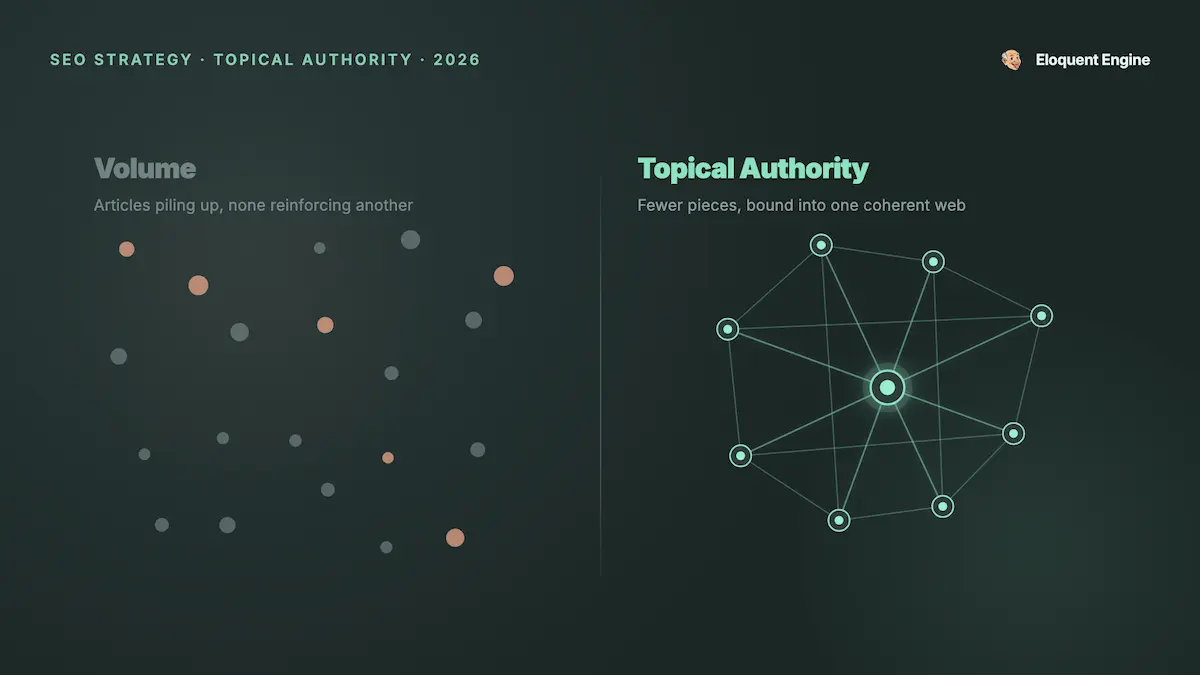
Publishing content without topical architecture produces a specific kind of failure. Not a dramatic drop in traffic. A slow accumulation of pages that Google indexes and ignores. Thin coverage across too many topics. No cluster depth behind any pillar. Pages that technically exist and functionally do not.
Topical authority is built through coverage depth, not publishing volume. A content cluster with a coherent pillar page, supporting articles that extend the pillar’s argument, solid internal linking, and entity coverage across the domain signals something specific to search: this brand knows this subject. Publishing 200 loosely related articles broadcasts diffusion instead of depth.
G2’s CMO has documented how B2B buying behavior has shifted as AI enters the research process. Buyers now encounter AI-generated summaries before they reach branded content. The brands that appear in those summaries are the ones that have established demonstrable authority on a subject – through depth, specificity, and genuine expertise. Volume-based AI content strategies were already weak. They are now structurally misaligned with how buyers actually research.
The authenticity move practitioners are making – toward personal stories, niche positioning, content that AI cannot mimic – is a real signal. It is practitioners discovering through failure what content architecture would have told them upfront: the brands that build topical depth around specific expertise outperform the brands that flood a topic with thin articles.
Measuring AI content strategy by content produced per dollar is the wrong metric. The right measurement is whether the content builds authority that compounds. Agencies billing for AI content at scale without topical architecture are billing for technical debt their clients will pay in rankings.
Generic output at volume poisons the index. Topical depth at measured scale builds something.
Diagnosing your actual problem: tool or strategy?
I used to think the diagnosis was obvious once you knew what to look for. Honestly, it is less clean than I initially let on. Tool constraints are real. Some generators are genuinely weak for specific use cases, and strategy cannot fully compensate for a model that cannot handle your domain’s technical language or your audience’s specificity. I overcorrected early toward “it is always a strategy problem.” In practice, it is usually both, and the question is which to fix first.
The publishing industry went through a version of this in the early CMS era. Every team suddenly had the technical capacity to publish anything, instantly, at any volume. The teams that thrived built editorial systems. The teams that collapsed mistook publishing capacity for publishing strategy. The constraint was never the tool. It rarely is now.
Generic input encodes generic output. Only strategy changes this equation without changing the tool.
A working diagnostic – probably not perfect, but useful:
- Strategy problem: Your output is technically coherent but interchangeable. Detection scores are high on Originality.ai. Different prompts produce similar-feeling content. You have no brand context document. Your content does not cluster around pillar pages. You publish across many topics without depth in any.
- Tool problem: Your output consistently fails on domain-specific terminology, loses coherence in longer formats, or cannot hold a consistent point of view even when the brief is detailed. A different generator produces noticeably better output for your specific use case when given the same brief.
- Both: The output is interchangeable AND technically broken. Fix the strategy layer first. A better tool without architecture still produces hollow content faster. Comparing tools honestly only makes sense once the architecture exists to test against.
Practitioners running distributed tool stacks are often solving a tool problem while a strategy problem sits underneath it. The stack gets more sophisticated. The content stays thin. The AI detection scores do not improve because the generation input did not change.
Start here: a framework you can sketch in an hour
The tools do have real limits. Acknowledging that matters. And strategy is still a separate lever – one that changes what any tool produces without requiring you to switch tools.
Here is where to start. Take a blank document. Write down three topic domains your brand has genuine expertise in. For each one, list five questions your actual clients or audience have asked you in the last six months. Those questions are the skeleton of a content cluster. The answers your brand gives, drawn from real experience, are the brand intelligence layer.
That document – rough as it is – already changes what you put into a brief. You stop prompting from nothing. You start encoding something real.
From there: cluster the questions under each domain. Identify which question is the broadest entry point. That is your pillar. The others are spokes. Build a content brief for each spoke that references the pillar explicitly, carries the brand’s specific position, and specifies the entities and subtopics that need to appear.
Run that brief through your current tool. Compare the output to what a blank prompt produces on the same topic. The gap you see is the value of the architecture you just built.
Strategy before generation. That is the whole framework. If you are running this as a business owner without a content team, that one document is where the system starts. If you are an independent marketer explaining your process to clients, it is also the answer to “how is your AI content different from cheap bulk output.” The architecture is the answer. Build that first.