Your AI Content Sounds Generic Because Your Voice Was Never Defined as a System
You get the feeling that your content is super generic. You read back the AI output and something is hollow. The sentences hold. The argument tracks. The content is technically correct. But it reads like it could have come from anyone, published on any site, about any product that does roughly what yours does.
Most people flag that feeling and move on. They run it through Quillbot. They tweak a few phrases. They tell themselves this is just how AI works, that the tool has limits, that maybe a better prompt would fix it next time.
That hollow quality signals a broken system: no brand voice was encoded upstream. The AI generated content with no voice architecture upstream. No brand context, no documented patterns, nothing to encode your specific way of writing before the first word appeared. So it defaulted. It averaged. It produced the most statistically common version of content about your topic, and that is exactly what it is supposed to do when no one gave it a reason to do otherwise.
A prompt library without voice architecture is not a content strategy. Personality adjectives in a style guide do not constitute a voice architecture. If your output needs to be humanized after generation, the system was wrong before the first word. This is a design problem, not an editing problem. And the only way to fix a design problem is to understand what was missing from the design.
What was missing is brand voice. Not as a feeling or a trait list, but as a system of specific, repeatable choices that a model can be trained against. That is what this piece explains.
What is brand voice, and why does the standard definition not get you there?
The consensus answer, honestly, is not wrong. Brand voice humanizes your business. It makes sure everyone writing for you is talking the same language. It sets you apart and builds trust. Experienced practitioners on r/copywriting and r/marketing will tell you to immerse yourself in the brand’s mission, create a persona with specific attributes, define three to five key traits that align with your positioning.
I believed this framework for longer than I should have. At the time, it seemed sufficient. You define the traits, you share them with the team, consistency follows. Then I watched a detection score come back at ninety percent AI on a piece where the prompt had included the voice guidelines. Bold, curious, direct. All three traits in the brief. The output was still detectable. Still flat. Still interchangeable with every other SaaS blog in the index.
That is when I realized the trait framework answers the wrong question. “What does your brand sound like?” is a different question from “What choices does your brand make at the word and sentence level, consistently, across every piece?” The first produces adjectives. The second produces a map.
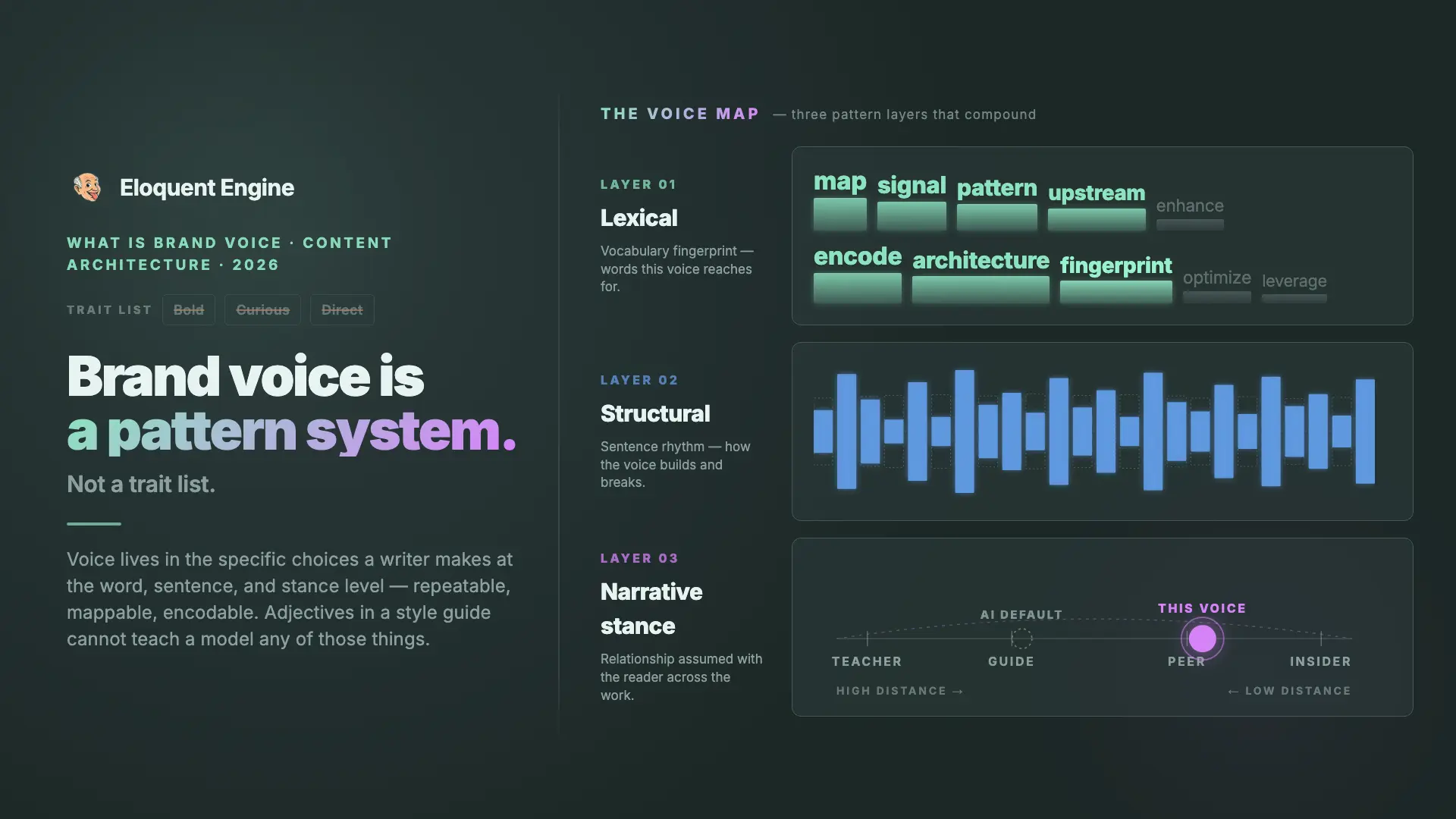
Brand voice is a pattern system. Specifically, it is a set of repeatable decisions operating at three levels simultaneously. The words you reach for, the way you build and break sentences, and the relationship your writing assumes with the reader. Those decisions compound. Enough of them, applied consistently, produce something recognizable. Something a reader could identify without a byline.
The practitioners arguing that brand voice primarily serves internal alignment are not wrong. It does. But that framing undersells what is actually happening when voice works. Readers trust content that sounds like a specific person thought it through, not like a committee averaged it. Algorithms surface content with coherent entity signals and semantic density, not content that reads like every other page in the cluster. The real stakes are trust and authority, not just internal consistency. And you cannot get there with a trait list alone.
What you need is a brand context document: voice illustrated by real examples from founder communications and customer language, not described through adjectives. The difference between “we write with curiosity” and three annotated paragraphs showing what curiosity looks like in your sentence construction. That is the difference between a feeling and a system.
The three pattern elements that make voice visible in any piece of content
Here is where I probably overcorrected, in hindsight. I kept editing AI output instead of fixing the input. I built a whole prompt library and still got flagged. The prompts described voice. They did not map it. And the model, with no map to work from, kept churning out the same vanilla output.
What I missed was that voice is already visible in existing content, yours, a competitor’s, anyone’s, if you know what to look for. Three elements. Not a comprehensive audit, not a full brand voice document. Three things you can see right now.
Lexical choices: the words that keep reappearing
Every writer has a vocabulary fingerprint. When two words mean the same thing, one of them gets chosen more often. “Start” versus “begin.” “Show” versus “demonstrate.” “Build” versus “construct.” Individually, those choices feel arbitrary. Across fifty pieces, they are a signal.
There are also vocabulary domains. Some writers borrow consistently from engineering and systems language even when writing about marketing. Words like “architecture,” “encode,” “signal,” “map.” Others pull from cooking, from athletics, from design. That domain bleed is not random. It reflects how the writer actually thinks about their subject. It is one of the most distinctive fingerprints in any voice, and one of the first things a blank prompt strips out.
Structural choices: how sentences and paragraphs move
Sentence rhythm is probably the strongest voice signal most readers feel without being able to name. Some voices build long compound sentences that accumulate force before landing. Some write in short declarative punches. Some mix both deliberately. Some qualify a claim before making it; others assert first, qualify later, or not at all.
Paragraph shape matters too. Where does the main claim land. First sentence, last sentence, or distributed without ever being stated explicitly? How quickly does the writing move to the next point? These structural habits create the reading experience, and they are what AI generation dilutes first. The model moves toward structural averages across its training data. Your structural signature is not average.
The debate about whether voice needs formal documentation or can emerge through immersion has a practical answer here. Immersion might let a single writer reproduce a voice intuitively. A model cannot be immersed. SaaStr’s analysis of prompt portability in AI agents identifies the same structural problem across AI systems: consistency at scale requires explicit encoding, not intuition. Brand voice is no different. The structural patterns must be documented or they will not survive the generation process.
Narrative stance: the relationship the writing assumes with the reader
Every piece of writing carries an assumption about who the reader is and what they already know. Some voices treat the reader as a peer and skip the setup entirely. Some lead carefully through every step. Some create shared ground through “we” even when the writer is clearly one person. The distribution of certainty and uncertainty across a body of content is one of the most recognizable patterns in any experienced writer’s voice, and one of the first things that collapses in generic AI output. Models tend toward false confidence across everything. Real voices are uncertain in specific, documentable places.
These three elements compound. A consistent vocabulary domain plus a recognizable sentence rhythm plus a specific narrative stance produces something readers identify as a voice. Remove any one of them and the recognition fades. Remove all three, which is what running a blank prompt does, and you get content that sounds like every other SaaS blog in the index.
Why does the model keep generating the same kind of output no matter what you ask it?
I think this is where people get stuck. They assume the problem is the prompt. They refine the prompt. They build a prompt library. The output is still detectable, still thin, still interchangeable. The prompt was never the variable that mattered.
AI language models generate text by predicting what token comes next based on patterns in their training data. Without a voice map constraining those predictions, the model moves toward the statistical center. The most common choices across everything it has processed. That center is not anyone’s voice. It is the average of everyone’s voice, which means it belongs to no one.
The chiasmus worth sitting with: you cannot get a specific output from a generic input. A generic input gets you generic output. Specific input, voice mapped at the lexical, structural, and narrative levels, encoded in the content brief before a single instruction is written, gets you something else entirely.
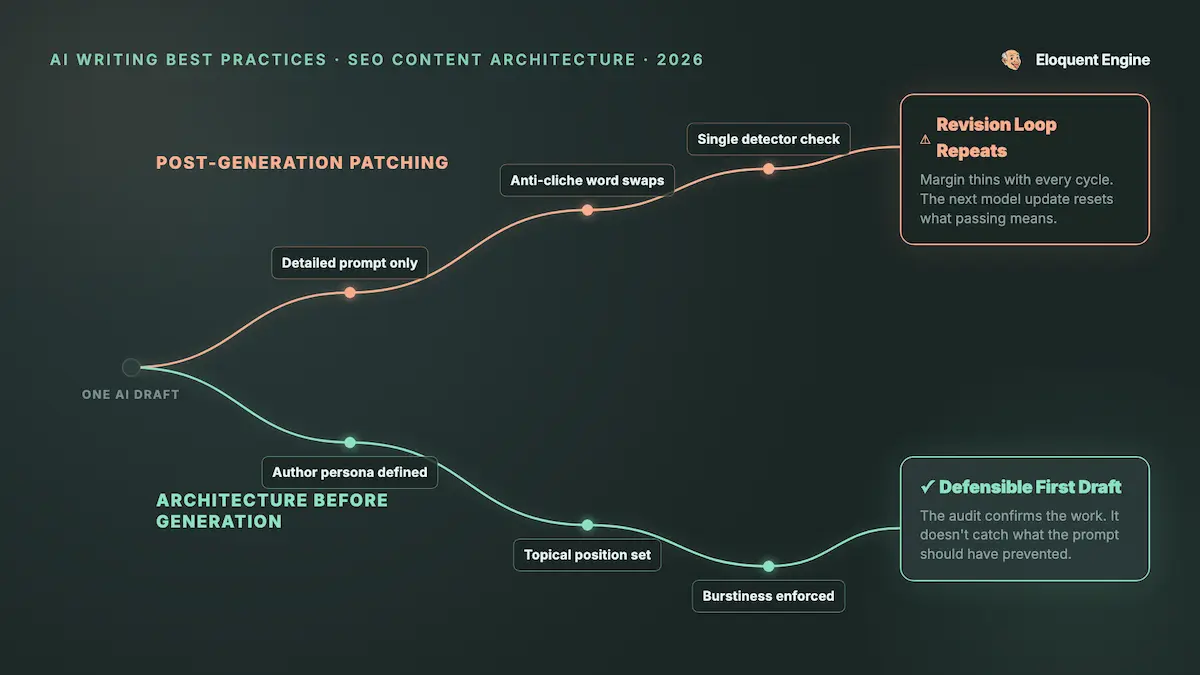
Running the output through a humanizer tool after the fact does not change what happened at generation. Post-processors are selling a second product to fix the first product’s failure. The generation ran without context. No editing pass recovers context that was never there.
Brand voice fidelity starts in the brief, not in the edit pass. The practitioners who argue you can maintain voice through immersion alone, without documented patterns, without a brand context document built from real founder and customer language, are describing a process that works for one human writer who has spent months inside a brand. They are not describing a process that works for an AI system generating at scale.
Here is how to read your own voice in the content you have already published
Pull three pieces of content you wrote yourself. No AI assistance, just your own drafts. Then pull three recent AI-generated pieces on the same topics. Read them against each other.
Most people who do this have the same conversation with themselves:
“The AI version covers all the same points.”
“Right. Which words appear in yours that never appear in the AI’s?”
“I say ‘map’ a lot. And ‘encode.’ The AI says ‘optimize’ and ‘enhance.'”
“That’s your vocabulary domain. What about the sentences?”
“Mine are shorter. And I start a lot of paragraphs with observations before I make a claim. The AI leads with the claim every time.”
That conversation is a voice audit. Those specific observations, vocabulary domain, sentence rhythm, paragraph shape, are the beginning of a brand context document. Not the trait list (“bold, curious, direct”). The actual choices, illustrated by actual examples.
The brands building consistent AI-generated content at scale are not running better prompts. They are feeding the model a document that maps these patterns before any prompt is written. Sophisticated marketing operations build systems first, not assets. Brand voice encoding is the same principle applied to content generation.
You do not need to complete that document before you can see what is missing. Run the diagnostic. If you can name three consistent choices across those six pieces, you have a voice map beginning. If you cannot name them, your voice exists in your writing but has never been articulated. Both outcomes are useful. Both tell you exactly where the work is.
The output will keep defaulting until the input changes
Someone asks me every few weeks whether there is a prompt that finally fixes the generic problem. A template, a formula, a better tool. The question is understandable. It is also the wrong question.
Generic output stems from voice architecture absence, not tool limitations or prompt formulation. Specifically, the absence of one. The AI generated content with no brand context and produced exactly what it should produce under those conditions. Detectable. Hollow. Disposable.
Break that cycle at the input level. Build a brand context document before the model sees a single instruction. Encode your vocabulary domain, your structural habits, your narrative stance. With real examples, not trait adjectives. That document becomes the constraint that pulls generation away from the statistical average and toward something that sounds like you.
A prompt library without voice encoding is not a content strategy. Adjectives in a style guide do not constitute a voice architecture. If you cannot articulate your voice as a pattern system, you cannot teach it to anything. Human writer, new team member, or AI tool. The articulation is the prerequisite. Everything else follows from there.
Start with the six pieces. Name three choices. That is the first sentence of your brand context document.