
Your client runs the latest batch through Originality.ai. The score comes back at 74% AI probability. Every article passed your internal review. A writer touched every one. You used the tool your team built the prompt library around. The output still reads, to a detection algorithm, like it came from a machine running on hollow instructions.
So you look at the tool. Maybe a better one exists. Maybe the prompt templates need rebuilding. Maybe you add a humanizer pass before delivery.
None of that addresses the actual problem.
Detection scores are downstream of a broken input. The system generated content from a blank understanding of what the brand actually is, what it believes, and what it’s earned the right to say. Encoding that context before generation starts is the only variable that changes the output in a way that holds.
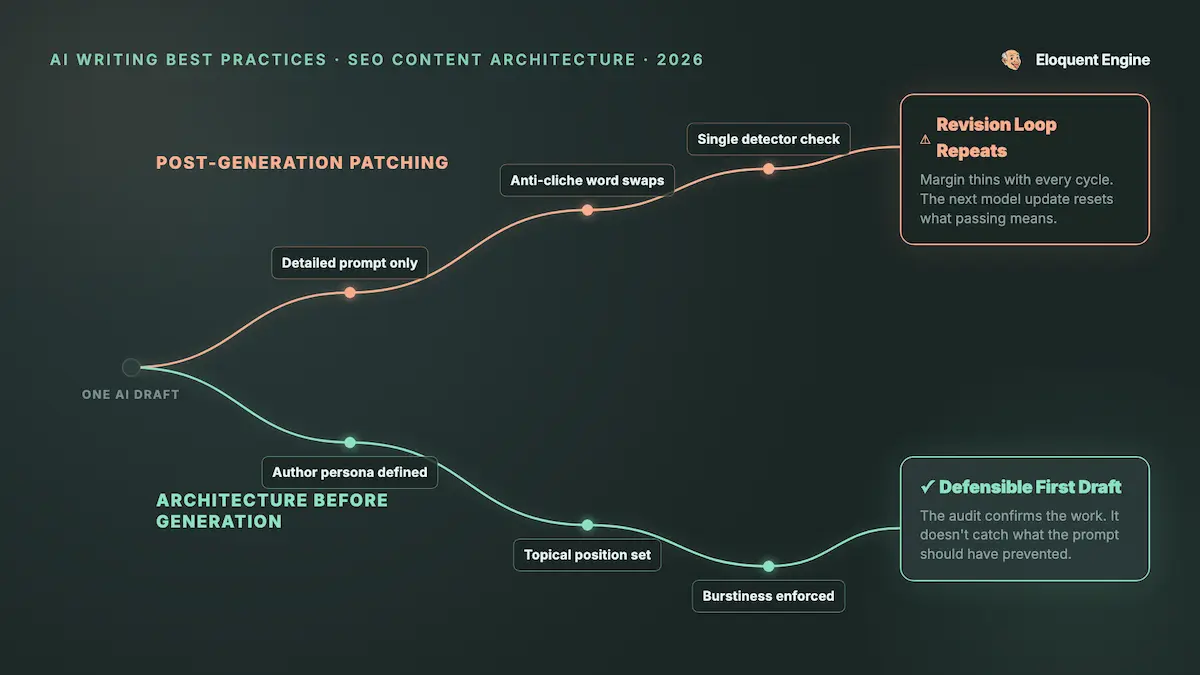
A prompt library executes a content strategy that was never built. Post-processors are selling a second product to fix the first product’s failure. If your output needs to be humanized, the system was wrong before the first word.
The architecture is the problem, not the tool.
We add human review to every piece. Why is that not enough?
Most agencies have settled into a workflow that feels reasonable: ChatGPT or Perplexity for research, a generation tool for drafts, Surfer or Semrush for optimization, and a writer doing cleanup before delivery. That’s the consensus workflow right now. Practitioners defend it with something like “ChatGPT and Perplexity do the job, the rest is overkill.” The logic holds at a surface level. Research speeds up. Drafts appear faster. The human pass catches the obvious errors.
One agency running that workflow produces ten articles a month. Detectable patterns appear, but sporadically, and the human pass catches most of them. Detection risk stays manageable. Topical authority builds slowly, but it builds.
An agency running the same workflow across eight client accounts, with three writers batching content in two-day sprints, produces something different entirely. AI content detection fires on pattern, and generic prompts produce predictable patterns. The same transitions. The same problem-to-solution arc. The same calibrated vocabulary across every client, every category, every batch. The detection fingerprint doesn’t weaken at volume. It compounds. When Originality.ai scores a single article at 60%, that’s borderline. When it scores twelve articles from the same tool and the same prompt library at 60% each, the cluster reads as a structurally sound, demonstrably non-human body of work.
The human review catches hollow phrasing. It does not encode the brand’s actual competitive position, its documented point of view, the vocabulary its audience uses and resists. Those are not editing problems. They are input problems. No amount of cleanup fixes what was never there to begin with.
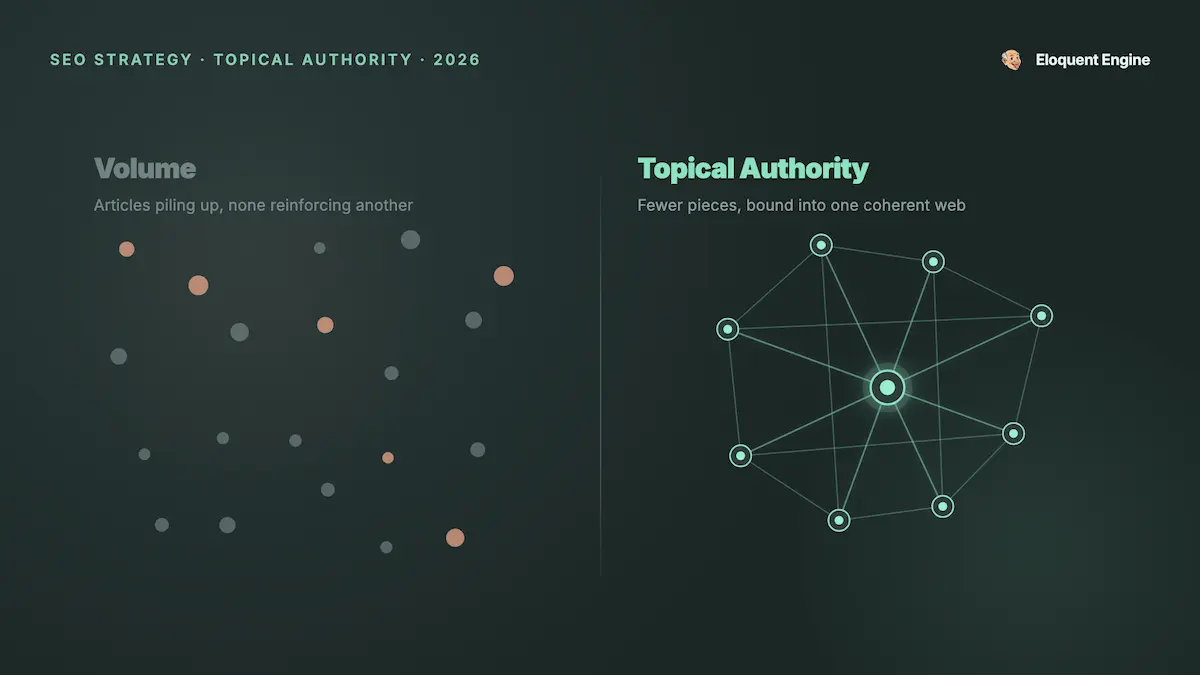
This is the gap between using AI to speed things up and using AI as a brand-encoded generation system. The brands that own search in three years are building content architectures, not publishing blog posts at scale. Topical authority is not built by volume. It is built by coverage depth. And coverage depth requires the system to actually understand each brand before it produces a single sentence on that brand’s behalf.
Three writers, eight clients, two-day sprints, and a generic prompt library…
The technical reason AI writing sounds fake is not that the tool is unsophisticated. It’s that the tool was never given anything specific enough to generate from.
Prompt libraries and humanizer passes are the obvious fixes. What am I missing?
The mainstream view is reasonable: the output sounds off because the prompts aren’t specific enough. So you build better templates. You get more detailed. You add tone instructions, audience descriptions, competitor references. The prompt library grows. The output improves at the margins. Then it gets flagged again.
Here’s where the honest version of this gets uncomfortable. Prompts are instructions for how to write, not knowledge about what to write from. A detailed system prompt telling the model to “write with authority in a conversational tone for a B2B SaaS audience” produces content that behaves that way. It does not produce content that expresses any specific argument, any differentiated perspective, any expertise claim the brand has actually earned. The output is technically correct and intellectually interchangeable with every other B2B SaaS blog running the same category of prompt.
That’s the detectable pattern. Generic output is a system design problem.
The second fix is the humanizer pass. QuillBot. Undetectable.ai. Running the output through a secondary layer that rearranges the statistical fingerprint enough to score lower on GPTZero. This has become a standard step in more agency workflows than anyone publicly admits. What it signals is that the generation tool produced output the team knew was broken, and a second tool was purchased to obscure that fact.
Post-processors are selling a second product to fix the first product’s failure.
The practitioner community is already feeling this, even if the framing is different. The consistent complaint is that “I still rephrase manually for that personal touch,” that whitepapers and gated assets “still need human creativity,” that AI drafts are rough starts rather than finished work. The problem being described is always the same missing thing: the system produced output without a real point of view, so a human had to supply one after the fact. That’s the encoding work happening at the wrong stage, expensively and inconsistently, one article at a time.
A prompt library is a set of instructions for executing a strategy that was never built, not a content strategy.
What would actually solving this upstream look like?
I used to think the prompt was the problem. Honestly, I spent longer than I should have rebuilding templates, tightening tone instructions, adding competitor context fields, testing variations. The output got better. Not enough. At the time, I kept editing the output instead of fixing the input, and I told myself the gap was a generation quality issue when it was a system architecture issue.
The shift happened when I watched a detection score come back at 90% on content I had personally reviewed. The articles were well-structured. The tone was right. They read fine. And they were flagged as almost certainly AI-generated, because the statistical profile of the output matched what happens when a model generates from no particular intellectual position: probable sentences, predictable transitions, vocabulary distributed across the topic without any of the idiosyncratic weight that comes from an author who actually holds a view.
We built a whole prompt library and still got flagged. That was the moment the framing changed.
There are two directions from that point. One direction: accept the gap, add more editing passes, build the humanizer step into the workflow, and treat detection risk as an ongoing cost of doing business. Manage it. Hope the client doesn’t run a test. Prepare the explanation if they do.
The other direction: build the brand context into the system before generation starts, not as a tone instruction but as an intellectual foundation. The difference is specific.
A brand context document, built before any content brief is written, contains what the brand actually knows. The contested arguments in the category and where this brand lands on them. The vocabulary the audience uses in real communications, support channels, community forums, not the vocabulary the marketing team uses in internal briefs. The expertise claim the brand has genuinely earned, the specific experience or track record that makes it credible to speak on particular topics. The gaps in competitor content clusters that this brand could actually own with depth.
When that context is encoded into the brief before the model sees any instructions about format or tone, the output changes in a way that a better prompt cannot replicate. The model generates from a specific intellectual position. The result doesn’t pass detection because it was cleverly formatted. It passes because it doesn’t read like statistically probable content produced from a generic starting point.
Practitioners are already noticing the limitation from the other direction. The consistent observation is that high-value content, guides, whitepapers, gated assets, still requires human involvement that AI can’t replace. The reason is always the same: strategic thinking, specific perspective, real expertise. Those aren’t things a better generation model delivers. They’re inputs. The strategic question is whether those inputs live in the system before generation or in the editor’s brain after the fact.
To be honest, this is harder to implement than it sounds. Especially for an agency managing ten or fifteen clients with writers who are under production pressure. Building a real brand context document takes senior-level time. Using it correctly requires that writers understand why it matters. There’s probably a gap between a well-built system and a system that junior staff use well under deadline.
But Google’s current position on AI content isn’t about detection. It’s about E-E-A-T signals: experience, expertise, authoritativeness, trust. Those signals come from specificity of perspective, not from passing a statistical test. Encoding brand context solves the detection problem as a side effect of solving the content quality problem. That’s the direction worth building toward.
How do you evaluate ai content writing for marketing agencies on criteria that actually matter?
Most tool evaluations compare pricing tiers, feature lists, and output samples. Those things tell you almost nothing about whether the tool will produce content that survives client scrutiny six months from now. The comparison that matters is architectural: what does each approach actually know about the brand before generation starts?
I won’t even get into the fact that Jasper and Copy.ai both claim “brand voice” as a core feature while that feature amounts to a tone preference field and a few saved vocabulary examples. Let’s just look at the actual questions.
| Evaluation question | Weak answer | Strong answer |
|---|---|---|
| What does the system know about each brand before generation? | System prompt with tone instructions and keyword targets | Brand context document encoding competitive position, audience vocabulary, and expertise claims |
| How is brand context maintained across multiple writers? | Shared prompt library in a doc; writers adapt as needed | Encoded at the brief level before writers touch it; not dependent on individual interpretation |
| Where does detection risk get addressed? | Post-processing humanizer pass, or “our output is hard to detect” | At the generation input: context specificity reduces generic patterns before the first word is written |
| How does the approach handle multiple clients with distinct voices? | Separate prompt templates per client, maintained manually | Client-specific context documents that encode competitive position, not just tone preferences |
| What does topical authority look like in the output? | Keyword targeting and content volume | Entity coverage mapped to pillar pages, with depth prioritized over volume across content clusters |
The tension the industry keeps circling is real: practitioners use ChatGPT for drafts and Perplexity for research because specialized AI writing platforms haven’t demonstrated they produce meaningfully better output for agency use cases. Jasper and Copy.ai are good for brainstorming, quick variations, overcoming the blank page. Not for final output. That’s the consensus. It validates the skepticism about volume-optimized tools rather than undermining it.
What the skepticism misses is that the problem isn’t which generation tool you use. It’s whether any tool in your stack actually encodes brand intelligence before generation runs. Most don’t. An honest comparison of what different AI writing tools actually do at the generation input layer, not the feature list layer, shows the gap clearly.
Before scaling any new prompt template across client accounts, benchmark detection scores on a sample first. Run ten articles through both Originality.ai and GPTZero. Those tools are inconsistent and noisy, yes. They’re also the tools your clients are running. What you’re measuring is client-facing risk, not ground truth. The benchmark tells you whether you’re managing a known problem or inheriting a surprise.
If you’re evaluating alternatives to Jasper specifically because the brand voice features haven’t held up at scale, the right question to ask any replacement isn’t “does it produce better output.” The right question is: what does it know about each client brand before the brief is written, and how does that knowledge get into the generation process.
What does this mean for an agency with real headcount and client constraints?
An agency with twelve active clients and four writers has two production realities. In the first one, the team generates content from generic prompts, runs a humanizer pass, ships, and hopes. Detection incidents happen every few months. Each one costs two weeks of client management and some amount of permanent trust damage. The workflow is fast. The risk is unpredictable.
In the second one, the agency builds brand context documents for each client during onboarding. Senior time goes in upfront. Generation runs from that context. Detection scores drop not because the tool changed but because the output stopped being generic. The workflow takes longer to set up. The risk is controlled.
Neither path is free. The question is which cost you’d rather pay.
For agencies under ten people managing more than eight clients, the honest answer is that full brand context encoding for every account isn’t achievable immediately. Start with the highest-risk accounts. The clients who run their own detection tests. The clients in competitive categories where vanilla output is obviously thin. Build the context document for those accounts first, benchmark the detection scores before and after, and build the process from there.
The conversation in B2B marketing has shifted from “can we use AI” to “does AI actually impact pipeline and trust.” That shift matters for agencies because clients are asking the same question about their content. The answer to that question comes from brand-encoded output that demonstrates real expertise, not from detection scores alone.
If the capacity to build this in-house doesn’t currently exist, the practical alternative is a purpose-built system that handles the encoding layer so your team doesn’t have to do it manually for every client. The approach we built for agencies is designed around exactly that problem. If you want to see what brand encoding looks like at the system level rather than the prompt level, that’s where to look.
So where does this actually land?
Honestly, I think there’s a version of this argument that sounds like: build the perfect system and everything works. I’ve watched teams build what should have been the perfect system and still produce detectable content because the juniors were using it wrong, or the context documents were out of date, or the process broke down under deadline pressure.
The real conclusion is that most agencies haven’t yet asked the question the architecture answer requires: what does this system actually know about the brand? Brand encoding doesn’t solve everything, but it solves what matters.
The counterargument is real. You’ve been managing this with editing passes and it’s been fine. Clients haven’t complained. Production is faster than it was. Why rebuild what’s working?
Because at some point, a client runs the test. And when they do, “we always add a human pass” is not an explanation. The detection score is the explanation. What you missed was never the edit. It was the input. I kept editing the output instead of fixing the input for longer than I want to admit. Probably most agencies have. The question is when to stop.
That’s probably the real diagnostic: not “is our tool good enough” but “what did our system know about this brand before we generated a single word.” Answer that honestly. The path forward clarifies itself.