The detection failure you had was not a skill issue
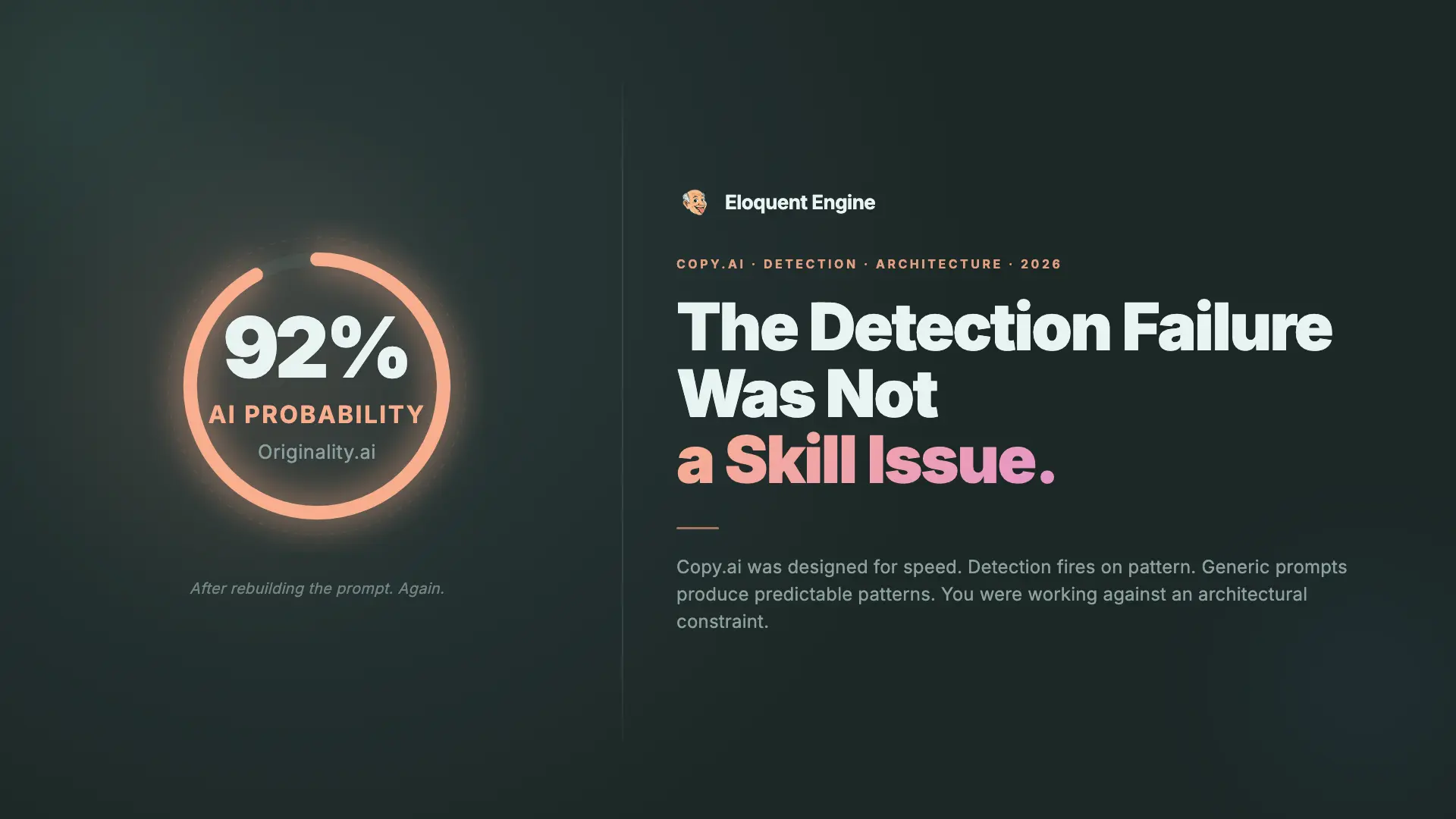
You ran the content through Originality.ai. The score came back at 85, 90, 92 percent AI. You rebuilt the prompt. You added tone instructions, audience parameters, a brand voice note at the top. You ran it again. Still flagged. At some point the conclusion started forming: you were probably just bad at this.
That feeling is legitimate. And the cause is specific. Copy.ai was architected for speed and low-friction output. AI content detection fires on pattern, and generic prompts produce predictable patterns. What you experienced was the tool performing exactly as designed. The mismatch was between what you needed and what the system was built to deliver.
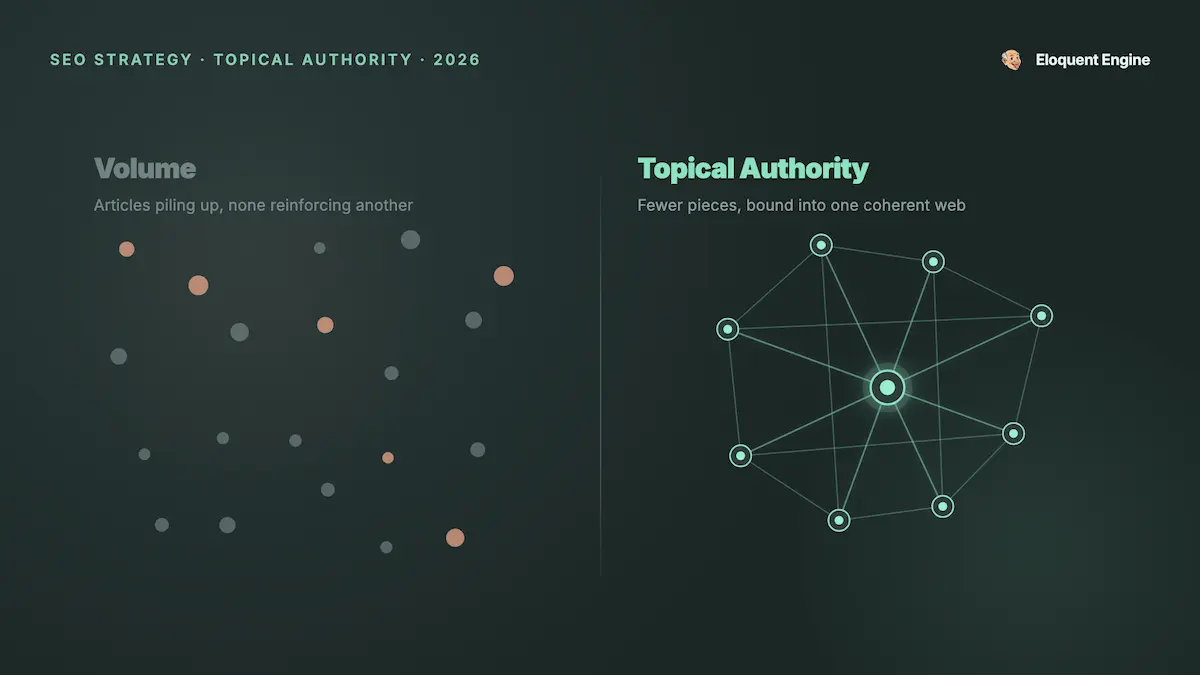
If you feel like something is structurally broken in that workflow, you should. Every prompt you refined was working against an architectural constraint built into the system. The brands that own search in three years are building content architectures, not publishing blog posts at scale. Topical authority builds through coverage depth, not output volume. The detection problem is where that bigger issue first becomes visible.
Wait, what is Originality.ai actually measuring? Because I assumed it was simpler than this
I assumed, for longer than I should admit, that detection tools were scanning for something like a watermark. Some embedded AI signature in the output. Missing that distinction is probably why so many people rebuild prompts for months and wonder why nothing improves.
Originality.ai and GPTZero measure two statistical patterns. The first is perplexity: how predictable the word choices are. Human writers reach for unexpected phrasing; they break expected sentence patterns; they make choices a probability model would rank low. AI systems trained to complete sequences fluidly generate the most probable continuation at each step. The output reads smoothly because it is statistically smooth. That smoothness is the signal.
The second is burstiness: variation in sentence length and rhythm. Human writing is irregular in ways that feel natural. A long compound sentence, then a short one, then a fragment, then two medium ones. AI output clusters. Sentence lengths converge. The rhythm stays even. Detection tools clock that evenness as a pattern. For a deeper look at why AI writing produces these patterns at the generation level, the technical explanation goes further than most people expect.
The more you edit AI output to read smoothly, the worse the detection scores can get. I kept editing the output instead of fixing the input. Meanwhile, the whole conversation in practitioner forums was a feature comparison. Jasper versus WriteSonic versus Copy.ai, side by side, evaluated on templates and pricing tiers and unlimited-usage claims. The actual variable, what the model optimizes for during generation, was not in any of those threads. That pattern remains true today.
Copy.ai’s detection problem runs deeper than the prompt, and that matters before you look for a copy.ai alternative
The debate about whether specialized AI writing tools justify their cost over ChatGPT plus Grammarly is real. Practitioners are having it openly. Some are winning that argument. But the argument almost always stays at the wrong level: speed, cost, format-specific outputs, how many words per dollar.
The question nobody asks in those threads is what the system optimizes for during generation. That is where Copy.ai’s detectable output originates.
What prompt-responsive generation actually means
Copy.ai’s architecture is prompt-responsive. You submit instructions. The system generates against them. Brand context, tone parameters, and voice guidelines function as instructions the model tries to follow. The generation engine itself runs the same way regardless of what context you provide. It produces the most statistically probable continuation of each sequence, constrained by your prompt. That optimization target is speed and coherence, not perplexity variation. The output arrives fast. The detection score reflects how it was built.
Consider what running content through a humanizer tool signals. Post-processors are selling a second product to fix the first product’s failure. Output that requires humanization reveals the generation process was flawed from the start. The humanizer pass does not change the underlying generation process. It surfaces the signal, masks it imperfectly, and adds a step that erases the time savings the original tool was supposed to deliver.
The prompt library problem
A prompt library does not change what the model optimizes for. It changes the instructions. A well-constructed prompt inside Copy.ai produces better-structured output with closer tonal alignment. It does not change perplexity or burstiness scores in any durable way, because those scores reflect the generation mechanism, not the content of the instructions. Building a prompt library as a substitute for brand voice documentation is how detectable output scales. You end up with more of it, faster, flagged just as reliably.
The cheap-alternative arms race misses this entirely. Price is a legitimate evaluation dimension. Detection safety is a different one. They do not trade off against each other directly, and collapsing them into a single “value” comparison is how practitioners end up rebuilding workflows six months later. Read about how AI content detection actually works before evaluating any tool’s claims about it.
If the problem is architectural, what would a different architecture actually look like?
I used to think the difference between tools was mostly UX – that the same underlying models produced roughly equivalent output and the wrappers around them were what differentiated the experience. I missed this distinction for longer than I want to say.
The distinction that probably matters most is whether a system encodes brand context before generation begins or applies it after a prompt is received. These are mechanistically different things. Copy.ai is specifically good for marketing texts, ads, and short-form campaigns, and practitioners generally agree on that. The format-specific strength reflects the architecture: short, fast, prompt-responsive generation for defined output types. That works well until the use case becomes client-facing long-form content that needs to pass detection natively.
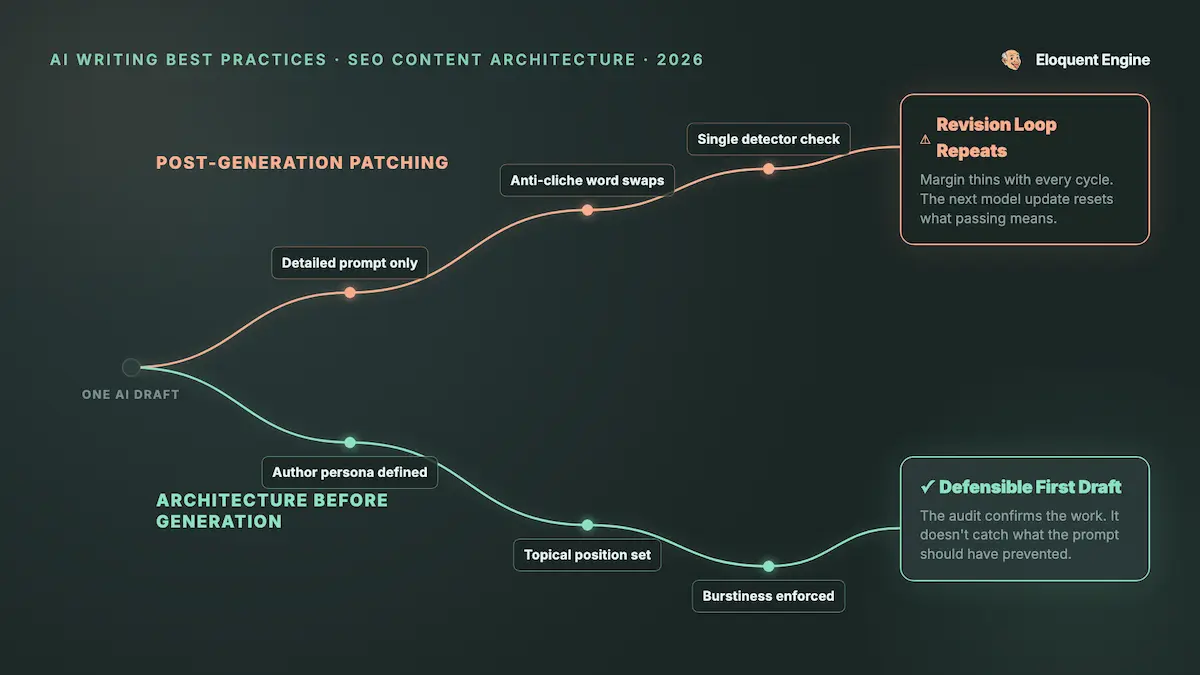
A brand-context-first architecture builds a representation of voice, audience, and style as constraints that shape the generation process before the first word is produced. Brand characteristics are not instructions layered on top of standard generation. They are part of the statistical context that determines word choice at every step. That changes the perplexity profile of the output in a way that prompt instructions alone cannot replicate.
I think I overcorrected when I first understood this, assuming the architecture gap explained every detection failure. Probably not. Implementation matters too. Running AI generation with no brand context document, using a single generic prompt across all clients regardless of vertical, publishing at volume without topical coherence. Those anti-patterns produce detectable output in any system. The architecture sets the ceiling. The implementation determines where you sit under it.
The ChatGPT plus Grammarly argument gets at this indirectly. ChatGPT with a well-constructed, brand-encoded prompt will outperform Copy.ai with a blank prompt on detection scores. The tool matters less than the context fed into it. A purpose-built system that encodes brand intelligence structurally takes that principle and removes the dependency on the practitioner doing it right every time. Agencies working at scale for clients need content systems that hold brand context at the architecture level, not at the prompt level.
Before you commit to any copy.ai alternative, ask these five questions
The fear underneath most alternative searches is reasonable. You burned time on Copy.ai. You built a prompt library and still got flagged. You watched the detection score come back at 90 percent and had no explanation for the client. Switching to another tool and hitting the same ceiling would be worse than staying put. That fear should inform how you evaluate any new system, not paralyze the evaluation.
Most tool comparisons stop at features, pricing, and format support. Those criteria will not tell you whether a different architecture will change your detection outcomes. These five questions will.
- Does brand context enter the system before generation begins, or after? Ask the vendor to describe, specifically, when and how brand voice parameters affect the generation process. “We support brand voice” is not an answer. “Brand voice is encoded into the generation context before the model produces output” is. If they cannot explain the mechanism, assume it is prompt-level styling.
- Does the output change detectably when brand context changes? Run the same brief through the system with two different brand profiles. If the output is substantively similar in both cases, the system is not encoding brand context as a generation constraint. Test this in any trial before committing.
- What are the baseline detection scores on a fresh sample, with no editing? Benchmark detection scores before scaling any new prompt template. Run five pieces of unedited output through Originality.ai and GPTZero. Consistent scores above 70 percent AI probability across that sample are a generation signature problem, not a prompting problem.
- Does the system treat detection safety as a first-order constraint or a downstream feature? Ask directly. Some tools have added “humanization” features as post-processing layers. Those are evidence that the generation layer was designed around a different constraint. Post-processing does not fix generation architecture.
- What does the tool optimize for in its training? Speed and volume optimization produces low-perplexity output. Detection safety as a first-order constraint requires the opposite trade-off. No tool optimizes equally for both. Understanding which trade-off a tool made tells you what its detection ceiling is, before you spend a trial period finding out the hard way.
The tool-stacking phenomenon, ChatGPT for drafts, Grammarly for edits, a humanizer pass before sending, reflects practitioners solving the architecture problem manually. It works until it doesn’t scale. A system built around the constraint eliminates the stack. How AI humanizer tools work explains exactly why the stack keeps breaking at the humanization step.
Copy.ai is genuinely good at specific things. Here is where it stops.
Remember when you first tested Copy.ai for a quick ad campaign? The output came fast. The variations were usable. You shipped the campaign and saved four hours. That experience was real. Copy.ai delivers on short-form marketing texts, ad copy, and email campaigns. Practitioners who use it for that use case are not wrong. The tool does what it was built to do.
The problem surfaces when client deliverables require brand-encoded, topically coherent long-form content that passes detection natively. That is a different constraint. Copy.ai was not designed around it. Stealth AI churn is already showing up in tools that built subscription models around one use case without solving the deeper constraint their users actually needed. The category is not broken. The mismatch between tool design and use case is.
Billing agency rates for lightly edited Copy.ai output and ignoring detection scores until a client flags them. That is the version of this workflow that damages trust. The responsibility lies with the practitioner making that choice.
The question was never which tool is better
Imagine hiring a contractor to renovate your kitchen and asking them, halfway through, to also diagnose a structural issue with the foundation. They might look at it. They might offer an opinion. But the foundation is not what they optimized for, and the tools they brought are not the right ones. Replacing them with a different kitchen contractor does not fix the foundation.
Copy.ai alternatives that compete on price, template count, or format support are kitchen contractors. The detection problem is a foundation problem.
The brands building content architectures that hold up are encoding brand voice before generation, calibrating content briefs against E-E-A-T criteria, clustering output around pillar pages with real entity coverage. AI content detection fires on pattern. Generic prompts produce predictable patterns. The conclusion that follows is architectural, not preferential: the system that encodes brand intelligence as a constraint before generation begins will produce measurably distinct output. That output indexes differently. It survives client scrutiny differently.
The right evaluation question is: which constraint does this tool design around? Answer that, and the comparison resolves itself. For freelance marketers navigating this for their own content, what that looks like in practice is a different starting point than another feature list.