You bought the tool after you watched the demos, got impressed by the speed, and ran it on a test article that came back clean. Then you deployed it across actual client accounts, with actual brand requirements and actual audiences, and the drafts came back hollow. Structurally sound. Completely off-brand. Your editors started flagging them, fixing them, eventually rewriting them from scratch, and the time savings you had calculated never appeared.
That cycle will repeat with the next tool, too, unless the input changes.
Your client portfolio is heterogeneous. An e-commerce brand sounds nothing like a B2B SaaS company, and neither sounds like an e-learning provider trying to establish authority in a credentialed space. No single configuration serves all of them. But the mistake agencies make is identical across every vertical: generation starts before anyone has encoded what “good” looks like for each client. The tool is irrelevant until that problem is solved.
A prompt library is not a content strategy. It is a faster way to produce the wrong thing at scale.
Why does switching tools keep producing the same problem?
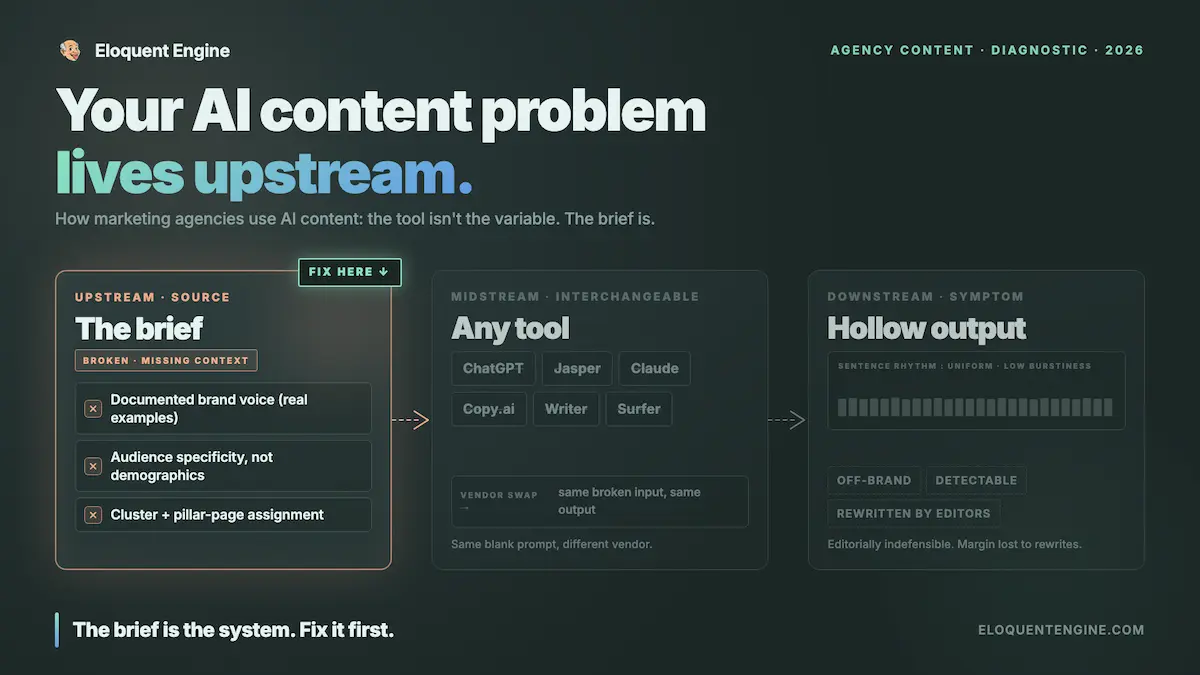
The context fed into the tool is the variable, not the tool itself.
Junior writers running Jasper’s free tier or unstructured ChatGPT prompts are producing detectable, interchangeable content outputs because the generation request contained zero brand intelligence.
It’s common knowledge that generic prompts produces generic articles. I mean, the LLM has to draw from what it is given, and a blank prompt gives it nothing distinctive to draw from. That is the complete causal chain.
The industry debate has quietly shifted from “does AI content rank” to “does this content deserve to rank at all.” That shift matters because it moves the question away from detection mechanics and toward content structure and genuine value. The Google penalty conversation has burned enough calendar cycles. The real constraint is upstream: did the content earn its existence before the model generated a single word?
One emerging signal worth taking seriously: practitioners building content for AI search are structuring pieces differently. Clear sections, direct answers, explicit comparisons. The logic is that models pick up and reuse well-structured content more accurately. That is the inverse of the blank prompt problem. Instead of trying to optimize generation, they are encoding intelligence into content structure so the output is reusable by both humans and machines.
The organizations at the frontier of this are not using off-the-shelf tools with generic prompts. SaaStr documented building a purpose-built AI marketing system with brand context, audience intelligence, and functional specialization encoded at the architecture level, not patched in at the prompt level. That is a systems decision, not a vendor decision. Most agencies have not had that conversation yet.
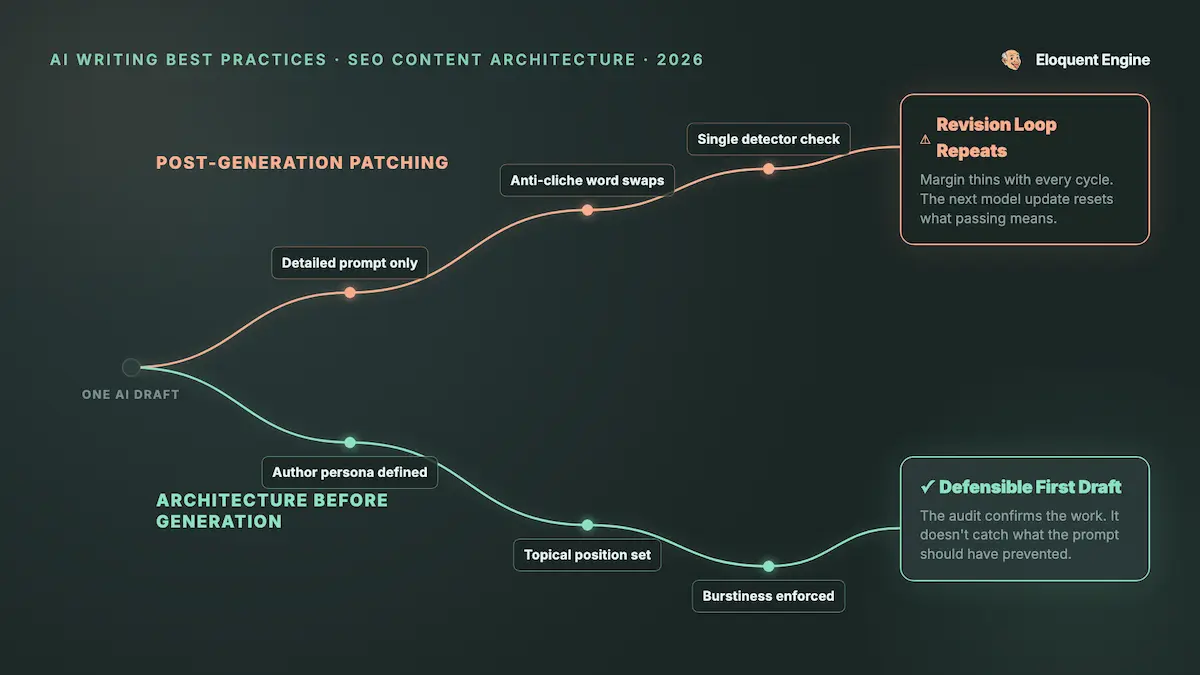
A system that requires post-humanization before delivery was wrong at the design stage.
How marketing agencies use AI for content when the output is actually defensible
The agencies producing AI content that holds up under editorial review share one habit. They build the brand context document before the content brief, and the content brief before the prompt. In that order, every time.
What goes into a brand context document that actually changes output quality? Not a mission statement. Not a tone-of-voice summary written by committee. Real vocabulary the client uses and vocabulary they would never use. Sentence rhythm pulled from founder communications or high-performing historical content. The specific framing they apply to their category, which is almost always different from how competitors frame it. Customer language sourced from reviews, support tickets, and sales calls. This document travels with every generation request for that client account. Without it, the model writes for a generalized reader. That is how you end up with content that sounds like every other SaaS blog in the category.
The practitioners who have figured this out are consistent on one point: AI works for research, rough drafts, keyword clustering, and structured ideation, but fails when treated as a prompt-to-publish pipeline. Agencies recovering their margins use AI as an input tool with human review gates before publication, not as a prompt-to-publish output mechanism.
AI didn’t kill content marketing. It killed the economics of one specific type of content: the middle-tier SEO article that existed to rank for a keyword and deliver no genuine value to the reader who landed on it. That category is gone. What remains has to earn its place. Content needs real entity coverage, internal linking tied to a pillar page architecture, and E-E-A-T signals that a topic-agnostic LLM cannot manufacture from a blank prompt.
Consider what a functioning content brief actually contains. Encoded brand voice from documented real examples. Audience specificity that goes beyond demographic description into the specific belief the reader needs to hold by the end of the piece. A cluster assignment: which pillar page does this support, and which gap in topical authority does it fill? Entity coverage targets validated against competitor content clusters, not just keyword gap tools. When that brief exists before the model sees any instructions, the output is editorially defensible. Without it:
You are scaling noise, not content.
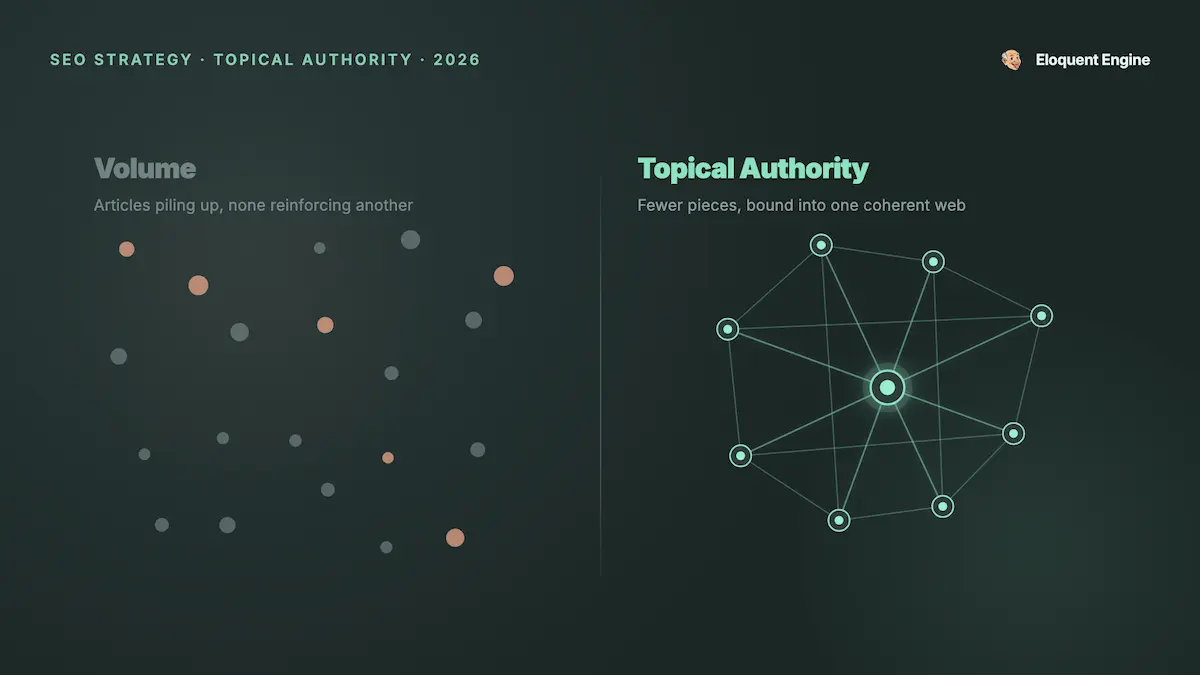
The other structural failure is volume without architecture. Publishing thin articles across hundreds of keywords with no cluster coherence does not build topical authority. It builds technical debt. Google’s understanding of a site’s expertise is shaped by how well the content covers a topic space, not by how many URLs exist. Running AI generation at volume without entity coverage targets and pillar page logic is how agencies build sites that rank for nothing despite publishing constantly.
So which failure mode is actually breaking your operation?
Think of a content brief the way you’d think about a client intake form before starting a project. An agency that skips the intake and guesses what the client wants will spend more time in revisions than the intake would have taken. A content brief with no brand context is the same mistake, made faster and at scale.
Three failure modes cover almost every agency struggling with AI content right now. Usually more than one is active simultaneously, which is not insignificant when you are trying to diagnose the actual break point.
No brand context document
Generation is running from blank prompts or generic templates copied across client accounts regardless of voice or vertical. The output is detectable, disposable, interchangeable from one account to the next. The fix: build a brand context document for every active client before generating another piece. Document brand voice with real examples from founder communications and customer language. Assign entity-level coverage targets before building the content calendar. This is upstream work. It cannot be skipped and recovered from on the back end.
No client tolerance map
Your team does not have a documented position for each client on AI content. Writers make individual calls that create inconsistent quality and undefined liability. Some clients have explicit no-AI policies that may be getting quietly violated. Others would accept AI-assisted work if the quality holds, but nobody has had the conversation. Map every active account against three categories: AI-comfortable, needs a direct conversation, and AI-excluded. Route workflow accordingly. Document it so the decision is not remade on every new brief.
No detection benchmarking before scaling
Ignoring AI detection scores until a client flags the content is a self-inflicted version of the worst-case scenario. AI detection fires on statistical patterns: low perplexity, low burstiness, sentence-level predictability that comes from generation without sufficient contextual constraint. Benchmark a sample from your current prompt templates against Originality.ai before scaling any new template. High scores mean the brief is the problem, not the output.
On the specialized versus general-purpose tools debate: take a position. The agencies running the most functional AI content operations are using specialized, bounded tools for specific functions. SaaStr’s documentation of 20+ purpose-built AI agents for distinct marketing functions reflects the same logic practitioners are landing on independently: ChatGPT and Perplexity for research and rough drafts, Surfer or Semrush for SEO structure, human review gates before anything goes live. General-purpose models commoditize the output. Specialized, context-encoded systems differentiate it. That distinction is where the real difference between AI writing tools lives, not in feature lists or pricing tiers.
One thing to do before the next generation request goes out
Pull one active client account. Open the brief your team is using to generate content for that client. Ask three questions. Does it contain documented brand voice with real examples, not a one-line tone description? Does it connect to a content cluster with a defined pillar page? Does it encode audience specificity beyond a demographic profile?
If the answer is no to any of those, every piece generated from that brief is starting from broken context. The editing burden you are absorbing, the detection risk you are carrying, the margin you are losing to rewrites: all of it traces back to that brief. Fix the brief. The output changes because the input changed. That is the whole mechanism.
Post-processors are selling a second product to fix the first product’s failure. Understanding why humanizer tools exist tells you exactly what went wrong one step earlier in the process. The agencies that stopped reaching for the humanizer pass are the ones that stopped generating from blank prompts. Same insight, different direction.
The brief is the system. Fix it first.