AI humanizer tools – software that rewrites AI-generated content to lower its detection scores – are everywhere right now, and the vendor claims are getting bolder every month.
The honest reaction from most people who’ve spent ten minutes with one is something like: “This feels like I’m paying to polish content I shouldn’t have published in the first place.” That instinct is correct.
Humanizers do change the output. They do move the scores. But we’ve found that well-constructed detection-passing only works when engineered into the generation step, not patched in after the fact.
To put it simply: every humanizer on the market operates at the wrong layer of AI content generation.
What “passing AI detection” actually means when a tool claims it
The score changed. The underlying content remained unchanged.
AI detection tools – software that scans text to determine whether a human or a model produced it – don’t read content the way a reader does. They measure three specific statistical properties of the text itself.
Perplexity measures how predictable each word choice is relative to what a language model would have selected at that position. Language models generate text by choosing the statistically safest token at each step, which produces text where every word is highly expected given what came before it. That’s low perplexity. Human writing is more surprising, more idiosyncratic. Detectors measure that gap.
Burstiness measures how sentence length varies across a passage. Human writers cluster short and long sentences in irregular ways based on emphasis and rhythm. AI output tends toward flat, evenly distributed, medium-length sentences. Flat burstiness is a secondary signal.
Lexical entropy measures vocabulary diversity. Models compress vocabulary by defaulting to high-frequency phrasing because it carries high training probability. Humans rephrase the same concept multiple ways without deliberate effort. Models repeat.
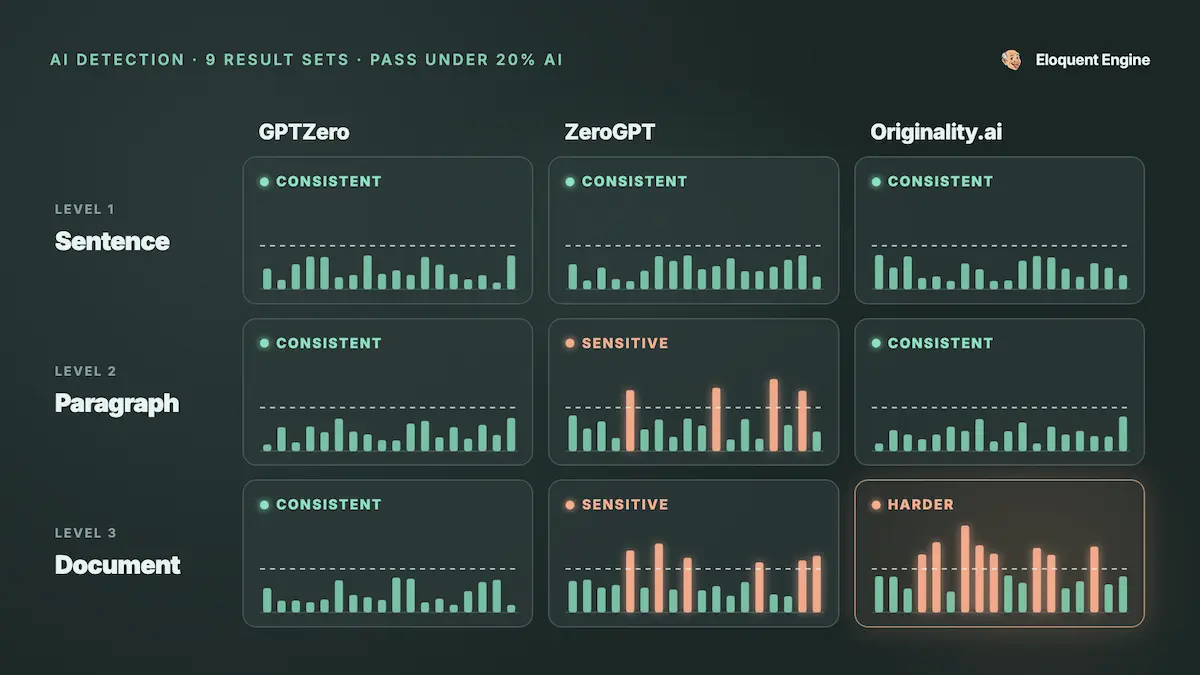
When a tool claims it “passes GPTZero,” it means the rewrite raised those metrics above the detection threshold for that classifier. Practitioners who’ve tested tools like UnAIMyText directly against Turnitin have found the problem this creates: the score moves on one detection system and gets caught by another. That’s not detection resistance. That’s a positioning problem mistaken for a technical solution, and it exposes the meaningful differences between how GPTZero and Originality.ai actually score content – differences that make “passes detection” a nearly meaningless claim without specifying which system, on which day.
What humanizers actually change in the content (and what they don’t touch)
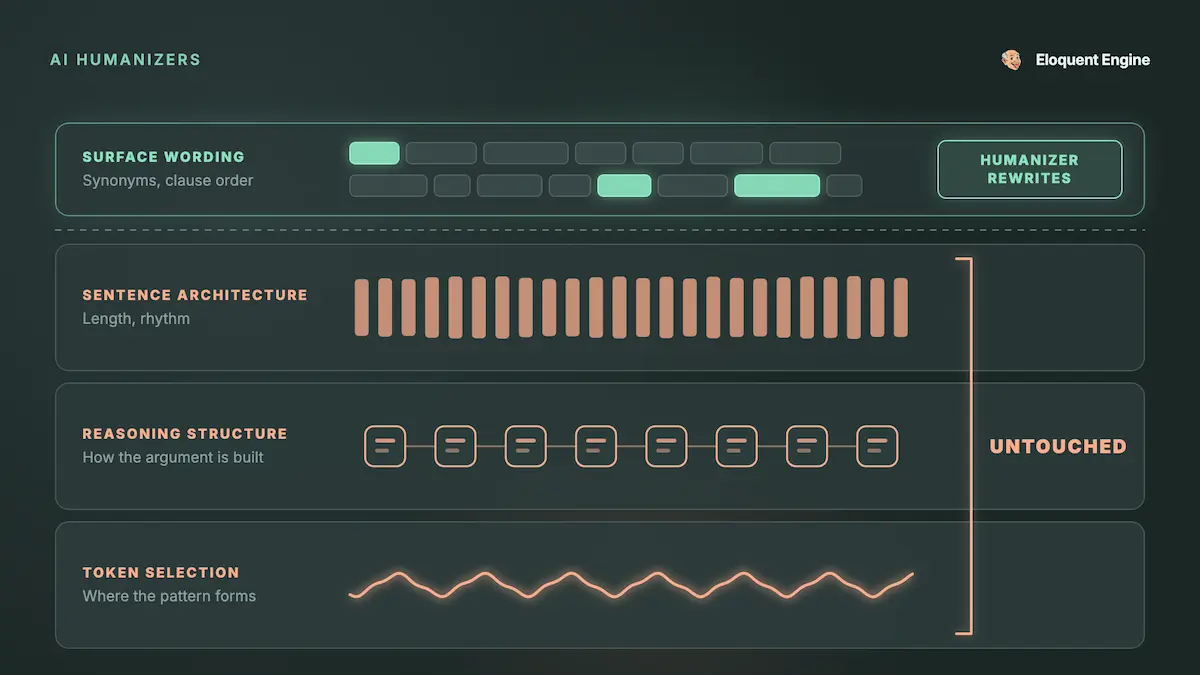
A humanizer applies a secondary rewrite to the generated output. Word substitution. Sentence restructuring. Synonym swapping. The goal is raising perplexity, burstiness, and lexical entropy scores enough to drop below the detection threshold. On that narrow task, some tools are better than others – practitioners report that tools like Superhumanizer perform differently on technical content than on general blog posts, and that inconsistency tells you something structural. A fix that only works on certain content types isn’t a fix. It’s a workaround with conditions.
What every humanizer shares is where it operates: after generation. After the token sequences were assembled and the reasoning structure was built and the vocabulary was selected. The rewrite changes surface features – individual words, clause order, phrase substitution. The underlying construction stays generic, stays hollow, stays built the same way it was built when generation finished.
Even worse, the rewrite sometimes degrades content that didn’t need fixing. A sentence generated cleanly gets “humanized” into something choppy and lifeless, worse than what came out of the model, because the tool changed it anyway to move a score. That’s not quality control. That’s an admission that the process eroded the content further instead of improving it. Choppy.
Choppy is the starting point, and now there’s more work to do.
Why fixing output instead of generation is the wrong layer entirely
The most honest thing practitioners have said about this category – and it surfaces repeatedly in forums where people actually compare results – is that most of these tools don’t work; they just claim they do. That’s not cynicism. That’s what you’d expect from a category that’s built around fooling a classifier rather than producing better content, and it gets worse as detectors update to catch the new rewrite patterns, which leads to tools updating to beat the new detectors, which leads to a cycle that produces no actual leverage for the person publishing the content.
The structural problem looks like this:
| Approach | Where it operates | What it changes | What it leaves intact |
|---|---|---|---|
| Humanizer bolt-on | After generation | Surface features: word choice, clause order, phrase substitution | Reasoning structure, sentence architecture, generic construction, hollow brand voice |
| Generation-level design | During generation | Token variance, syntactic unpredictability, voice specificity from the first draft | Nothing. The problem doesn’t form. |
Rewriting, repackaging, re-running the content through another model – all of it operates downstream of where the detectable patterns formed. Every time a humanizer “fixes” content, it fixes output while the generation step compounds the same problem into the next article, and the one after that, and every one after that until the process gets rebuilt.
Extensive post-generation editing is an admission the generation process failed. A humanizer is just a formalized version of that admission, sold as a product. The content drifts further from real brand voice with every pass, EEAT signals – the Experience, Expertise, Authoritativeness, and Trustworthiness signals that govern how Google assesses content quality – erode quietly. Traffic plateaus and teams ask what changed, but the damage was done layers back.
What Google actually penalizes (and why this reframes the whole question)
Honestly, the Google penalty framing might be the part of this conversation that does the most damage – because it’s almost entirely wrong, and vendors have repeated it so many times that it feels like established fact.
Google doesn’t penalize content because a model produced it. There’s no AI origin flag (at least that used to be the case before Anthropic started applying watermarks to their generated content).
What Google’s systems do penalize, consistently, across core updates, is content that fails quality signals: thin topical coverage, generic answers that match a query but carry no real expertise, pages that exist to fill a SERP position rather than genuinely answer a question. The EEAT framework rewards demonstrated knowledge. Generic AI-gen output tends to fail those signals – and that’s a correlation that gets misread as causation.
A team publishes high-volume AI content, rankings drop, and the assumption is that AI detection caused the penalty. The actual cause is content that was hollow. Treating that as a detection problem leads to buying a humanizer. Treating it as a generation quality problem leads somewhere more useful.
This distinction shapes every purchasing decision in this space. Humanizer purchases are driven by fear of a penalty mechanism that functions differently than vendors describe.
Where detection resistance actually has to be built
Detection resistance gets engineered at generation, not patched after. That’s the only durable approach, and it’s also the only approach that solves both problems simultaneously – content that generates naturally from the first draft also happens to carry the specificity and voice consistency that EEAT rewards.
In practice, this means building prompts that govern voice, rhythm, and structural constraints before a single sentence is written.
Prompts that encode specific phrasing patterns, sentence length variance, and brand voice characteristics push the model toward higher-perplexity output from the start. The goal is not deceiving a detector but achieving specificity that produces idiosyncrasy, which detectors can’t easily score as AI-generated. This is why brand voice in AI content is a detection problem as much as a quality problem.
One framework governs both.
Treating prompts as a living system – revisited, tuned, updated as brand guidelines evolve – prevents the drift that compounds when nobody owns prompt maintenance. Outsourcing prompt engineering with no ownership of upkeep is how teams end up babysitting output article after article, spending the same time cleaning up the bad parts that they thought they were saving by using a tool. The detection-resistant, voice-accurate, scalable output that actually produces consistent leverage comes from systematically maintained generation architecture.
If Jasper or Copy.ai solved this natively, there’d be no humanizer market. The bolt-on category exists because the main tools produce output that needs fixing. Building detection resistance into the generation process is the structural alternative to buying a bolt-on for a broken output stream.
The one question worth asking about any tool in this category
A publisher runs AI content through a humanizer. The score drops. The content goes live. Three months later, rankings plateau and a colleague reads the piece back and says it sounds hollow. The score was fine. The content never was.
There’s one question that cuts through every vendor claim in this space: does this fix generation, or does it fix output?
Apply it directly. If a tool is applied after content is produced, it’s an editing layer. Evaluate it as one. If a tool shapes how content is generated – through prompt architecture, voice encoding, variance built into the first draft – it’s addressing root cause. Govern your decisions from that distinction.
Map every tool you’re considering to one side of that question. Audit your current workflow against it. This is a systems problem, not a rewriting trick, and detection resistance engineered at generation doesn’t need a humanizer bolt-on to hold.
A content strategy built on that foundation is the only one that doesn’t require you to keep buying the next fix for the last fix.