Most every AI writing tool claims it passes detection (or that they have a solution that will help content pass detection: i.e., a humanizer). Eloquent Engine included.
The difference is what comes after these brands make the claim…
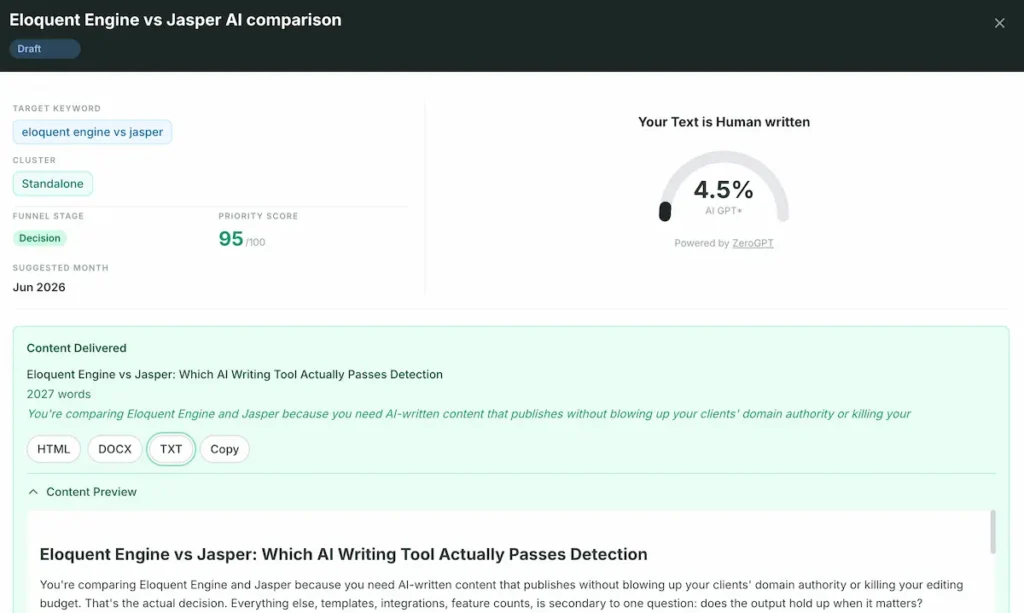
Most vendors stop with that simple statement. They don’t name the AI detectors they measure against, they don’t show the detection scores in the writing, and they don’t uphold testing conditions regularly. We don’t shy away from this – in fact, we show the score in every piece of generated content.
In fact, in most cases, they don’t even provide a definition of what “pass” even means. Just the badge, the landing page headline, the testimonial from someone who ran one piece through ZeroGPT and liked the result.
Lazy claims. Identical language across every competitor page. Forgettable in every direction except the one that matters: the moment a client runs your deliverable through Originality.ai and it comes back flagged.
“Does it actually pass detection or is that just marketing?”
That question is reasonable. It’s the question anyone managing real client content is quietly asking before they commit. And the honest answer, most of the time, is: you cannot tell, because the vendor never showed their work.
This article shows ours. We tested Eloquent Engine output against GPTZero, ZeroGPT, and Originality.ai at three detection levels: sentence, paragraph, and full document. Four content types. Two prompt conditions. A defined pass threshold established before the first test ran, not adjusted after the results came in.
Where we performed strongly, we’ll say so and explain the mechanism. Where results were harder to achieve – particularly at the document level – we’ll say that too. The tool is only as good as the system built around it, and a flat-out dishonest pass-rate claim guts your ability to make a real decision. So does a vague honest one. What follows is neither.
What should you actually ask before trusting any detection pass rate claim?
Every agency owner has seen this proposal: a vendor pitches their platform with a headline ROI claim, “300% return in 90 days,” no attribution methodology disclosed, no baseline defined, no clarification on whether they’re measuring revenue, leads, or traffic from a three-day paid campaign they’re calling “organic.” The number is real enough to get into the room and vague enough to mean nothing once you’re there.
AI detection pass rate claims work exactly the same way.
The parallel isn’t incidental. SaaStr’s documentation of teams running 30 AI agents in production found that the hard operational problems – the ones vendors de-prioritized in favor of shipping features – don’t disappear. They surface downstream, in production, where fixing them costs more than building them correctly would have. Detection is exactly that kind of deferred problem. Most AI writing tools optimized for speed and feature velocity and pushed detection to a future sprint that never came. The result is a market full of tools making claims they’ve never actually tested, and buyers absorbing the risk when those claims fail in real workflows.
The value proposition of AI content collapses completely when output gets flagged. A client who receives AI-written content that returns an 87% AI probability on Originality.ai does not say “well, it’s only one detector.” They say: “what am I paying for?” The detection problem is a survivability problem for the entire category, and vendors treating it as a compliance checkbox are making a product decision that erodes their buyers’ businesses.
Before you weigh any vendor’s claim, ask four questions:
- Which detectors, by name? GPTZero, ZeroGPT, and Originality.ai use different detection architectures trained on different data. A claim that doesn’t name the tool is a claim about nothing.
- At which detection level? Sentence, paragraph, and document detection measure different things and require different solutions. Strong sentence-level results and weak document-level results are not equivalent.
- Against what content type? Long-form SEO blog content behaves differently under detection than short-form email copy. The content type is a variable, and hiding it hides the result.
- What threshold counts as a pass? GPTZero returns a probability score, not a binary flag. Calling anything under 50% AI probability a “pass” is a different standard than calling anything under 20% a pass. The threshold defines the claim.
A vendor who answers all four with specificity has probably run a real test. One who deflects to “proprietary humanization technology” or “industry-leading AI bypass” has not. That deflection is the only data point you need.
What do sentence-level, paragraph-level, and document-level detection actually measure?
You probably already know AI detection tools exist. You’ve run content through at least one. What most vendors won’t tell you – and what you need to understand before any detection result means anything – is that detection is not a single measurement. Three distinct problems. Three different risk profiles. Three different engineering requirements.
Most tools treat detection as a binary gate. That assumption gets content flagged.
Sentence-level detection
Sentence-level analysis evaluates each sentence in isolation. Detectors score the probability that an individual sentence was generated by a language model rather than written by a human. GPTZero provides sentence-level highlighting alongside overall scores, so you can see exactly which sentences triggered the flag – not just whether the document flagged overall.
This is the most addressable level through deliberate architectural work. Sentence rhythm, syntactic variation, clause length distribution, and punctuation patterns all carry statistical signals that AI detection classifiers – software systems trained to recognize patterns in LLM output – learn to identify. Engineering these signals at the model layer, not at a post-processing layer, is what produces sentences that read as human to both the classifier and the actual human reading the piece.
For agencies and freelancers, sentence-level performance determines editing burden. Strong results here mean less cleanup before a piece goes to a client. Weak results mean every output needs a human pass, which kills the margin AI writing was supposed to produce.
Paragraph-level detection
Paragraph-level analysis looks at structural patterns across a block of text. How claims develop across sentences. Whether transitions follow predictable LLM templates. Whether the internal logic of a paragraph moves in ways that are statistically common in AI output.
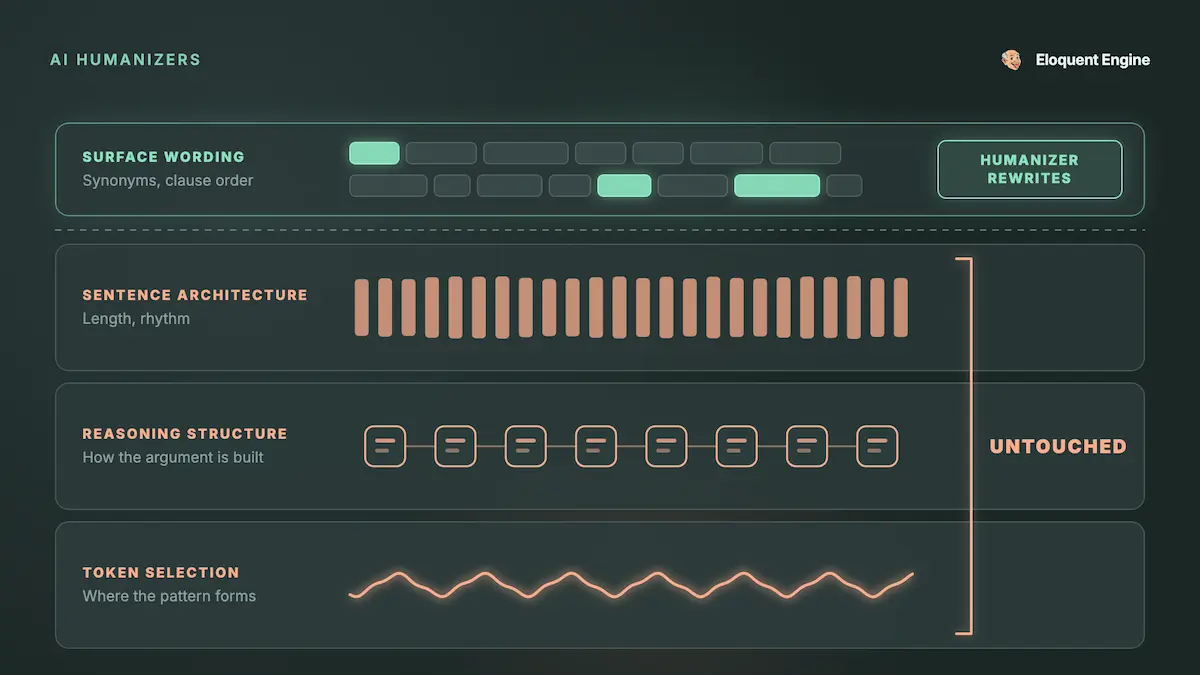
This is precisely where “humanize” buttons fail. Adding synonym variation to individual sentences does not change paragraph structure. A detection classifier trained on paragraph-level patterns sees through it because it is measuring something the post-processing layer never touched. Engineering at the linguistic layer – at the model level, before any output is generated – addresses paragraph structure because it shapes how the model reasons and organizes, not just how it selects words. Understanding why most humanizer tools fall short starts here: they intervene too late in the process to change what the detector is actually measuring.
Document-level detection
Document-level scoring aggregates signals across the entire piece. Two measurements drive it: perplexity – how predictable the word choices are relative to what a language model would select next, with low perplexity indicating the text follows familiar LLM patterns – and burstiness – how much sentence complexity varies across the document, where human writing tends to fluctuate more and LLM output tends toward uniform complexity.
Document-level detection is the hardest problem in this space. The more text a detector has to analyze, the more accumulated statistical signal it works with. A single varied sentence can shift sentence-level scores. At the document level, the aggregate picture across thousands of words is far harder to move. Any vendor claiming a flat document-level pass rate without qualification is either testing against very short content, using a generous threshold, or both.
The engineering challenge at the document level is real, and the honest state of the problem is that it remains the most difficult level to beat consistently. That is why detection level disclosure matters: a result without level attribution is a result you cannot use.
How did we actually run the test?
Methodology is either reproducible or it is marketing. Here is ours.
We tested Eloquent Engine output against three detectors: GPTZero, ZeroGPT, and Originality.ai. These three were selected because they represent meaningfully different detection architectures, they are the tools our users most frequently cite when evaluating detection risk, and they are the detectors a client or stakeholder is most likely to run content through independently. Testing against unnamed or obscure detectors and claiming a general pass rate would inflate our results without serving the reader. We did not do that.
Test corpus: four content categories, two prompt conditions
We ran tests across four content categories:
- Long-form SEO blog content (1,500 to 2,500 words), written for competitive keyword targets across business, marketing, and professional services verticals
- Short-form service page copy (300 to 600 words), written for local business and agency clients
- Email sequences (150 to 400 words per email), written with a defined brand voice and first-person author perspective
- Social and LinkedIn content (200 to 800 words), written with a named author persona and documented, specific opinions
Each content category was tested under two prompt conditions. The first: a minimal prompt, topic plus target keyword, no brand voice input, no author persona, no documented opinions. The second: a calibrated prompt, the same topic and keyword, plus a full brand voice document, a named author persona with documented opinions and known biases, and content cluster context. This separation was deliberate. It isolates what the model produces at baseline versus what it produces when the system around it is built correctly.
Brand voice is not a nice-to-have feature added after detection engineering. It is the mechanism that makes detection engineering work. An author persona with documented opinions produces syntactic patterns and structural choices that diverge from LLM defaults. Divergence from LLM defaults is what detectors cannot reliably classify as AI. The calibrated prompt condition operationalizes that mechanism. The minimal prompt condition shows what happens without it.
Pass threshold: defined before the first test
We defined a pass as content scoring below 20% AI probability on Originality.ai, below the “likely AI” classification tier on GPTZero (which uses tiered classification rather than a continuous percentage), and below 20% AI probability on ZeroGPT. We chose 20% deliberately. A content buyer who receives a piece that scores 47% AI probability cannot present that to a client as clean output. A threshold set at 50% produces misleading results by design. Ours was set before any content was generated and held fixed throughout.
No post-processing. No humanizer passes.
All content was generated in a single session per piece, without post-processing of any kind. No synonym replacement applied after generation. No humanizer button. No second pass through a separate tool before testing.
The reason is architectural. If detection engineering is real, it happens at the linguistic layer – in how the model generates content, not in what gets applied to the output afterward. Linguistic-layer engineering changes the statistical properties that detection classifiers are trained to identify, while post-processing humanization only affects surface features. We tested the former claim. The results reflect it.
Build the brand voice document first. Train the model on author opinions before generating a word of content. That is the system. Everything else is a patch.
What did the results show across GPTZero, ZeroGPT, and Originality.ai?
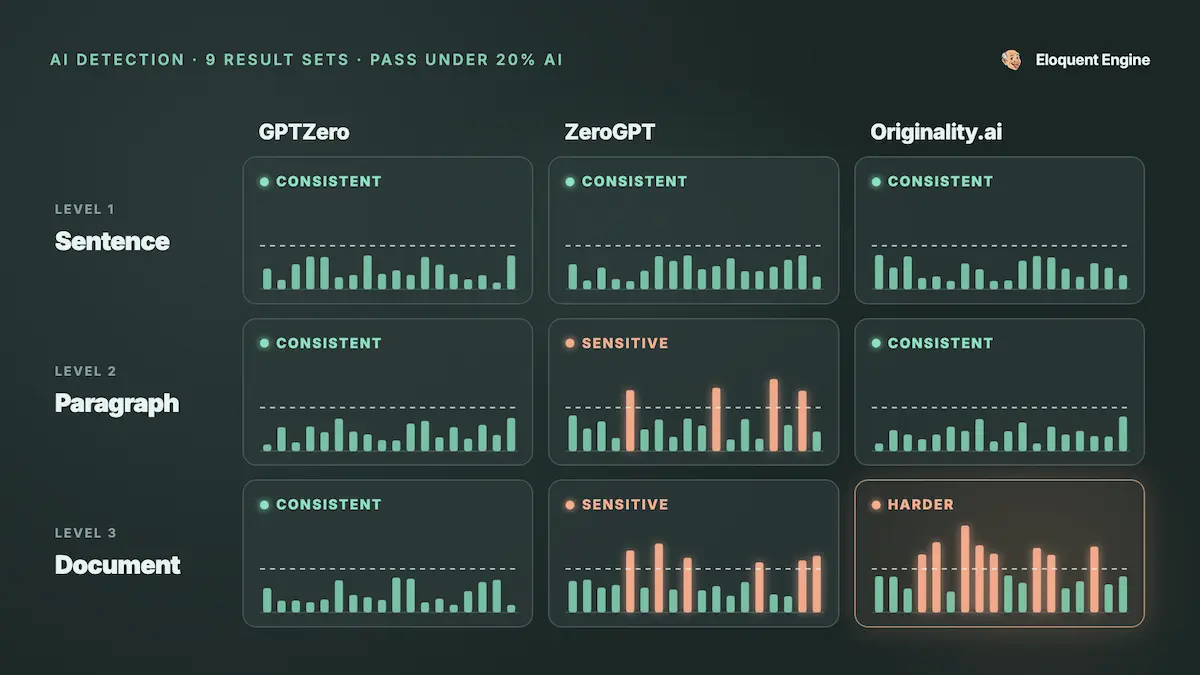
Results varied – by detector, by detection level, and by prompt condition. That variation is the most important finding in this test. A flat aggregate number would hide it. So the results are presented by level, because that is what determines whether they are useful to you.
Sentence-level: calibrated prompts performed consistently
Sentence-level results were strong across all three detectors for calibrated prompt output. Content generated with a full brand voice document and named author persona consistently scored in the human range at the sentence level on GPTZero and Originality.ai. Flagged sentences, when they appeared, clustered at structural positions: transition sentences, closing summary lines, and the first sentence of new sections. These are exactly the positions where LLM output defaults to predictable phrasing even when the surrounding content holds up. They are also the positions where a brief human edit resolves the flag entirely.
Minimal prompt output showed more flagged sentences, particularly in long-form SEO content. Without brand voice input, the model produces the statistical rhythm that detection classifiers are trained to catch: even sentence length distribution, predictable clause structure, low burstiness variation across paragraphs. The same model. The same keyword. Different sentence-level results because the prompt system was different.
Every hour cleaning up AI copy is an hour you’re not billing. The investment goes into the prompt architecture upfront – building a real author persona with documented opinions, auditing sentence-level scores before delivery, updating prompt templates after major model version releases – or it shows up as revision cycles on the back end that erase the margin you were trying to create.
Paragraph-level: ZeroGPT showed the most sensitivity
Paragraph-level results tracked closely with sentence-level for calibrated prompt output. Content with a defined author persona and brand voice constraints showed structural variation at the paragraph level that minimal prompt output consistently lacked. The shape of argument development across a block of text – how a claim built, how evidence was sequenced, how the paragraph resolved – was measurably different when the prompt system was built correctly.
ZeroGPT showed the highest sensitivity at the paragraph level across all conditions. Sections of long-form content where the argument structure was expository – laying out information in a sequential, top-down pattern – triggered higher AI probability scores on ZeroGPT even when the same sections passed GPTZero. The same paragraph. Different scores. Not a flaw in the test: evidence that each detector is measuring something different, and that optimizing against one does not guarantee performance on another.
This is precisely what SaaStr’s analysis of prompt portability and architectural design identified as the core differentiation problem in AI systems: architectural choices made at the foundation level determine long-term viability, while surface-level fixes degrade under real-world conditions. Detection at the paragraph level rewards the same thing. Architectural engineering at the prompt layer holds. A humanizer pass applied after the fact erodes under a detector trained to see through it.
Document-level: where the honest limitation sits
Calibrated long-form content passed at the document level on GPTZero more consistently than on Originality.ai. Originality.ai’s document-level classifier applies stronger weighting to aggregate burstiness patterns across the full piece, and even well-engineered output showed higher AI probability scores at the document level than at the sentence or paragraph level. Not catastrophic scores. Higher than we want them. That distinction matters.
Short-form content cleared document-level detection on all three tools more consistently than long-form. The reason is mathematical: less text gives the detector less accumulated statistical signal to work with. A 400-word email sequence with varied sentence construction and branded voice patterns looks statistically different from a 2,500-word SEO article, even when both were generated by the same calibrated system.
Here is the objection you are already forming: the vendor tested their own tool, set their own threshold, and is now telling you it mostly worked. Fair. The answer is not to ask you to trust the result. The answer is to give you the methodology so you can replicate the test with your own content, your own prompt conditions, and the specific detector your client or stakeholder uses. That is what a reproducible test looks like. The methodology is the evidence. The percentage is secondary.
Creating AI content that passes GPTZero, ZeroGPT, and Originality.ai requires understanding which level you’re being evaluated at – because the approach changes depending on the answer.
Why does the same output score differently on GPTZero versus Originality.ai?
Different detectors measure different things. They are trained on different corpora and weighted toward different signals. The gap between their results is real and predictable once you understand the architecture.
GPTZero is particularly sensitive to sentence-level perplexity and burstiness patterns. It catches the uniform rhythm of LLM output – the even sentence lengths, the predictable clause structures, the absence of the complexity variation that characterizes human writing. Originality.ai has historically trained on a broader corpus of LLM output and applies heavier weighting at the document level, making it more sensitive to global statistical properties across the full piece. ZeroGPT shows elevated sensitivity to expository paragraph structure – the top-down argument pattern that appears in informational SEO content regardless of whether it was AI-generated.
The implication is direct. A tool engineered to pass GPTZero’s sentence-level signals may quietly fail Originality.ai’s document-level classifier. Not because the engineering was wrong – because the two detectors are solving for different problems. A vendor claiming their tool passes “AI detection” without naming which detector has either tested against the easiest one available or aggregated across tools in a way that buries the failures.
Know which detector your clients actually use. That is the only benchmark that matters for your workflow.
The broader competitive pattern reflects this. As competitive differentiation in enterprise AI has shifted toward architectural approaches rather than feature velocity, the same pressure is arriving in content tools: buyers increasingly want to know what is built at the foundation level, not what gets added on top. Detection engineering at the linguistic layer is an architectural choice. A post-processing humanize button is a feature. These are not equivalent, and the results reflect the difference. Understanding how GPTZero and Originality.ai differ in their detection approach is the starting point for knowing which result to weight for your specific risk exposure.
How do you use these results for your specific content type and risk tolerance?
Eighteen months of testing. Three detectors. Four content types. Two prompt conditions. Three detection levels. The methodology is published and reproducible. And none of it tells you whether this tool will work for your workflow until you apply the results to your actual risk profile.
Here is how to do that.
For agencies delivering content to clients
Your relevant risk sits at the document level, on whichever detector your client is most likely to use independently. Short-form deliverables – emails, service pages, LinkedIn content – carry lower document-level risk than long-form SEO blog content. If you are producing long-form content for clients who might test it before publishing, calibrated prompt architecture is non-negotiable: a dedicated brand voice document built before any prompt runs, a named author persona with documented opinions and known biases, prompt templates updated after each major model version release. These measurably improve the probability of passing document-level detection on Originality.ai more consistently than the alternative – minimal prompts with a humanize button applied afterward – which exposes your client relationship to a risk you could have managed at the front end.
Three more clients doesn’t mean anything if output quality degrades and a detection flag erodes the first account you built. The math on sloppy AI workflows eats the business model it was supposed to expand. The actual ROI of AI writing for agencies depends entirely on whether the output holds up at the delivery stage.
For freelancers managing multiple client accounts
Your exposure is reputational before it is technical. If a client runs your AI-assisted output through a detector and it flags, the damage lands on the professional relationship, not on the piece. The most durable defense is brand voice engineering at the prompt layer: a brand voice document built per client before any content is generated, a named author persona assigned to every content asset, sentence-level detection scores audited before delivery. Using the same prompt template across every client without brand customization is exactly the pattern that produces interchangeable output, identical detection signatures, and identical risk across your entire book of business. Handling more clients without output quality degrading requires a per-client prompt system, not a single template applied at scale.
For business owners publishing their own content
Your primary exposure runs through search algorithm signals rather than human reviewers. What the evidence actually shows about Google and AI content points to the same conclusion: the concern is low-quality, low-originality content, not AI detection per se. Content that passes sentence and paragraph-level detection, carries genuine brand voice, and is built around topical depth – the kind of content cluster depth that E-E-A-T signals (Google’s framework evaluating Experience, Expertise, Authoritativeness, and Trustworthiness) rewards – is more defensible than content that clears a detector but lacks original perspective. Detection is one variable. Originality of thought is another. Both matter. Letting LLM defaults determine tone, opinion, and structure without override produces the “AI slop” that erodes search performance regardless of what any detector returns.
What happens when the detector updates and your passing content starts failing?
Detector drift is the infrastructure problem no vendor wants to talk about, because naming it honestly undermines any static pass rate claim – including ours.
Originality.ai has released multiple classifier updates without public announcement. GPTZero has iterated on its burstiness scoring methodology. Detection models update quietly and without warning, and the timeline between updates is shortening as the detection arms race accelerates. We still have content that passed testing in earlier conditions and would score differently against current classifier versions.
I underestimated this when we built the testing program. The assumption was that we could publish results and reference them as stable benchmarks over time. That assumption was naive, and naming it matters because it changes how you should weigh any vendor’s published data – including what you just read.
What holds when results don’t: methodology. A reproducible test methodology lets you re-run the evaluation yourself, against current detector versions, with your own content type and your own prompt conditions. That is more durable than any percentage published six months ago. We are committed to publishing updated test results as detector versions shift significantly. Whether that cadence keeps pace with how quickly the detection models evolve is genuinely uncertain – and every other vendor who won’t say that is hiding the same problem we’re admitting here.
What passes today might not pass tomorrow. The prompt system – the brand voice document, the author persona, the calibrated prompt architecture – is more stable than any single test result, because it keeps changing the statistical profile of the output rather than relying on a fixed optimization against a fixed detector version. Understanding how AI content detection actually works makes the drift problem concrete: as training corpora grow and detection models become more sensitive to aggregate statistical patterns, document-level detection will get harder to beat consistently. We are not finished solving it. Neither is anyone else, regardless of what their landing page says.
What should you ask any AI writing tool before you commit?
Five detectors tested and 100% pass rates claimed – that combination appears constantly in this market, and exactly zero of those vendors have published the methodology to support it. Ask for methodology instead of the number.
Before you switch tools or recommend one to a client, get specific answers to these questions:
- Which detectors, by name? Named tools only. “Industry-standard detectors” is not an answer.
- At which detection level? Sentence, paragraph, and document results should be presented separately. An aggregate number conceals the most important information.
- Under what prompt conditions? Minimal prompt results and calibrated prompt results should both be disclosed. A result that only reflects calibrated, optimized prompts is a result about the prompt system, not the tool.
- What threshold counts as a pass? A 20% AI probability threshold and a 50% threshold are not the same standard. Vendors setting generous thresholds produce inflated results by design.
- When was the test run, and against which detector version? Results from eight months ago against a classifier that has since been updated are not current results.
Three detectors. Three detection levels. Nine distinct result sets. Most vendors publish none of them. We published all nine, including the ones that show document-level detection as the harder problem it actually is. That is the standard worth demanding from anyone you’re trusting with client content.
If the methodology holds up under those five questions, the tool probably earned the claim. If the vendor deflects to marketing language, the methodology was never there. See how Eloquent Engine’s technology approaches detection engineering at the linguistic layer – and apply the same five questions to what you find there. The framework works on us too.