Why Every Jasper AI Alternative (Except Eloquent Engine) Produces the Same Flat Output

Searching for a better Jasper alternative? Here’s why almost no one finds a better one.

You know the feeling: six months of Jasper output, and the edit cycles are longer than the writing. The content calendar is full. Every piece is technically correct, grammatically clean, and somehow identical in feeling to the piece from last week and the week before that.

A prospect ran your last post through ZeroGPT and sent you the screenshot of a super high AI detection score followed by the question no one wants to hear: “client asked, quietly, whether the articles were “”was this written by a real person?”

So the search starts. Jasper AI alternative. Cheaper. Just as good. ChatGPT underneath anyway. Unlimited usage. Haven’t been happier.

That is the whole problem right there.

The alternatives market is built around a comparison that flatlines the moment you pressure-test it: feature parity at lower cost. Copy.ai has better built-in scripts. Writesonic is much more budget-friendly. Orwell is great for blogs. Every one of these claims might be true. None of them address why Jasper stopped working for you. And if you don’t know why Jasper stopped working, you will burn through the next tool the same way.

The comparison everyone runs treats this as a tool problem. It is an architecture problem. The tool is just where you finally noticed it.

The output keeps sounding the same because the architecture keeps doing the same thing

Here is what most vendors will not say out loud: the sameness problem you’re experiencing with Jasper will follow you to Copy.ai and to Writesonic and to whatever comes next, because the sameness problem lives in the workflow structure, not the tool.

Every mainstream AI writing platform runs on a version of the same pipeline. A user provides a topic and a brief. The model generates text by predicting the most probable sequence of words given that input. And the output enters the world. That’s it. That is the entire architecture.

And it guarantees content convergence because “most probable” is definitionally the center of the distribution. It is the gravitational middle of everything that has already been written. Run enough topics through that pipeline and every piece pulls toward the same place, regardless of which tool is generating the prediction.

Now, a fair objection: couldn’t a better model make the output less generic? And the honest answer is yes. Partly, and temporarily. The AI SaaS pricing conversation happening right now is largely about this: vendors are trying to justify premium pricing against a market that has decided the underlying model is commoditized. The practitioners saying “ChatGPT-powered alternatives are just as good as Jasper” are probably right. Not because Jasper’s model is weak, but because model quality has stopped being the differentiator. The pipeline is the differentiator. And the pipeline across all these tools is the same.

Humanizers don’t fix this. They operate on surface features, synonym substitution, sentence length variation, burstiness adjustment, and they do move perplexity scores on older detection methods. What they don’t touch is the reasoning signature underneath: the way a paragraph sequences its evidence, the predictability of how a point resolves, the statistical coherence of the argument’s structure. Tools like GPTZero are measuring those patterns now. You can paraphrase AI output into oblivion and the detection signature is still there, in the shape of the logic.

And this is where the self-undermining admission has to land. We looked at this problem for a long time and assumed a better prompting system was the answer. Better briefs. More specific inputs. Tighter templates. And those things helped, and the testing improved the output, and the detection scores moved in the right direction. And the content still flattened after sixty days. The brief was not the bottleneck. The pipeline was. No amount of volume fixes that. No amount of humanization fixes that. Fast mediocrity is still mediocrity.

The reason this matters before any tool comparison: if the sameness problem comes from the pipeline, then switching to a cheaper tool with the same pipeline structure is not progress. It is just a lower subscription fee for the same outcome.

Before you switch anything, run this diagnostic on your own workflow

The debate over which underlying model matters more, Jasper’s proprietary training versus GPT-4 versus Claude, is the wrong debate. Practitioners choosing ChatGPT-powered alternatives because “the core model is what matters” are making a reasonable guess that happens to miss the actual leverage point. The model is not where this breaks. The workflow is where this breaks.

Here is the diagnostic. Three questions. Answer them honestly before you sign up for anything.

First: where does brand voice live in your current system? If the answer is “in the brief” or “the writer knows it” or “we have a style guide somewhere,” your brand voice lives outside the tool. That means every generation starts from a generic baseline and you edit toward distinctiveness after the fact. That editing overhead is not a tool problem. A different tool produces the same baseline and requires the same editing.

Second: does your content system have a structural reason for each piece to exist? If topics come from a keyword list without a pillar-cluster map, without a cannibalization audit, without a documented gap in your existing topical authority, then AI output fills arbitrary slots in an arbitrary calendar. Measurably, this produces content that flatlines on Google despite being well-written. Changing the tool does not change the strategy. The tool is not the strategy.

Third: what happens to the AI’s output before it publishes? If the answer is “we edit it,” the question is what you are editing toward and whether any tool shortens that distance. If the answer is “we run it through a humanizer,” you have already admitted the tool’s raw output fails your quality bar. A different tool’s raw output will fail in a similar way, because the failure is structural.

If brand voice is inside your generation system, if every piece has a structural reason to exist, if the output requires minimal editing because the inputs are architecturally complete. Then a tool switch might actually help. You are calibrating a working system. If those conditions don’t hold, you are shopping for a tool to fix a system that the tool cannot reach.

What you actually need a Jasper AI alternative to do differently

You searched for this comparison six months ago and found a roundup. Copy.ai, Writesonic, Rytr, maybe Anyword. The listicle said they were much more budget-friendly. You may have even tried one. The output was fine. The edit cycles were the same.

That is the circular structure of this problem: the tool changes, the workflow stays broken, the content flattens, the search starts again. Each lap through that cycle costs you time and detection risk and, eventually, client trust. The consequences escalate. A piece that sounds AI-generated embarrasses the individual writer. A pattern of AI-sounding content erodes the client relationship. A failed detection audit collapses the retainer.

So when you evaluate any alternative, including this one, evaluate it on criteria that actually map to the failure mode:

  • Does brand voice live inside the generation process, or does it require post-generation editing to appear? Tools that take brand input as a parameter before generating are architecturally different from tools that generate first and let you adjust after.
  • Does the tool have a strategy layer, or does it require you to bring strategy to it? The publish-more mentality is costing you rankings. A tool with no built-in pillar-cluster logic or cannibalization awareness makes that problem worse, not better.
  • Does the output pass detection at the reasoning level, or only after humanization? Detectable AI content is a liability. If a tool requires a humanizer pass to be publishable, the architecture has already failed.
  • Does content uniqueness come from the generation process, or from your editing? If you are the source of originality and the tool is the source of structure, you are doing the hard work and paying for the scaffolding.

Template libraries are not on that list. Unlimited usage is not on that list. “ChatGPT but with built-in scripts” is not on that list. Those are features. These are criteria.

Here is how the tools actually compare when price stops being the only criteria

Okay, but you have a vested interest here. This comparison is going to make Jasper look bad and Eloquent Engine look great. That’s what these pages do.

That’s fair. So let’s establish what the comparison is actually measuring before scoring anything. And let the criteria do the work.

The live disagreement in practitioner communities right now is between all-in-one platforms like Copy.ai and Writesonic versus specialized tools like Orwell for blog generation and Wilde for optimization. The emerging consensus is that specialized tools outperform generalists for specific use cases, despite being more budget-friendly. That claim is probably true at the task level. Orwell may generate a better blog draft than Jasper for a comparable input. The task-level comparison is real.

The problem is that no collection of specialized task-level tools addresses the system-level failure. You can have the best blog generator, the best optimizer, the best humanizer. And still produce content that cannibalizes your own keyword targets, ignores your brand differentiation, and flatlines at month three. The tools improved. The architecture stayed broken.

CriteriaJasperCopy.ai / WritesonicSpecialized tools (Orwell, Wilde)Eloquent Engine (THREAD)
Brand voice inputPost-generation style guide; requires editing toward brandLimited voice parameters; primarily template-drivenTask-specific; no persistent brand layerEncoded before generation; part of the mathematical input
Strategy layerExternal; user brings topic and keywordExternal; template selects format, not strategyExternal; task is defined, strategy is notInternal; pillar-cluster logic and topical gap analysis built into content architecture
Detection riskRequires humanizer pass for reliable detection scoresSame pipeline; same detection signature; same humanizer dependencyTask output varies; detection risk varies by toolGeneration from a mathematical foundation rather than statistical text prediction; structurally different output signature
Content uniquenessDepends on prompt quality and post-editingTemplate-shaped output; uniqueness comes from user input qualityBetter task-level output; no uniqueness at the reasoning levelUniqueness from brand research and audience intelligence inputs; generated from a differentiated foundation
Cannibalization awarenessNone built inNone built inNone built inStructurally integrated into topic assignment

I want to be genuinely honest about one cell in that table. Whether THREAD’s detection scores hold across all content types and all detection tools. I am not certain. The tools are moving. GPTZero updates its models. What passes today may not pass in six months. What I am confident in is the architectural reason why the approach is structurally different, not just cosmetically different. The generation starts from brand research and audience intelligence encoded mathematically, not from a topic prompt run through a prediction engine. That is a different kind of input producing a different kind of output. Whether that difference is large enough for your specific situation depends on what your specific situation actually is.

That uncertainty is not a disclaimer. It is the honest answer to a market that has been sold too many guarantees already.

The architecture rebuild is not as complicated as it sounds

Three years ago, the conversation about AI content was about speed. How many posts per week could a tool produce. How fast could a writer go from brief to published. The assumption underneath all of it: more output equals more results. We got burned on that assumption. Everyone did.

Now the conversation is about architecture. And the reversal that matters is this: the question was never what can AI produce for your content system. It was always what does your content system need to give AI before it can produce anything worth reading.

The rebuild has three concrete pieces, and none of them require a genius to implement.

Brand voice engineering before generation. Document not just tone but point of view. The positions your brand takes, the things it refuses to say, the specific knowledge it brings that no other brand in the category has. That becomes an input, not an editorial pass.

Topic architecture before the calendar fills up. Map your pillar clusters. Run a cannibalization audit on what you already have indexed. Every new topic assignment needs a structural reason to exist: a documented gap, a cluster connection, a SERP intent that isn’t already served by something you published. This is what building compounding topical authority actually looks like operationally.

Detection as a quality signal, not a final check. If content is running through ZeroGPT after publication, the workflow is checking the wrong thing at the wrong time. Detection risk surfaces during generation, at the architecture level. The fix is upstream, not at the end of the pipeline.

THREAD’s mathematical approach to content strategy operationalizes exactly these inputs, brand research, audience intelligence, and topical architecture, as the foundation before any content is generated. The architecture piece was not obvious at all when we were building it. Took longer than it should have to understand that the output problem was really an input problem.

So where does this leave you

Probably somewhere uncomfortable. You came here for a comparison and the comparison is in that table. But I am not sure the table is the thing you needed most.

Think about what happens when a business hires a faster printer because their marketing isn’t working. The printing gets faster. The marketing still isn’t working. The printer was never the constraint. Switching tools when your content system is the constraint produces the same outcome: the new tool runs faster through the same broken process.

If you ran the diagnostic in section three and your brand voice lives inside your generation process, your topics have structural reasons to exist, and your output passes detection without a humanizer. Then the comparison table tells you something actionable. You are choosing between real options.

If those conditions don’t hold, the honest question is: how long can you keep switching tools before a client runs a detection audit you can’t explain? That window is closing. The detectors are getting better and the clients are getting more aware, quietly, in ways they don’t always say out loud. The cost of staying in the current architecture is not zero. It is accumulating, probably faster than it feels right now.

I assumed good tools were enough for longer than I should have. Maybe that was just us.
AI Content Detection Is Not A Guessing Game. Here Is Exactly What AI Detectors Measure.

AI content detectors hit the market right when ChatGPT, Claude, and Gemini became mainstream. Before the humanizer tools, before the “AI-safe content” marketing, before the product categories built around evading scores. The detection came first.

The metrics being scored were defined, training distributions were built, scoring systems were calibrated. All of that existed before humanization became something you could buy.

That sequence is the whole problem right there. Humanizer tools were designed to address a measurement that already knew what it was looking for. Not to change what the measurement captures. To move the number. Those are not the same thing.

If you paid for a humanizer and felt like it might not be working. You were not wrong. You were measuring the right instinct with the wrong framework. The tool was not broken. The category has a structural limitation that does not appear in the pricing page. That is worth understanding before you buy another one, or before you explain your content strategy to a client who just asked about it.

What follows is the mechanics. What detection tools actually measure. Why AI-generated text has those properties in the first place. What humanizers can and cannot change about them. And what a genuinely different approach would need to do.

What AI content detection actually measures. And why the metrics matter

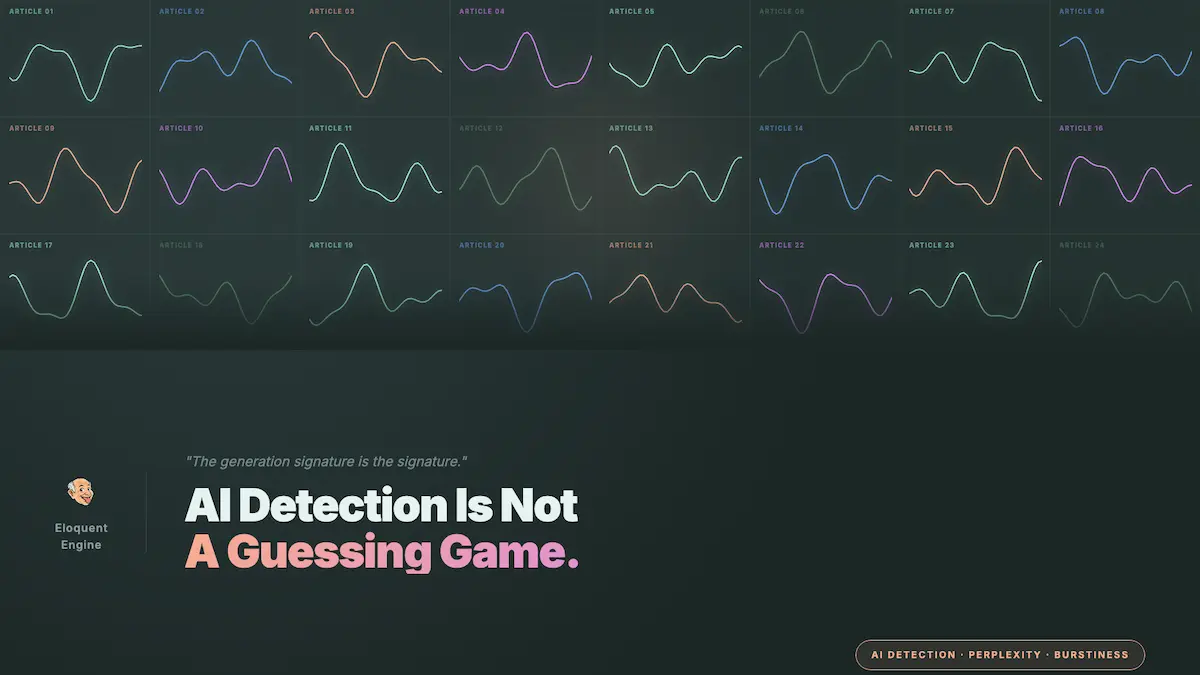
Detection tools are not performing editorial judgment. They are running statistical measurements and comparing results to distributions of known human and AI-generated text. Two metrics drive most of this: perplexity and burstiness. Not “AI patterns.” Not “robotic phrasing.” Measurable numbers.

Perplexity measures how predictable the text is relative to a language model’s probability distribution. At every step of generation, a model assigns probabilities to every possible next token and selects from the high-probability options. It is optimizing for coherent, contextually appropriate output. Which means it makes token choices that are statistically expected. Low perplexity means the text is predictable to a language model. High perplexity means the text contains choices the model would assign low probability to: an unexpected word with the right texture, a structure that is technically awkward but emotionally precise, a detour the model would never take because it does not optimize for effect. Human writers make those choices constantly. AI-generated text clusters around the high-probability selections, which produces measurably lower perplexity across the passage.

Burstiness measures variance in sentence length and complexity. Human writing is irregular. Short declarative next to a long subordinate clause, three tight sentences followed by one that runs long because the thought demands it. The rhythm follows the argument. AI-generated text tends toward regularity: sentences cluster in a similar length range, complexity distributes evenly, and the whole passage reads smoothly. That smoothness is not a quality signal. It is a detection signal.

Tools like GPTZero and Copyleaks are trained on corpora labeled as human or AI-generated. They learn what perplexity and burstiness distributions look like for each category, then score new text by running the same measurements and comparing results to those training distributions. The output is not a guess about whether the text sounds AI-generated. It is a measurement of where the text sits relative to two known statistical populations. The “accuracy doubts” and “serious accuracy concerns” practitioners discuss on Reddit are real. No tool is perfectly calibrated, and edited or hybrid content creates genuine classification challenges. But the underlying metrics are valid. The uncertainty is about implementation, not about whether perplexity and burstiness are real signals. They are.

One claim circulating among practitioners is worth addressing directly: that the correct response to detection anxiety is to stop obsessing over scores and focus on deploying AI at scale. That argument has real force at the strategic level , the practitioners building content systems are ahead of the ones still evaluating tools. But “stop worrying about detection” only works if the architecture of what you are deploying actually avoids the problem. Deploying at scale while ignoring the structural signature is not a deployment strategy. It is volume on top of a broken foundation.

Why the signature exists. And why this part is actually simpler than it sounds

The statistical signature in AI-generated text is not a flaw in the model. It is a direct product of how generation works, and I assumed for longer than I should have that this was complicated to explain. It is not.

A language model generates text token by token. At each step, it conditions on everything before it and selects the next token based on probability. The model is not deciding what it wants to say and then finding words for it. It is producing the statistically most coherent continuation of what it has already produced. That mechanism, repeated thousands of times across a piece of content, creates a specific statistical shape: smooth, predictable, uniform in complexity. Every sentence is appropriate. Every transition is clean. The whole thing reads well. And the underlying pattern is measurably different from what a human produces when actually thinking through a subject.

Human writers make decisions at multiple levels simultaneously. Argument, structure, word texture, sentence weight. Those decisions produce irregular patterns. The irregularity is the signal. It is not carelessness; it is the natural output of a mind working through something rather than optimizing for coherent continuation.

Some practitioners argue that detection tools are mostly solving a plagiarism problem, not a quality problem. And there is probably something to that framing. Detection and quality are different measurements. Organizations deploying AI at the systems level have figured out that the real challenge is architectural integration, not whether the output passes a score. But those are not competing concerns. The statistical signature matters because clients and platforms measure it. The quality problem matters because readers and search engines measure it. You can fail both tests with the same piece of content, and it is worth understanding them as separate mechanisms rather than assuming fixing one fixes the other.

What humanizer tools change. And the one thing they structurally cannot

A humanizer that claims to solve AI detection has to answer a specific question: which metrics does it actually change, and are those the metrics that detection tools measure? Most humanizer tools do not answer that question in their documentation, which is worth noticing.

Post-processing transformations are real. Synonym substitution, sentence restructuring, insertion of informal phrasing, variation of sentence length. These operations change surface metrics. Insert a two-word sentence after a long one, and measured burstiness rises. Substitute a low-frequency synonym for a high-frequency one, and the perplexity score nudges upward. A practitioner who runs content through a humanizer and then through a detection tool will often see the score move. That movement is not fabricated. It reflects real changes in measurable surface properties.

What it does not reflect is any change in the underlying token probability pattern. The statistical shape of how the content was constructed, token by token, probability-weighted, optimized for coherent continuation, is not touched by post-processing. Because post-processing is editing. Editing changes individual data points in a distribution. It does not change the shape of the distribution itself, which is what the detection model was trained to classify.

Consider what practitioners have already observed about Turnitin: it works correctly for content that is entirely AI-generated, working reliably in those cases, but performance degrades meaningfully when content is edited or run through additional tools. That observation reveals the detection mechanism more clearly than most vendor documentation does. The detection is reading a statistical shape. Editing perturbs individual points without restructuring the shape. Enough perturbation, particularly in heavily rewritten sections, can move a score substantially. But partial perturbation, which is what most humanizer workflows produce, leaves the underlying signature largely intact.

A freelancer billing content hours who runs everything through a humanizer is not building on a different foundation. The detection architecture is still there. The pattern is still classifiable. The score might look better today than it did last week. Whether it looks better than the detection models of six months from now is a different question. Systematically solving this problem requires changing what the content is made of, not applying a layer of variation to the surface of what was generated. The humanizer category addresses symptoms. The signature is structural.

What Google is actually doing. And why the answer is less satisfying than practitioners want

The mainstream claim is that Google has automatic AI detection built in and algorithmically penalizes AI content in rankings. A number of practitioners state this with confidence. The evidence for it, at the level of mechanism, is thin.

What Google has consistently documented is quality assessment through E-E-A-T signals: experience, expertise, authoritativeness, trustworthiness. These are not perplexity measurements. They are not burstiness scores. They are signals about whether content demonstrates real subject matter depth, original perspective, and the kind of specificity that comes from someone who actually knows what they are talking about. Google’s systems are trained to reward that. They are not trained to run content through GPTZero.

The nested point here matters: AI-generated content that was produced without genuine expertise, without editorial architecture, and without substantive human input tends to fail on E-E-A-T signals. Not because Google detected the generation mechanism. Because the content lacks the properties E-E-A-T rewards. The risk is real. The mechanism is different from what ZeroGPT measures, and conflating the two leads practitioners to optimize for the wrong thing. Chasing detection scores while the quality signal problems compound quietly in the background.

ZeroGPT having serious accuracy doubts, as the practitioner consensus acknowledges, should not be read as evidence that detection is irrelevant. It should be read as evidence that detection tool scores and actual search performance are measuring different things. A piece of content can pass ZeroGPT and still accumulate quality signal problems. It can flag as AI-generated and still rank well if it has genuine depth. Running detection scores as a quality proxy is the wrong diagnostic. Both things are worth addressing. They require different responses.

What ground-up construction actually changes

I spent longer than I should have thinking architecture was something you added after the first draft. That assumption flatlines the moment you understand what detection is measuring.

The signature is not in the words. It is in the construction process. Token-by-token probabilistic generation produces a specific statistical shape because the mechanism is always optimizing for coherent continuation from a blank context. The shape is a product of that mechanism. You cannot edit it away because the editing happens after the mechanism has already done its work.

Ground-up construction changes the conditions before generation begins. A topic framework built around documented expertise. An outline that reflects actual argument structure. Source synthesis and editorial direction that constrain what the model generates and how it generates it. When a language model writes within those constraints, the output reflects human decisions made at the structural level. The generation still uses probabilistic selection. That part does not change. But it is operating inside an architecture built by a person thinking through a subject, which produces different patterns than generation operating from nothing but a prompt.

The result is content that does not need to hide. Not because the tool is better at disguising the signature. Because the signature is different in the first place. That is the distinction worth understanding: disguise the output versus change the architecture. The former requires constant effort to stay ahead of improving detection models. The latter produces a different kind of content from the start.

If you want to understand what that looks like in practice, Eloquent Engine’s approach to content architecture starts with mathematical structure before any generation begins. The mechanism is what changes the signature. Not the post-processing.

The question worth asking before you evaluate any AI writing tool

Understanding perplexity and burstiness is useful. What you do with that understanding is what matters. Before evaluating any AI writing tool or humanizer service, one question cuts through the marketing: what metrics does this actually change, and are those the metrics that detection tools measure?

If the answer involves vocabulary frequency, sentence length variance, or readability scores. The tool is operating at the surface. Those changes are real. They are not sufficient to alter the underlying distribution that detection models classify.

If the answer involves how content is constructed before generation begins, the problem is addressed at the level where the signature originates.

The consequences of confusing these two answers escalate in a specific direction:

  • Detection scores improve temporarily, because surface metrics shifted. But the underlying signature persists, and newer detection models close that gap because they are trained on increasingly edited and humanized content.
  • Client relationships become exposed, because detection tools are already in active use by editorial teams, agencies, and clients running their own audits, and “we use a humanizer” does not hold up as a defense when the structural signature is still classifiable.
  • Search performance erodes over time, because content produced by a generation process with no human architectural input tends to fail on E-E-A-T signals independently of any detection score. The quality problem and the detection problem compound each other, and volume accelerates the damage rather than diluting it.

The practitioners building durable content systems right now are the ones who diagnosed this as an architecture problem early and stopped treating it as a post-processing problem. That window is narrowing. Mechanistic clarity about what detection actually measures is the starting point for building on the right foundation.

Most AI Writing Tools Are Solving the Wrong Problem

The whole industry is pretending these tools are different when most of them are built the same way

Most agencies know the content they’re producing through AI writing tools is bad. They ship it anyway in hopes the client cannot tell the difference.

That window is closing, predictably, and nobody wants to say it out loud because the retainer clears the bank account before the audit happens.

Vendors tolerate this arrangement because it’s convenient and profitable. They know you cannot expose an architectural flaw in a thirty-minute demo, so they bill for “AI-assisted content,” bury the methodology, and let the logos do the rest.

I will not even mention the fact that several of these tools are calling the same OpenAI API endpoint and competing on button color.

What follows is not a ranked list. It is the diagnostic framework that exposes which architectural category AI writing tools actually belongs to, what that means for detection risk and brand voice, and how to match the right approach to your workflow.

If you think passing detection is about sounding human, that assumption is actively costing you

The “best AI writing tool” debate is fragmenting because practitioners have stopped asking which tool is fastest and started asking which tool actually holds up. 55% of departmental AI spend is now going to coding, not content tools. The B2B market has already moved upstream. Writing tools are losing budget oxygen because they keep promising that they’re solving a quality problem when in reality they’re just solving a speed problem at the expense of quality.

The reason most tools fail detection is not that the output sounds robotic. Detection tools like GPTZero and ZeroGPT measure two mathematical properties: perplexity and burstiness. Perplexity scores how predictable each word choice is given the surrounding context. Language models optimize for coherent, probable sequences, which produces consistently low perplexity scores. Burstiness scores variation in sentence complexity across a document. Human writing is structurally irregular. LLM output trends uniform because it optimizes for well-formed sentences throughout.

These are measurable signals, not impressions. A tool that restructures sentences and swaps synonyms after generation changes the surface without shifting either measurement. The generation signature was set before the humanizer touched it.

The local-versus-cloud debate, Ollama and LM Studio versus SaaS tools, is a proxy for a more important disagreement: control over the generation process versus convenience layered on top of a shared pipeline. Both camps are solving real problems. They are not solving the same problem. Practitioners claiming that psychology-based tailoring through tools like Elaris matters more than “polish” are right for a specific reason. Audience connection requires systematic intent at the generation level. Algorithmic fluency applied after the fact misses the structural point entirely.

How to identify which architecture you are actually dealing with, because the vendor will not tell you

Every tool fits one of three approaches. The marketing copy almost never names the approach directly. The documented process usually does, if you know what to look for.

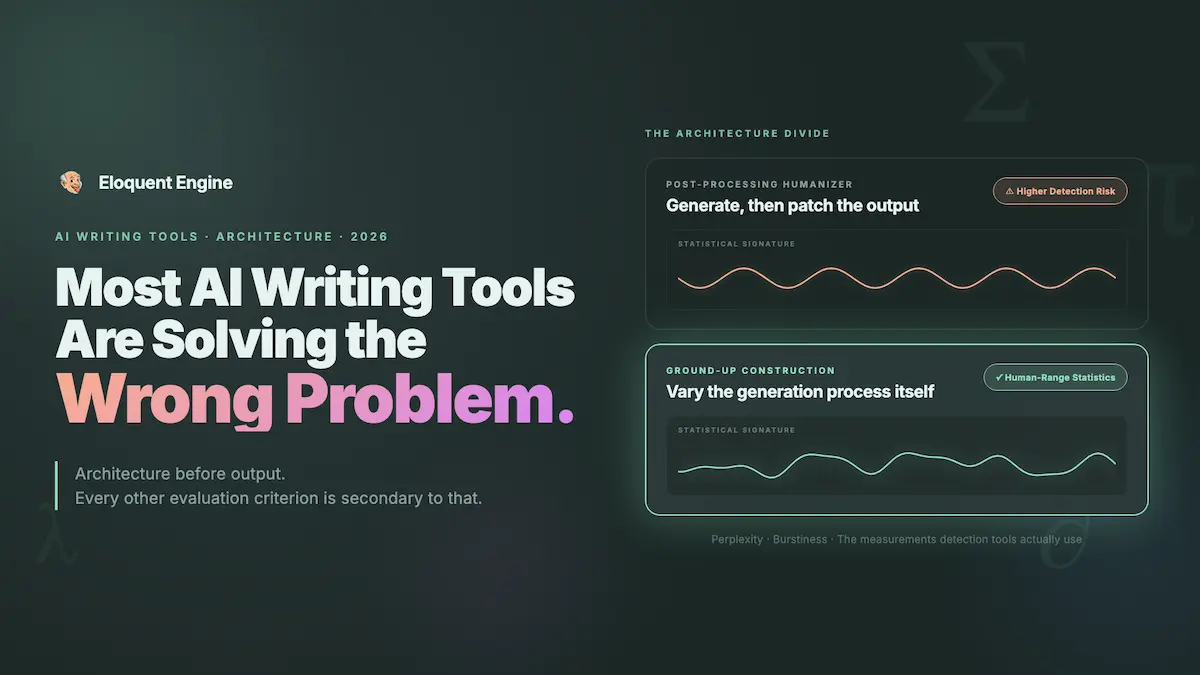
Post-processing humanizers generate text using a standard language model pipeline and then apply a secondary transformation layer. The tell is a two-step workflow: generate, then refine. Sometimes the refinement is surfaced to the user as a “humanize” toggle. Sometimes it runs silently in the background and the documentation describes it as a “proprietary humanization layer” or “anti-detection technology.” Both phrasings describe the same architecture. The generation signature is set upstream. The transformation layer is intervening too late to shift perplexity or burstiness in any measurable way.

Jasper and Copy.ai operate here. Their value is real: template systems, prompt engineering, workflow integration, and content brief scaffolding are genuinely useful. The architectural limitation only becomes a dealbreaker under consistent detection audits. Detectable AI content is a liability, not a feature gap.

Algorithmic assembly tools combine pre-written or pre-structured components: sentence templates, transition banks, topic sentence libraries. Detection behavior varies based on how much live LLM generation is involved versus pre-written blocks. Assembly is fast. The output is consistent. Over time, the output is also formulaic in a way that cannibalize brand differentiation across a content library. Every piece sounds like the same tool wrote it, because the same tool wrote it.

Ground-up construction varies the generation process itself rather than patching output afterward. Statistical properties are addressed before text is produced, which is why the measurement changes instead of just the surface. This approach is harder to market because “we built variation into the generation parameters” does not fit on a features page as cleanly as “humanize your content in one click.”

The market’s growing consensus that Claude produces the closest-to-human output reflects this distinction, though practitioners citing “human-like tone” are often naming the effect without the cause. The real question is not which tool sounds most human. The real question is which tool was structurally built to vary the properties detection actually measures.

Speed is not a differentiator. The market already knows this. Practitioners asking “worth using in 2026” are asking an architectural question, not a throughput question.

Architecture before output. Every other evaluation criterion is secondary to that.

What the best AI writing tool conversation looks like when nobody is trying to sell you something

“Does this tool humanize my content?”
“Yes, it runs your output through our refinement layer.”

That is a post-processing humanizer. Move on.

I assumed strong prompting was enough to differentiate client voices. It is not, if the tool is generating the same statistical signature for every account and smoothing it to the same surface texture afterward. Took longer than it should have to figure that out.

ToolArchitectural approachDetection profileBrand voice differentiationReal fit
Claude Pro (3.5 Sonnet)Ground-up constructionLowest risk in general-purpose categoryHigh with structured brief inputFreelancers, single-brand SMBs
ChatGPTGround-up constructionModerate; varies with prompt qualityModerate; brief does the differentiation workVersatile; workflow dependent
JasperPost-processing humanizerHigher risk under audit conditionsTemplate-constrainedVolume content, low-audit environments
Copy.aiPost-processing humanizerHigher risk under audit conditionsLimited cross-client differentiationShort-form copy, marketing teams
AuthWriterProcess support layerLower risk; human in loop by designHigh; built around human decision-makingWriters rejecting the AI-as-replacement model
ElarisPsychology-based targetingVaries; not primary architecture focusHigh for audience-specific positioningAudience-tailored content, B2B
UnAIMyTextPost-processing humanizerBetter than most humanizers; structural limit remainsLowDetection-pass use cases only

On the local-versus-cloud split: Ollama and LM Studio are solving a privacy and control problem, not a content quality problem. Both are legitimate concerns. If your workflow requires keeping client data off external APIs, self-hosted is correct regardless of output architecture. If your workflow requires polished UX and team collaboration, cloud SaaS wins on practical grounds. These are different constraints. Picking a side is the wrong frame.

The right tool depends on which problem you actually have

Run this gut-check before evaluating any tool against a feature list.

  • You manage multiple client accounts. Your primary risk is content cannibalization across brand voices. A post-processing humanizer will produce the same statistical signature and similar surface patterns for every client regardless of the brief. Over time your content library flatlines into one recognizable voice with different logos. The fix is upstream: a tool that takes differentiated input and generates differentiated output, not one that polishes everything through the same refinement pass. This is where ground-up construction earns its cost.
  • You publish under your own brand at volume. Detection risk is the dominant concern. Speed is already table stakes. The question is whether your tool’s architecture will hold up when a client runs an audit six months from now, not whether it produced the draft in forty seconds today. No amount of volume fixes a structurally broken detection profile.
  • You are a writer who needs AI to reduce friction, not replace your process. AuthWriter’s explicit positioning as a process support tool rather than a generation tool reflects where the most sophisticated practitioners are landing. AI as replacement produces content debt. AI as process support produces content that survives editorial review because a human was making decisions throughout. The “AI as support versus AI as replacement” distinction is the real conversation in 2026. The tools that understand this are architecturally different from the ones that don’t.
  • You need audience-specific content that earns search equity. Generic tone-smoothing does not solve an audience connection problem. Tools built around systematic audience intent, like Elaris with Solsten’s psychology targeting, address a structurally different failure mode than detection risk or volume. Identify which failure mode costs you most before defaulting to the tool with the best logo in the sales deck.

For a deeper look at how mathematical content architecture addresses these workflow problems at the system level, the framework behind THREAD is built specifically for this diagnostic.

Three questions that outlast every tool on this list

Here is the thing nobody says at the end of a tool comparison: you already know which category most of these tools belong to. You felt it when the output was predictably smooth in a way that real writing never is. You felt it when the fifth piece sounded like the first piece. You supposed it was your prompting. It was the architecture.

The binary is not “AI tool versus no AI tool.” That framing is dead. The real choice is between tools that modify an output and tools that build content correctly from the start. Most of the market is still selling you the first option while describing it as the second.

Three questions. Any tool, any vendor, any price point.

  1. Does this tool modify output after generation, or vary the generation process itself?
  2. What does the documentation say about detection, and is it describing a measurement solution or a surface fix?
  3. Does it take differentiated input and produce differentiated output, or does every account get the same statistical signature with different keywords?

The answers give you the architecture. The architecture gives you the downstream consequences. Every other evaluation criterion follows from there.

Solutions

Your Plan

Business $60/mo

Everything you need to publish with confidence.

  • 1 project
  • 8 articles/month
  • 1 strategy run/quarter
  • Generation rollover
  • Full data access
Start free trial Compare all plans
Freelance Marketer $150/mo

More clients. Same hours. Higher income.

  • 5 projects
  • 30 articles/month
  • 5 strategy runs/quarter
  • Generation rollover
  • Full data access
Start free trial Compare all plans
Agency $600/mo

Scale content across every client without scaling headcount.

  • 25 projects
  • 150 articles/month
  • 25 strategy runs/quarter
  • Unlimited team members
  • Generation rollover
  • Full data access
Start free trial Compare all plans