6 Steps to Build an AI Content Strategy That Actually Ranks Your Website on Google

The output is the last place to look for the problem

The output came back flat. You spent an hour editing it into something usable. You published it, watched it sit there, and quietly wondered whether the tool was worth the subscription.

That specific feeling – the dull weight of editing content you did not write, into a shape you cannot quite name, toward a result that keeps moving – is not a prompt problem. You have tried better prompts. The output is still interchangeable with every other article on the same topic. It still sounds like every other SaaS blog.

The problem is earlier. Before the prompt opens, before the tool is chosen, before a single brief is written, a set of decisions should already exist. Which topics your brand has the authority to cover. How those topics connect. What expertise lives in your brand that no generator can invent.

When those decisions are missing, the generator fills the gap with the statistical average of everything it has trained on. A prompt library is not a content strategy. Strategy comes before generation, or the generation produces nothing worth keeping.

What does “ai content strategy” actually mean, and what it isn’t

The consensus has settled into a comfortable framing: AI is best used to speed up the boring parts. Research, outlines, first drafts, repurposing. Humans own the creative work. AI handles the mechanical work. This framing is mostly right, and it’s the reason most AI content implementations still fail.

What it misses is that the boring parts were never where the content value came from. Speed without direction produces detectable output faster – a pyrrhic win. A first draft without a brand context document is a blank prompt with extra steps. The question practitioners should be asking is not “how do I use AI to go faster?” The question is “what architecture does the generator execute against when it writes?”

Agencies have started answering this through tool stacks: ChatGPT for drafts, Perplexity for research, Surfer or Semrush for SEO structure. This is smarter than a single platform. It is not a strategy. The tools are different but the missing layer is the same: a coherent content architecture that exists before any tool opens.

AI content strategy is that architecture. Which topic domains your brand has the credibility to own. How those domains connect semantically. What your brand knows that a generator cannot invent. These are strategic decisions. A brand voice dropdown in a tool interface is a generation feature. The two are not the same problem.

On the question of where content gets found: users asking ChatGPT instead of Google has shifted the conversation about whether SEO still matters. SaaStr’s search impressions grew 5x in twelve months despite the same predictions of Google’s irrelevance. The channel question is real. The underlying question stays constant: does this content deserve to exist? Generic output fails in search results and in AI-generated answers for the same reason. Neither surface rewards hollow content.

If your output needs to be humanized before it publishes, the system was broken before the first word. Post-processors are selling a second product to fix the first product’s failure. Post-processors are selling a second product to fix the first product’s failure.

What gets decided before the prompt, and how I got this wrong for longer than I should have

Honestly, I assumed for too long that prompt quality was the primary lever. I built prompt libraries. I refined templates. I watched detection scores come back at 90 percent and had no explanation for the client – because at the time, I was editing the output instead of fixing the input. The generation looked like the problem. In hindsight, the generation was just where the problem became visible.

Here is the question that eventually reorganized how I think about this:

“What does the AI know about your brand before it writes?”

“Whatever is in the prompt.”

“And what was in the prompt?”

“The topic and the word count.”

That exchange – I have had some version of it with almost every practitioner who comes to me frustrated with their output. The generator produced vanilla content because vanilla context is all it received. The prompt was the full extent of the brand intelligence encoded into the system. Which means the output could only be as differentiated as that prompt.

Content architecture changes what that prompt carries. A brand context document – built before any generation begins, containing actual examples from founder communications, customer language, competitor positioning, and the specific problems your audience brings to your content – encodes real intelligence into the brief. The generator executes against your perspective instead of inventing one.

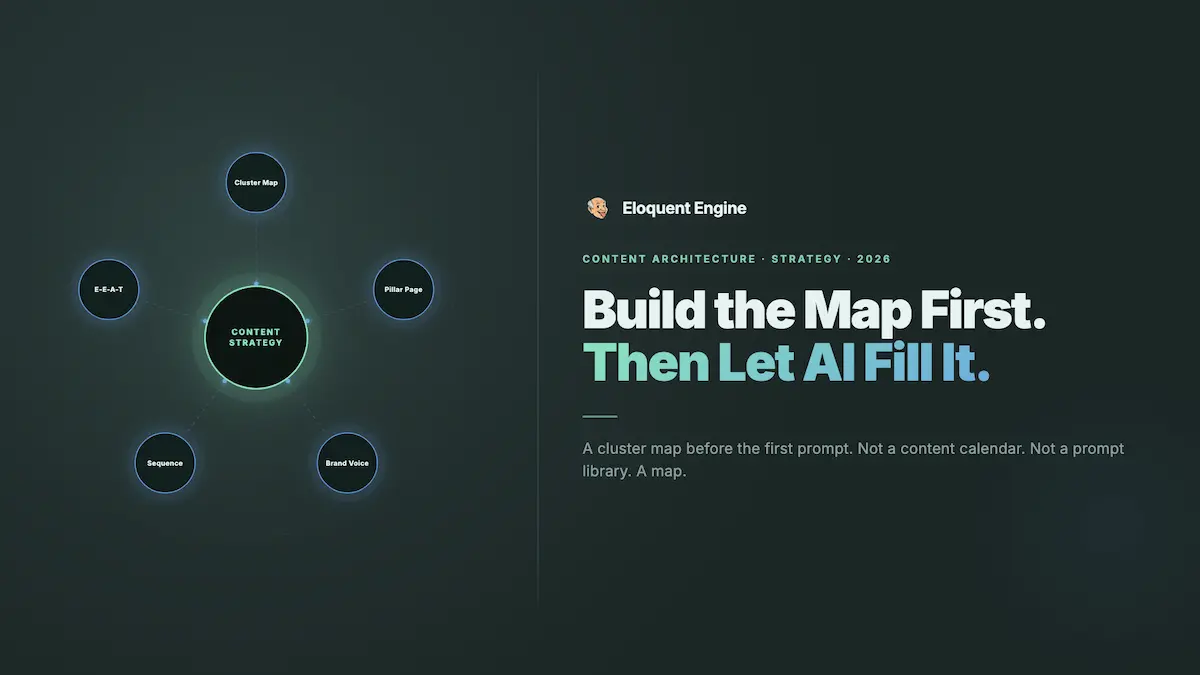
In practice, content architecture involves decisions in three areas before a prompt is written:

  • Topical scope: Which domains your brand will cover, how deeply, and what the connective logic is between them. This is the map the generator navigates.
  • Entity and depth targets: What concepts, named entities, and subtopics each cluster needs to cover to demonstrate genuine authority on that subject. Running topical gap analysis against competing content before assigning articles is how you identify depth gaps, not just keyword gaps.
  • Brand intelligence layer: The documented voice, perspective, and expertise claims that make your content structurally distinct from a blank prompt. Validating content briefs against E-E-A-T criteria before handing to generation is probably the step most teams skip. It is also probably where the most output quality is lost.

SaaStr’s shift to a 3-person team running 20 AI agents is instructive here – not because of the headcount math, but because the AI execution happened inside a content system with existing topical authority, brand identity, and editorial standards. The architecture preceded the automation. You could run the same AI agents against a site with no content architecture and produce nothing of equivalent value. The AI did not create the system. The system made the AI useful.

The question that reorganizes AI content work: what should the tool know before it writes? Answer that, and the prompt becomes execution. Skip it, and the prompt becomes the strategy. The content is only ever as good as the context you fed the model.

Topical authority is not optional infrastructure

Publishing content without topical architecture produces a specific kind of failure. Not a dramatic drop in traffic. A slow accumulation of pages that Google indexes and ignores. Thin coverage across too many topics. No cluster depth behind any pillar. Pages that technically exist and functionally do not.

Topical authority is built through coverage depth, not publishing volume. A content cluster with a coherent pillar page, supporting articles that extend the pillar’s argument, solid internal linking, and entity coverage across the domain signals something specific to search: this brand knows this subject. Publishing 200 loosely related articles broadcasts diffusion instead of depth.

G2’s CMO has documented how B2B buying behavior has shifted as AI enters the research process. Buyers now encounter AI-generated summaries before they reach branded content. The brands that appear in those summaries are the ones that have established demonstrable authority on a subject – through depth, specificity, and genuine expertise. Volume-based AI content strategies were already weak. They are now structurally misaligned with how buyers actually research.

The authenticity move practitioners are making – toward personal stories, niche positioning, content that AI cannot mimic – is a real signal. It is practitioners discovering through failure what content architecture would have told them upfront: the brands that build topical depth around specific expertise outperform the brands that flood a topic with thin articles.

Measuring AI content strategy by content produced per dollar is the wrong metric. The right measurement is whether the content builds authority that compounds. Agencies billing for AI content at scale without topical architecture are billing for technical debt their clients will pay in rankings.

Generic output at volume poisons the index. Topical depth at measured scale builds something.

Diagnosing your actual problem: tool or strategy?

I used to think the diagnosis was obvious once you knew what to look for. Honestly, it is less clean than I initially let on. Tool constraints are real. Some generators are genuinely weak for specific use cases, and strategy cannot fully compensate for a model that cannot handle your domain’s technical language or your audience’s specificity. I overcorrected early toward “it is always a strategy problem.” In practice, it is usually both, and the question is which to fix first.

The publishing industry went through a version of this in the early CMS era. Every team suddenly had the technical capacity to publish anything, instantly, at any volume. The teams that thrived built editorial systems. The teams that collapsed mistook publishing capacity for publishing strategy. The constraint was never the tool. It rarely is now.

Generic input encodes generic output. Only strategy changes this equation without changing the tool.

A working diagnostic – probably not perfect, but useful:

  • Strategy problem: Your output is technically coherent but interchangeable. Detection scores are high on Originality.ai. Different prompts produce similar-feeling content. You have no brand context document. Your content does not cluster around pillar pages. You publish across many topics without depth in any.
  • Tool problem: Your output consistently fails on domain-specific terminology, loses coherence in longer formats, or cannot hold a consistent point of view even when the brief is detailed. A different generator produces noticeably better output for your specific use case when given the same brief.
  • Both: The output is interchangeable AND technically broken. Fix the strategy layer first. A better tool without architecture still produces hollow content faster. Comparing tools honestly only makes sense once the architecture exists to test against.

Practitioners running distributed tool stacks are often solving a tool problem while a strategy problem sits underneath it. The stack gets more sophisticated. The content stays thin. The AI detection scores do not improve because the generation input did not change.

Start here: a framework you can sketch in an hour

The tools do have real limits. Acknowledging that matters. And strategy is still a separate lever – one that changes what any tool produces without requiring you to switch tools.

Here is where to start. Take a blank document. Write down three topic domains your brand has genuine expertise in. For each one, list five questions your actual clients or audience have asked you in the last six months. Those questions are the skeleton of a content cluster. The answers your brand gives, drawn from real experience, are the brand intelligence layer.

That document – rough as it is – already changes what you put into a brief. You stop prompting from nothing. You start encoding something real.

From there: cluster the questions under each domain. Identify which question is the broadest entry point. That is your pillar. The others are spokes. Build a content brief for each spoke that references the pillar explicitly, carries the brand’s specific position, and specifies the entities and subtopics that need to appear.

Run that brief through your current tool. Compare the output to what a blank prompt produces on the same topic. The gap you see is the value of the architecture you just built.

Strategy before generation. That is the whole framework. If you are running this as a business owner without a content team, that one document is where the system starts. If you are an independent marketer explaining your process to clients, it is also the answer to “how is your AI content different from cheap bulk output.” The architecture is the answer. Build that first.

AI Content Writing for Marketing Agencies [and the Problems Most Firms are Silently Facing]

Your client runs the latest batch through Originality.ai. The score comes back at 74% AI probability. Every article passed your internal review. A writer touched every one. You used the tool your team built the prompt library around. The output still reads, to a detection algorithm, like it came from a machine running on hollow instructions.

So you look at the tool. Maybe a better one exists. Maybe the prompt templates need rebuilding. Maybe you add a humanizer pass before delivery.

None of that addresses the actual problem.

Detection scores are downstream of a broken input. The system generated content from a blank understanding of what the brand actually is, what it believes, and what it’s earned the right to say. Encoding that context before generation starts is the only variable that changes the output in a way that holds.

A prompt library executes a content strategy that was never built. Post-processors are selling a second product to fix the first product’s failure. If your output needs to be humanized, the system was wrong before the first word.

The architecture is the problem, not the tool.

We add human review to every piece. Why is that not enough?

Most agencies have settled into a workflow that feels reasonable: ChatGPT or Perplexity for research, a generation tool for drafts, Surfer or Semrush for optimization, and a writer doing cleanup before delivery. That’s the consensus workflow right now. Practitioners defend it with something like “ChatGPT and Perplexity do the job, the rest is overkill.” The logic holds at a surface level. Research speeds up. Drafts appear faster. The human pass catches the obvious errors.

One agency running that workflow produces ten articles a month. Detectable patterns appear, but sporadically, and the human pass catches most of them. Detection risk stays manageable. Topical authority builds slowly, but it builds.

An agency running the same workflow across eight client accounts, with three writers batching content in two-day sprints, produces something different entirely. AI content detection fires on pattern, and generic prompts produce predictable patterns. The same transitions. The same problem-to-solution arc. The same calibrated vocabulary across every client, every category, every batch. The detection fingerprint doesn’t weaken at volume. It compounds. When Originality.ai scores a single article at 60%, that’s borderline. When it scores twelve articles from the same tool and the same prompt library at 60% each, the cluster reads as a structurally sound, demonstrably non-human body of work.

The human review catches hollow phrasing. It does not encode the brand’s actual competitive position, its documented point of view, the vocabulary its audience uses and resists. Those are not editing problems. They are input problems. No amount of cleanup fixes what was never there to begin with.

This is the gap between using AI to speed things up and using AI as a brand-encoded generation system. The brands that own search in three years are building content architectures, not publishing blog posts at scale. Topical authority is not built by volume. It is built by coverage depth. And coverage depth requires the system to actually understand each brand before it produces a single sentence on that brand’s behalf.

Three writers, eight clients, two-day sprints, and a generic prompt library…

The technical reason AI writing sounds fake is not that the tool is unsophisticated. It’s that the tool was never given anything specific enough to generate from.

Prompt libraries and humanizer passes are the obvious fixes. What am I missing?

The mainstream view is reasonable: the output sounds off because the prompts aren’t specific enough. So you build better templates. You get more detailed. You add tone instructions, audience descriptions, competitor references. The prompt library grows. The output improves at the margins. Then it gets flagged again.

Here’s where the honest version of this gets uncomfortable. Prompts are instructions for how to write, not knowledge about what to write from. A detailed system prompt telling the model to “write with authority in a conversational tone for a B2B SaaS audience” produces content that behaves that way. It does not produce content that expresses any specific argument, any differentiated perspective, any expertise claim the brand has actually earned. The output is technically correct and intellectually interchangeable with every other B2B SaaS blog running the same category of prompt.

That’s the detectable pattern. Generic output is a system design problem.

The second fix is the humanizer pass. QuillBot. Undetectable.ai. Running the output through a secondary layer that rearranges the statistical fingerprint enough to score lower on GPTZero. This has become a standard step in more agency workflows than anyone publicly admits. What it signals is that the generation tool produced output the team knew was broken, and a second tool was purchased to obscure that fact.

Post-processors are selling a second product to fix the first product’s failure.

The practitioner community is already feeling this, even if the framing is different. The consistent complaint is that “I still rephrase manually for that personal touch,” that whitepapers and gated assets “still need human creativity,” that AI drafts are rough starts rather than finished work. The problem being described is always the same missing thing: the system produced output without a real point of view, so a human had to supply one after the fact. That’s the encoding work happening at the wrong stage, expensively and inconsistently, one article at a time.

A prompt library is a set of instructions for executing a strategy that was never built, not a content strategy.

What would actually solving this upstream look like?

I used to think the prompt was the problem. Honestly, I spent longer than I should have rebuilding templates, tightening tone instructions, adding competitor context fields, testing variations. The output got better. Not enough. At the time, I kept editing the output instead of fixing the input, and I told myself the gap was a generation quality issue when it was a system architecture issue.

The shift happened when I watched a detection score come back at 90% on content I had personally reviewed. The articles were well-structured. The tone was right. They read fine. And they were flagged as almost certainly AI-generated, because the statistical profile of the output matched what happens when a model generates from no particular intellectual position: probable sentences, predictable transitions, vocabulary distributed across the topic without any of the idiosyncratic weight that comes from an author who actually holds a view.

We built a whole prompt library and still got flagged. That was the moment the framing changed.

There are two directions from that point. One direction: accept the gap, add more editing passes, build the humanizer step into the workflow, and treat detection risk as an ongoing cost of doing business. Manage it. Hope the client doesn’t run a test. Prepare the explanation if they do.

The other direction: build the brand context into the system before generation starts, not as a tone instruction but as an intellectual foundation. The difference is specific.

A brand context document, built before any content brief is written, contains what the brand actually knows. The contested arguments in the category and where this brand lands on them. The vocabulary the audience uses in real communications, support channels, community forums, not the vocabulary the marketing team uses in internal briefs. The expertise claim the brand has genuinely earned, the specific experience or track record that makes it credible to speak on particular topics. The gaps in competitor content clusters that this brand could actually own with depth.

When that context is encoded into the brief before the model sees any instructions about format or tone, the output changes in a way that a better prompt cannot replicate. The model generates from a specific intellectual position. The result doesn’t pass detection because it was cleverly formatted. It passes because it doesn’t read like statistically probable content produced from a generic starting point.

Practitioners are already noticing the limitation from the other direction. The consistent observation is that high-value content, guides, whitepapers, gated assets, still requires human involvement that AI can’t replace. The reason is always the same: strategic thinking, specific perspective, real expertise. Those aren’t things a better generation model delivers. They’re inputs. The strategic question is whether those inputs live in the system before generation or in the editor’s brain after the fact.

To be honest, this is harder to implement than it sounds. Especially for an agency managing ten or fifteen clients with writers who are under production pressure. Building a real brand context document takes senior-level time. Using it correctly requires that writers understand why it matters. There’s probably a gap between a well-built system and a system that junior staff use well under deadline.

But Google’s current position on AI content isn’t about detection. It’s about E-E-A-T signals: experience, expertise, authoritativeness, trust. Those signals come from specificity of perspective, not from passing a statistical test. Encoding brand context solves the detection problem as a side effect of solving the content quality problem. That’s the direction worth building toward.

How do you evaluate ai content writing for marketing agencies on criteria that actually matter?

Most tool evaluations compare pricing tiers, feature lists, and output samples. Those things tell you almost nothing about whether the tool will produce content that survives client scrutiny six months from now. The comparison that matters is architectural: what does each approach actually know about the brand before generation starts?

I won’t even get into the fact that Jasper and Copy.ai both claim “brand voice” as a core feature while that feature amounts to a tone preference field and a few saved vocabulary examples. Let’s just look at the actual questions.

Evaluation questionWeak answerStrong answer
What does the system know about each brand before generation?System prompt with tone instructions and keyword targetsBrand context document encoding competitive position, audience vocabulary, and expertise claims
How is brand context maintained across multiple writers?Shared prompt library in a doc; writers adapt as neededEncoded at the brief level before writers touch it; not dependent on individual interpretation
Where does detection risk get addressed?Post-processing humanizer pass, or “our output is hard to detect”At the generation input: context specificity reduces generic patterns before the first word is written
How does the approach handle multiple clients with distinct voices?Separate prompt templates per client, maintained manuallyClient-specific context documents that encode competitive position, not just tone preferences
What does topical authority look like in the output?Keyword targeting and content volumeEntity coverage mapped to pillar pages, with depth prioritized over volume across content clusters

The tension the industry keeps circling is real: practitioners use ChatGPT for drafts and Perplexity for research because specialized AI writing platforms haven’t demonstrated they produce meaningfully better output for agency use cases. Jasper and Copy.ai are good for brainstorming, quick variations, overcoming the blank page. Not for final output. That’s the consensus. It validates the skepticism about volume-optimized tools rather than undermining it.

What the skepticism misses is that the problem isn’t which generation tool you use. It’s whether any tool in your stack actually encodes brand intelligence before generation runs. Most don’t. An honest comparison of what different AI writing tools actually do at the generation input layer, not the feature list layer, shows the gap clearly.

Before scaling any new prompt template across client accounts, benchmark detection scores on a sample first. Run ten articles through both Originality.ai and GPTZero. Those tools are inconsistent and noisy, yes. They’re also the tools your clients are running. What you’re measuring is client-facing risk, not ground truth. The benchmark tells you whether you’re managing a known problem or inheriting a surprise.

If you’re evaluating alternatives to Jasper specifically because the brand voice features haven’t held up at scale, the right question to ask any replacement isn’t “does it produce better output.” The right question is: what does it know about each client brand before the brief is written, and how does that knowledge get into the generation process.

What does this mean for an agency with real headcount and client constraints?

An agency with twelve active clients and four writers has two production realities. In the first one, the team generates content from generic prompts, runs a humanizer pass, ships, and hopes. Detection incidents happen every few months. Each one costs two weeks of client management and some amount of permanent trust damage. The workflow is fast. The risk is unpredictable.

In the second one, the agency builds brand context documents for each client during onboarding. Senior time goes in upfront. Generation runs from that context. Detection scores drop not because the tool changed but because the output stopped being generic. The workflow takes longer to set up. The risk is controlled.

Neither path is free. The question is which cost you’d rather pay.

For agencies under ten people managing more than eight clients, the honest answer is that full brand context encoding for every account isn’t achievable immediately. Start with the highest-risk accounts. The clients who run their own detection tests. The clients in competitive categories where vanilla output is obviously thin. Build the context document for those accounts first, benchmark the detection scores before and after, and build the process from there.

The conversation in B2B marketing has shifted from “can we use AI” to “does AI actually impact pipeline and trust.” That shift matters for agencies because clients are asking the same question about their content. The answer to that question comes from brand-encoded output that demonstrates real expertise, not from detection scores alone.

If the capacity to build this in-house doesn’t currently exist, the practical alternative is a purpose-built system that handles the encoding layer so your team doesn’t have to do it manually for every client. The approach we built for agencies is designed around exactly that problem. If you want to see what brand encoding looks like at the system level rather than the prompt level, that’s where to look.

So where does this actually land?

Honestly, I think there’s a version of this argument that sounds like: build the perfect system and everything works. I’ve watched teams build what should have been the perfect system and still produce detectable content because the juniors were using it wrong, or the context documents were out of date, or the process broke down under deadline pressure.

The real conclusion is that most agencies haven’t yet asked the question the architecture answer requires: what does this system actually know about the brand? Brand encoding doesn’t solve everything, but it solves what matters.

The counterargument is real. You’ve been managing this with editing passes and it’s been fine. Clients haven’t complained. Production is faster than it was. Why rebuild what’s working?

Because at some point, a client runs the test. And when they do, “we always add a human pass” is not an explanation. The detection score is the explanation. What you missed was never the edit. It was the input. I kept editing the output instead of fixing the input for longer than I want to admit. Probably most agencies have. The question is when to stop.

That’s probably the real diagnostic: not “is our tool good enough” but “what did our system know about this brand before we generated a single word.” Answer that honestly. The path forward clarifies itself.

The Reason Your Brand Voice Disappears in AI Content Has Nothing to Do With Your Prompts

I thought better prompts were the answer to solving voice and tone. I built the library, probably spent weeks on it, and tested every variation. Then I watched a detection score come back at 90 percent on a piece I thought was solid, and had no real explanation for the client.

Here is what was actually happening, step by step:

  1. The prompt described the brand’s voice.
  2. The model generated from that description.
  3. The output reflected every brand described that way. Not this one.

The system was operating without brand context. Prompts cannot supply brand context. Edit passes cannot restore brand context. The missing variable, from the first word, was context.

What brand voice actually is at the level an AI system can use

The flattening is real. Every brand starts sounding like the same friendly tech voice regardless of what the prompt says. That observation, common in practitioner threads, in Slack channels, in Reddit posts about keeping brand voice alive when everything is AI-generated, gets dismissed as a setup problem. It is not a setup problem. It is a signal problem.

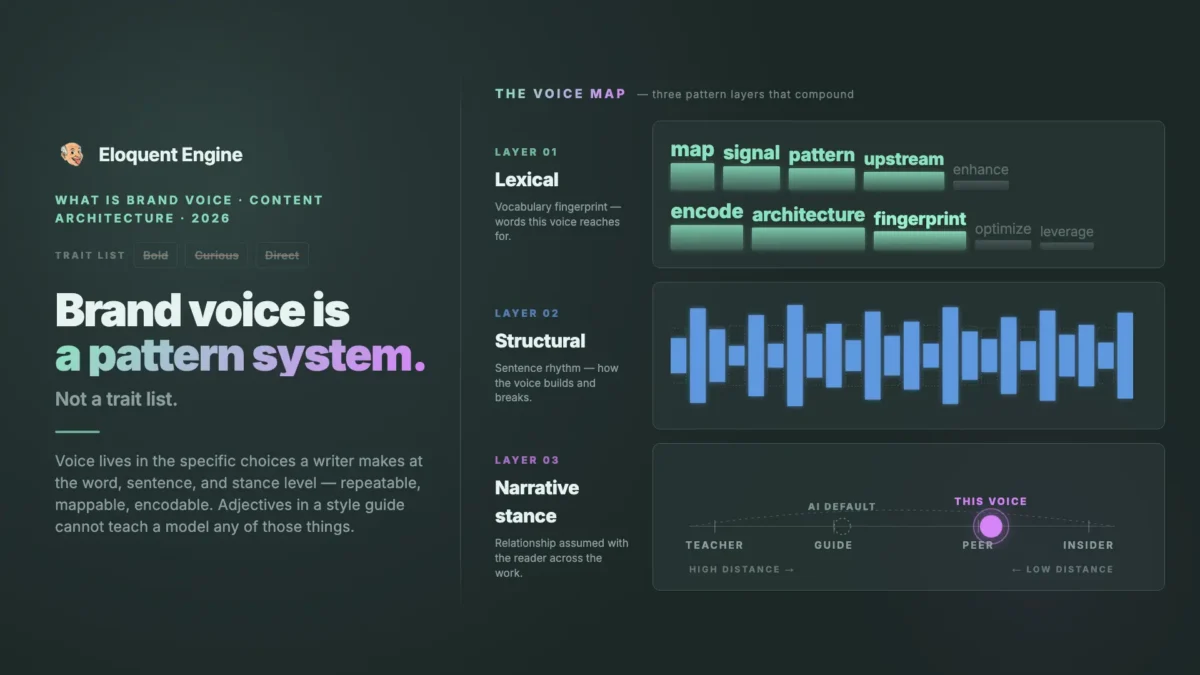
Brand voice is a behavioral pattern set, not an adjective list. “Direct but warm” describes a direction. A pattern is measurable repetition in word choice, sentence structure, and compositional refusal. A pattern is which specific words appear repeatedly, which never appear even when natural, how sentences end, where the claim lands in an argument, what the brand structurally refuses to do. Those patterns are measurable in existing content. They cannot be described in a prompt at sufficient resolution to reproduce them.

The Custom Brand Voice GPT workaround, training on historical social content, gets closer. But surface pattern matching on social posts captures register, not voice. It catches the informal tone without encoding why the brand chose it or how it applies in longer-form content. The output sounds adjacent to the brand, not identical to it. The technical reason AI writing sounds off-brand even with detailed setup traces back to exactly this gap between surface pattern and behavioral data.

As SaaStr observed in examining AI orchestration systems, the real work of AI is not prompt-to-publish but structured orchestration with human oversight. Brand voice encoding is that orchestration problem. The brands that understand this now are building voice architectures while their competitors are still tweaking prompts. In two years, the gap between those two approaches will be visible in every content program. The prompt-optimizers will still be editing for two hours per article. The teams that encoded brand voice as a system input will not.

Why brand voice ai content fails at the system level, not the prompt level

When you prompt a model with “direct and irreverent,” the model generates a statistical average of every piece of content ever described with those words. The output represents the genre, not your specific brand. Your specific departures from the average, the vocabulary choices that make the brand recognizable, the argument structures that feel like you, those are absent from the output because they were never in the input.

I won’t even get into what happens to audience trust when readers start noticing that a brand’s content sounds indistinguishable from every other brand in the category.

The debate over whether human editing is acceptable in a volume workflow has an honest answer: if you are substantially editing every piece for voice, the AI is saving you keystrokes on the parts that did not need your judgment anyway. The hours you spend restoring voice are evidence that the generation failed at the architectural level. SaaStr’s framework on prompt portability levels makes the architectural point directly: prompts that work in one brand context do not transfer to another. Brand voice is context. A prompt that preserved one client’s voice will not preserve a different client’s voice, regardless of how detailed it gets.

Running it through a humanizer after generation only masks the problem. If your output needs humanization, the system architecture failed at generation time. Post-processors are selling a second product to fix the first product’s failure. What AI humanizer tools actually do is randomize perplexity and burstiness scores. They do not know what your brand sounds like and they do not care. The detection score they lower is only a symptom; the broken generation architecture is the root problem.

There is a growing practitioner view that AI should function as a brand voice exploration tool first, analysis and discovery, before it touches content generation at all. That framing is closer to correct. Understand the voice, encode the voice, then generate from it. The sequence matters more than the tool. Whether Google penalizes AI content is the wrong question. Whether your audience can tell you sound like everyone else is the question that determines retention.

What information the system actually needs, and why guidelines are not enough

The consensus view in the practitioner community is that a clear brand style guide, tone, vocabulary, dos and don’ts, can significantly improve AI output consistency. I assumed this too, at the time. Built detailed guidelines documents, watched the output come back hollow anyway. Guidelines describe voice in abstract terms. Systems need behavioral examples to encode it.

Examples. Real examples. That is the input the system actually needs. Actual sentences from the brand showing how vocabulary choices play out, how argument structure works, what “direct” looks like at the sentence level in this brand’s specific construction. The difference between feeding the system a guideline and feeding it examples is the difference between telling a copywriter “we’re irreverent” and showing them fifty pieces of the brand’s existing content.

SaaStr’s observation that brand strength is a prerequisite for AI effectiveness, not an output of it, applies directly here. Brand clarity has to exist before it can be encoded. If your team cannot identify what makes the voice distinct in behavioral terms, specific patterns in specific content, not “warm and direct”, the system cannot surface those patterns either. It reflects what it receives.

What actually needs to go into the system, honestly, is four things most brand context documents do not contain:

  • Vocabulary at the word level. Not “we use plain language.” Ten actual sentences showing which words the brand consistently chooses and which it avoids even when they would be the natural pick.
  • Structural patterns from real content. Does the brand lead with the claim or build to it? Where does the primary assertion land? These patterns require examples to surface. They cannot be described in the abstract.
  • Negative examples. What the brand has cut from its own content is often more distinctive than what it kept. Most guidelines never document refusals. Those refusals are frequently the most recognizable dimension of the voice.
  • Founder and customer language. Unedited founder communications and the exact words customers use to describe the brand’s value. This is where authentic voice lives before it gets polished into something that sounds like everyone else.

The teams that have genuinely resolved the editing-hours problem, where AI generation actually reduces hours rather than shifting them, built this input layer before they wrote a single prompt template. The ones still editing heavily probably skipped this step and convinced themselves it was optional. AI detection scores that flag their content are the downstream signal of that skipped step. Brand voice fidelity is determined by the quality of context input at the beginning, not by post-generation editing. The output is only as differentiated as the context you fed the model.

How to diagnose which variable is actually broken before switching anything

When publishing platforms made content creation easy in the early 2010s, every brand started a blog. Volume exploded. Most of it sounded identical, the same structure, the same advice, the same informational voice, because it was produced by the same tools with no brand differentiation built in. The brands that survived the flood were those with distinctive, recognizable content, not high-volume publishers. They were the ones readers could identify without seeing the logo. The same dynamic is repeating now, at ten times the volume and ten times the speed. The question is where your program sits in that pattern.

There are three variables that break brand voice in AI content. They are distinct, and the fix is different for each:

  • No brand data in the system. Your tool has a description of your brand, not behavioral examples from actual content. Build the brand context document first, founder communications, best-performing copy, customer language, before changing anything else. This is fixable within your current tool.
  • Guidelines too vague to encode. Your brand voice document uses adjective lists rather than patterns extracted from real content. Rebuild each guideline as a behavioral example. “We’re conversational” becomes a specific sentence showing what conversational looks like in this brand’s construction. Do this before evaluating any tool.
  • The tool is the variable. Ask your vendor directly: how does brand context shape generation in your system? If the answer is “add it to your prompt,” that is a different architecture than a system where brand data structures generation from the start. How AI writing tools differ in their approach to brand context is the diagnostic most teams skip entirely when evaluating options.

A prompt library is a tactic, not a content strategy. Isolating the right variable is where the strategy begins.

Start here, not with another prompt

Pull ten pieces of your brand’s most authentic content. Not the most polished, the most real. Extract three patterns from each: one vocabulary choice, one structural choice, one thing the piece refuses to do. Thirty observations. That is the beginning of a brand context document the system can actually use.

From there, the diagnostic question is direct: does your current tool accept this document as a foundational input, or does it treat it as one more prompt variable? If you are evaluating whether your current tool can actually encode brand context or whether a different architecture makes sense, that question is where the evaluation should start.

Without brand data in the system, brand voice cannot be encoded. This is non-negotiable.

Humanizer Tools Feel Like They Should Work. Here Is Why They Structurally Cannot.

Suppose you are a freelancer who just finished a 1,500-word blog post in ChatGPT. It reads fine. You run it through a humanizer, paste the result into ZeroGPT, and watch it flag as AI anyway. You edit, re-run, get a marginally better score. Try a different humanizer. Wonder if you are missing something obvious. Your instinct says this should be solvable with the right tool. That instinct is understandable. It is also pointed in the wrong direction.

The humanizer category was built on a specific assumption about how AI detection works. That assumption is wrong. Once you understand why it is wrong, you’ll see that the tools look like products architected against the wrong problem from the start. Understanding the gap between what humanizers change and what detectors measure is the only way to evaluate anything in this space with any confidence.

What AI detection tools are actually measuring

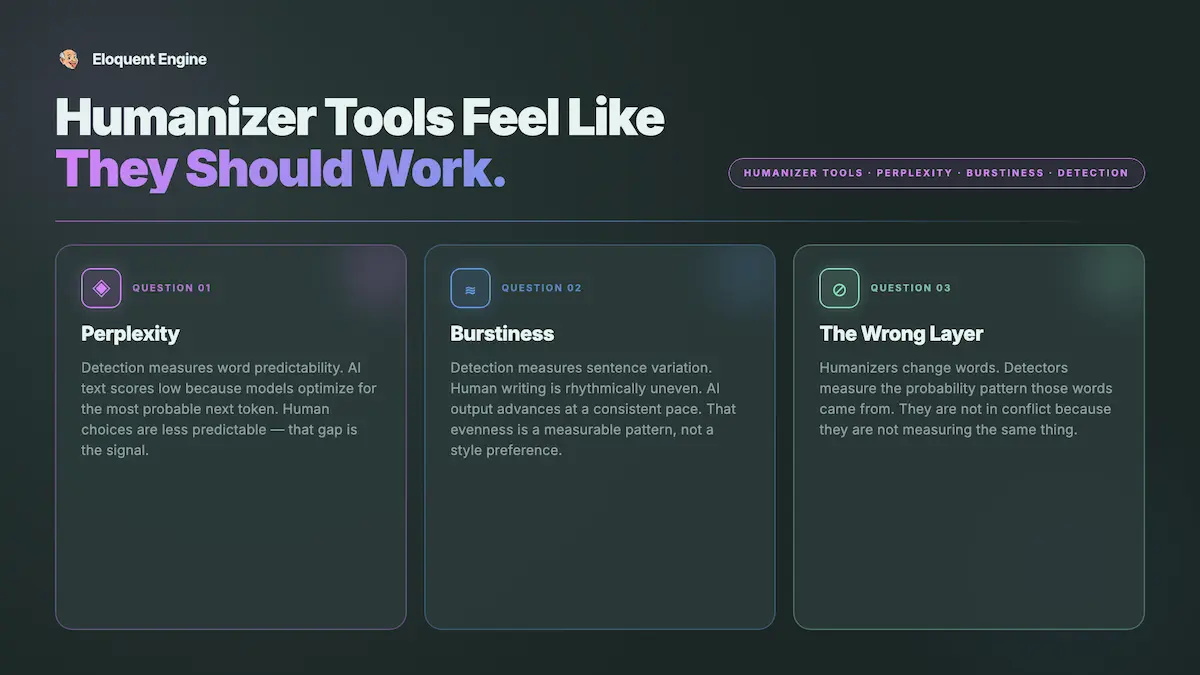
Perplexity. Burstiness. Two properties. Neither one is a fingerprint.

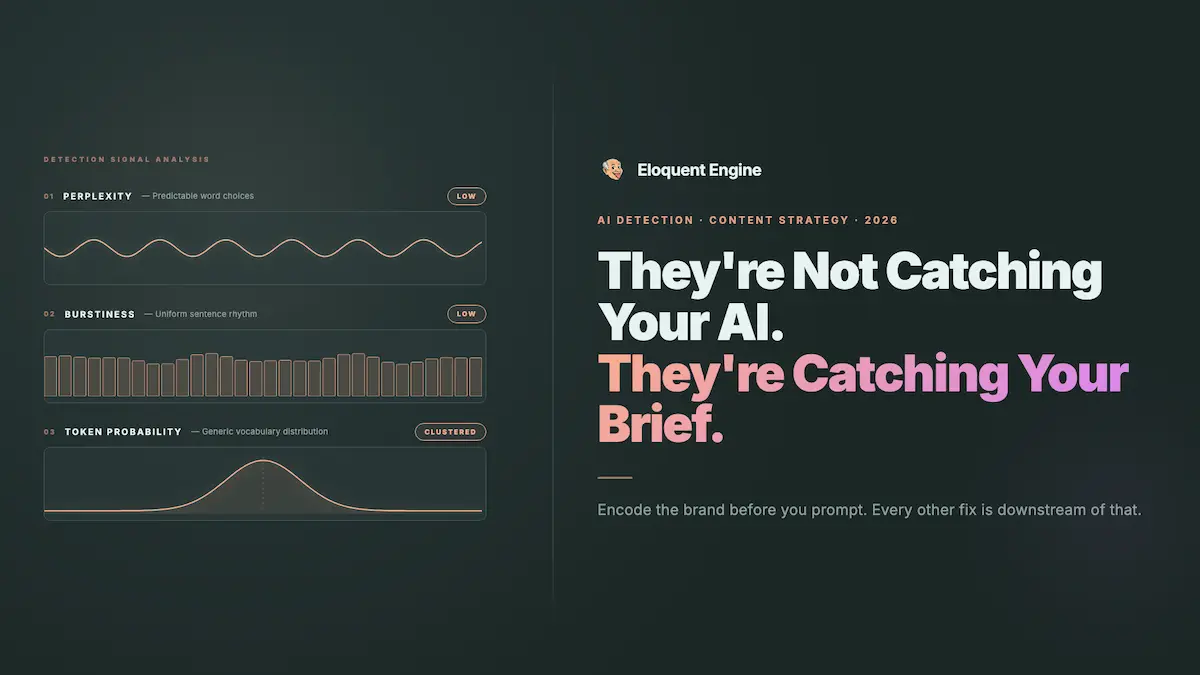
Tools like GPTZero and ZeroGPT do not maintain a library of known AI outputs and check yours against it. They measure how statistically predictable your word choices are and how rhythmically even your sentence structure runs. That is the whole mechanism. There is no proprietary ChatGPT signature to disguise. There is no model-specific tell to spoof. Detection is mathematical, not encyclopedic, and that distinction matters more than most humanizer vendors want to acknowledge.

Perplexity Defined

Perplexity measures word predictability.

A language model generates text by selecting the most probable next token given everything before it. The result is text with low perplexity: every word choice is the obvious one, the statistically comfortable one. Human writers make choices based on meaning, rhythm, instinct, and domain knowledge accumulated over years. Those choices score higher on perplexity because a language model would not have predicted them. Detection tools measure that gap and flag text that consistently sits in low-perplexity territory.

Bustiness Defined

Burstiness measures sentence variation.

Human writing is rhythmically uneven in a specific way: a long sentence working through a difficult idea, then a short one, then a fragment, then two medium sentences before another long one. AI output runs at a consistent pace. Similar lengths, similar complexity, advancing evenly in a way that no human writer actually does. Detectors read that evenness as a pattern.

A practitioner on Reddit ran through sixteen humanizer tools – StealthGPT, WriteHuman, Twixify, Walter Writes AI, HIX.AI, Smodin, Monica AI Humanizer, and a dozen others – and found that only two cleared detectors reliably.

The surface conclusion was “find the right tool.”

The real conclusion is that the other fourteen were doing exactly what all humanizer tools do: changing words on top of a statistical signature those words cannot actually change.

Another practitioner’s fix was to pair the humanizer with prompts that “emphasize human writing patterns.” That instinct is closer to right. But it still assumes the solution lives in post-processing. It does not.

What a humanizer actually changes when it runs your text

When you run AI output through Quillbot or Undetectable.ai, something real does happen. Vocabulary shifts. Sentence openings vary. A passive construction becomes active. The text reads differently. For a while I assumed that these changes were sufficient. If the writing sounded less robotic to me, I guessed it would score differently on a detector.

That assumption missed something kind of fundamental.

The perplexity score of a piece of text is set during generation, when each word is chosen through a probability distribution. When a humanizer swaps “utilize” for “use” or restructures a clause, it changes the words. The statistical residue of how those words were originally selected does not change with them. The generation signature is still present. The detector is still measuring it. The humanizer won the surface contest. The detector was not watching the surface.

Here is what I am not entirely sure how to explain simply: the humanizer and the detector are not really in conflict because they are not measuring the same thing. The humanizer revises the text a reader sees. The detector examines the probability pattern underneath that text. They are operating on different layers, and a change on the surface layer does not propagate down.

Which raises a question worth sitting with. If a humanizer cannot change what a detector measures, what would actually have to change for the statistical signature to shift? That question points somewhere the humanizer industry would prefer you not look too closely.

The detector improves. The humanizer updates. The content stays detectable.

Call it tone polishing. Call it detection evasion. Supposedly these are different use cases for the same tool, and tone polishing is the legitimate one. Nobody wants to say it plainly, but “tone polishing” and “bypasses AI detectors” appear in the same marketing copy, on the same landing pages, for the same products. The distinction is convenient framing, not a product difference.

The arms race framing is the tell. Detectors improve, humanizers update, you find what works right now in 2025. What that framing predictably buries is that “working right now” means the text temporarily escapes a score threshold. The statistical signature did not change. The content did not get better. The detector just has not caught up yet.

You are not beating the detector. You are scheduling the next time it beats you.

The tool does not solve the problem. The tool postpones the problem. Fast mediocrity is still mediocrity, and a lower score on today’s threshold is not the same operation as producing content that earns search equity over time. Pretending otherwise is how agencies bill hours on content that would collapse under a basic detection audit.

The one question every ai humanizer tool should have to answer

Here is the claim humanizer vendors make: the output is undetectable because it sounds more human. A human reader found it acceptable. GPTZero does not care about human readers. GPTZero measures perplexity and burstiness, and a human reader’s approval does not change either one.

The question that separates tools solving the actual problem from tools adding another cleanup layer:

Does this system produce text with human-range perplexity and burstiness during generation, or does it modify surface features after generation?

Those are different operations. One addresses the statistical signature at its source. The other revises words the signature already produced. The table below shows what each approach actually touches.

ApproachWhat it changesWhat detectors measureDoes it close the gap?
Humanizer tool (post-processing)Vocabulary, sentence structure, phrasing, tone at the surface levelPerplexity and burstiness set during original generationNo. Different layers.
Architectural generation (built-in variation)The probability distribution and structural variation used during generation itselfPerplexity and burstiness set during generationYes. Same layer.

Most tools on the market, free and paid, operate in the first row. The free versus paid debate is a distraction. A paid humanizer operating on the wrong layer is still operating on the wrong layer.

The practitioner who pairs a humanizer with prompts that emphasize human writing patterns is groping toward the second row without a clear framework for it. Prompt engineering that intentionally introduces structural variation before generation begins is closer to an architectural approach than anything a post-processing humanizer can do. THREAD builds that variation into the mathematical structure of content planning before a word is generated, which is a categorically different starting point than generating detectable text and patching it afterward.

When a vendor claims their tool is undetectable, ask which row they are in. If they cannot answer that directly, you already know.

Stop auditing humanizer tools. Start auditing generation architecture.

I will not even get into the detection audits sitting in client queues right now, the ones that will surface content that was supposedly humanized and cleared.

The architecture produces the signature. Change the signature by changing the architecture. Everything else is maintenance on a system that was broken at the foundation.

The concrete step: ask your current AI writing tool one question before you run another word through a humanizer. Does this system encode structural variation during generation, or does it rely on post-processing to change what it already produced? That question has a binary answer. Tools in the first category are solving the right problem. Tools in the second category are the humanizer problem wearing a different name.

No amount of polish fixes a fundamentally broken foundation. The reader who understands perplexity and burstiness does not need to test sixteen tools to know which two work. They know why none of them can.

Why Does AI Writing Sound Fake? [Hint: It’s Structural, Not Cosmetic]

You know that feeling deep down when you know you’ve prompted an awful article using ChatGPT. It never sits well, does it?

You publish a piece, maybe ten pieces, and something is just…off. Not wrong exactly, but hollow in a way that is hard to articulate to yourself, let alone to a client watching their blog fill up and seeing zero gains to show for it.

I’ve been there. I assumed, for a while, that the problem was me. That I needed better prompts. That my editing pass was not thorough enough. That the brief was too loose.

Probably most people using these tools go through the same thing, though I am not entirely sure this is universal. You push the content out, watch the analytics, and wait for something to happen that does not happen. The pieces look fine. They cover the topic. They hit the keyword. They do what the tool said they would do. And yet they flatline.

What is strange is that a writer from fifteen years ago would have looked at this moment and recognized the problem immediately: generic copy. The kind that filled content farms and article directories in 2009, churned out fast and forgotten fast.

The same hollow quality, the same predictable arc, the same phrases that technically convey information without actually saying anything. The tools are different now. The underlying output is recognizable from that era.

I missed this connection for longer than I should have, maybe because I kept hoping the problem was fixable at the surface level. Run it through a humanizer. Edit the transitions. Swap the opening paragraph. Try the detection tool again. The scores shifted a little. The content still felt like nobody in particular wrote it. Not entirely sure when I realized that the feeling was accurate. That it was pointing at something structural, not something I had done wrong in the prompt.

That structural thing has a name. Several names, actually, depending on whether you are thinking about it from the generation side or the detection side. Understanding it does not require a background in machine learning. It requires knowing what the model is actually doing when it produces a sentence, which turns out to be quite different from what the marketing copy for every AI writing tool implies.

That gap, between what the tools claim to do and what they mechanically do, is where the hollow feeling comes from. Once you can see it, the inconsistent detection scores make sense. The humanizer failure makes sense. And you stop trying to fix the symptom when the system is what is broken.

What the model is actually doing when it writes

The mechanical reality that tool vendors conveniently omit from their onboarding sequences: a language model does not write. It predicts. Given every token that has appeared in a sequence, every word fragment, punctuation mark, and space, the model calculates a probability distribution over what should come next and selects from the high-probability candidates. Then it does it again. Token by token, for the entire output. No plan. No argument. No sentence conceived before it was assembled.

The training data is where the industry quietly buries the real answer. The model was trained on an enormous corpus. Blog posts, documentation, marketing copy, forum threads, Wikipedia entries, scraped web content of wildly uneven quality. It learned which sequences appear most frequently across that corpus. So predictably, when it generates content, it gravitates toward the word combinations that appeared most often in its training set. The most common writing. Not the best writing. The mean of everything.

(This is why “it’s more important than ever” appears in AI output constantly. The phrase pattern is statistically dominant in the text the model trained on. It learned that this sequence is what follows an opening claim in professional-sounding content. The model does not believe the phrase. It selected it because the probability said to.)

Practitioners have landed on a useful shorthand: AI defaults to sounding like nobody in particular. That is not a creative limitation. That is what happens when you train a system on everything and ask it to produce something. It learns to sound like the average of everything it absorbed, regardless of whether that writing was good. Tolerate that framing for a moment. The model was trained on all the writing, which means it learned to sound like the statistical center of all the writing. Averaged. Homogenized. Unplaceable.

There is a development here that the prompting-optimization crowd glosses over. People who write heavily with AI tools are now finding their own independent writing flagged as AI by detectors. The saturation of AI-influenced text across the web has become the baseline. So content that sounds like the statistical mean of the internet reads as AI-generated even when a human authored it. The problem has spread beyond “this tool produces generic output” to “generic is now the fingerprint.” Prompts can push the model toward less predictable token selections at the margins. But the model still starts from the same probability space. Prompt engineering refines an assembly process. It does not replace that process with something structurally different, and that distinction is what most of the “just learn to prompt better” advice misses entirely.

So why does AI writing sound fake at the pattern level

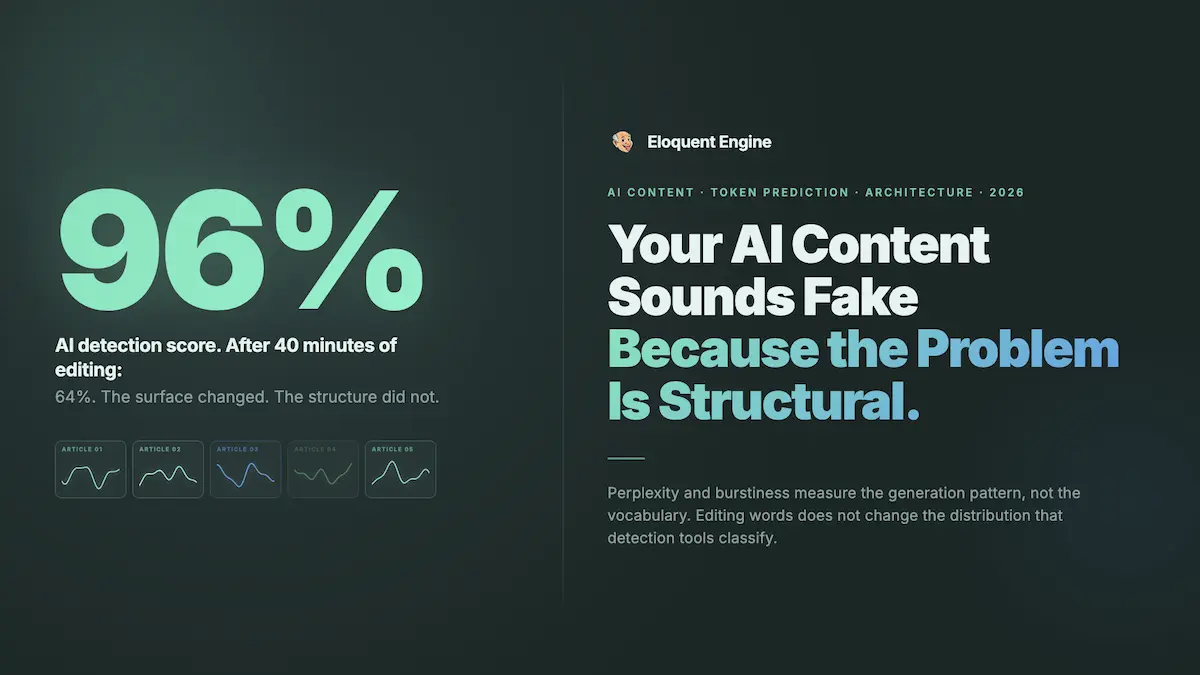
The detection tool just flagged your piece at 96%. You edited it for forty minutes. It is now at 64%.

That number moved because you changed words. The underlying pattern did not move, because changing words and changing a pattern are different operations on different layers of the same content. Tools like GPTZero and ZeroGPT are not scanning for specific phrases. They are not flagging you because of passive voice or because you left in the word “delve.” They are measuring perplexity and burstiness across the entire token sequence.

Perplexity tracks how predictable the text is at the token level. Assembly-based generation produces low-perplexity sequences because the model pulls from the same high-probability neighborhoods across the full piece. Burstiness tracks variance in sentence complexity: human writing alternates between complex and simple constructions in irregular patterns, while assembled content produces more uniform complexity distribution because the token selection process is consistent throughout. Changing a dozen surface words nudges the perplexity metric slightly. It does not touch burstiness. The detection tool reads the whole distribution. That is why the score moved six points and stopped.

There is a position circulating right now that the AI smell is a temporary detection problem, that as prompting gets more sophisticated, the output will pass. Dead wrong. The detection result is a symptom. The structural issue is that assembly-based generation cannot maintain the narrative continuity that makes content feel argued rather than assembled. A language model does not remember what it said in paragraph two when it writes paragraph six. It has context window, but it does not have intent. Each token selection is a local probability decision. The piece does not build toward a conclusion. It accumulates toward one.

That distinction embarrasses a lot of content strategies built on volume. Publish more posts, generate more traffic, fill the topic map. No amount of volume fixes a broken foundation. A hundred pieces that accumulate instead of argue do not create topical authority. They cannibalize each other’s keyword signals. They plateau. They flatline. The “narrative continuity” conversation has been in practitioner circles for a while, framed mostly as a quality complaint. That framing undersells the structural problem. Assembly-based content is fundamentally incapable of producing what search authority actually requires: a coherent body of content that demonstrates a singular, durable point of view across every piece it contains.

Why humanizer tools do not fix this

A brand sends over their analytics. Eight months of AI-assisted content, humanizer-processed, carefully keyword-mapped, structurally clean at the brief level. The traffic curve looks like a plateau that became a cliff at the four-month mark. Solid, systematic effort. Structurally sound briefs. Completely useless result.

The humanizer did what humanizers do. It audited output for statistically AI-like tokens and substituted alternatives at the word and occasional sentence level. The burstiness pattern of the original assembly remained intact across the full content corpus. It had to. No humanizer operates at that layer because no humanizer was present during generation. It arrives at the end of a process that has already produced its pattern signature and patches the visible surface of decisions it never touched.

The appeal of humanizer platforms is structurally predictable. They offer a contained, completable action. Run the piece through the tool, receive a new detection score, feel the problem resolved. The score changes. The sunk cost of the original generation is preserved. The admission that the process was wrong from the start is avoided. What these tools exploit, and the vendors know this, is that detection results are inconsistent. One piece flags at 80%, another passes at 22%. That variance creates uncertainty. The uncertainty creates demand for a product that promises to resolve it. Intentionally or not, the humanizer category has built its market on that uncertainty while doing nothing to address the architectural source of it.

The broader saturation problem compounds this further. If human writing is now being flagged as AI because AI-influenced text has become the internet’s statistical baseline, humanizer tools are calibrating toward a moving target they did not set and cannot control. They are methodically chasing a problem that their own category helped produce.

The tools are not badly engineered. The problem is that they are solving a cosmetic problem while the content architecture underneath remains broken. Diagnosing content performance issues as a detection problem is like auditing your tax return when the issue is the accounting system. The surface review produces a number. The underlying system produces the same problem next quarter.

There is a different order of operations, and it changes what the model produces

Something different is happening with content that earns search equity over time. Different in the order of operations that produced it, not in how it looks on the page.

Before a word was chosen, the structure existed. The specific claim. The sequence of reasoning that supports it. The transitions that are not filler transitions but logical connectives, present because the argument required them, not because the model defaulted to “with that in mind” or “building on this.” The argument was built before it was written. That sequence reversal is the whole problem right there.

The New York Times ran a piece explaining why AI writing sounds generic, centering the explanation on vocabulary patterns: the bloated language, the canned transitions, the phrases AI defaults to because they are statistically dominant in its training data. That explanation is accurate as far as it goes. It frames the problem as a word-choice problem, which is where most advice about “editing AI content more carefully” comes from. Swap the bloated language for less common synonyms. The token-level pattern signature persists. The narrative flatline persists. The piece had no architecture before it had words, and no vocabulary substitution reconstructs an architecture that was never built.

Construction-first content generation starts with the argument, not the prompt. What specific claim does this piece make? What is the minimum logical sequence required to support it? What does the reader need to understand in section two before section four makes sense? Those answers exist before the model generates a single token. The model is then constrained by an argument structure, not released into a probability space to find its own way there.

The pattern signature of construction-first output measures differently because the model was pushed off its statistical defaults at every structural level. Perplexity is higher because the argument required specific word choices the model would not have selected probabilistically. Burstiness is more human in its distribution because sentence construction was governed by logical necessity, not token-level probability averaging. The THREAD methodology builds content this way, establishing the logical architecture before generation begins, which is why the resulting output measures differently on detection tools from the start rather than requiring remediation after the fact.

You can gut-check your own approach before the next piece. Does the specific argument structure exist before you open the tool? Not the topic. Not the keyword. The claim, the support, the sequence. If those are determined inside the tool as you prompt it, you are assembling. The output will carry the signature of that assembly regardless of how well you edit it afterward.

The question to audit before your next piece goes live

The publish-more mentality is costing sites rankings in ways that were not obvious when the volume strategies launched. The evidence is accumulating methodically: programs that published aggressively on AI-assisted volume in 2023 are watching traffic erode, while programs with thinner but architecturally coherent content are holding position. The brands that moved fastest on content velocity have, in several documented cases, done the most measurable damage to their own content moats. Speed was the promise. Content cannibalization and topic overlap were the delivery.

Diagnosing where your program sits requires auditing at the architectural level before touching individual pieces. Check for keyword cannibalization across your existing indexed content before assigning new topics. Audit for topic cluster coherence: do your pieces build toward a demonstrable point of view on a subject, or do they cover adjacent ground without connecting? Evaluate your internal link architecture. Posts without deliberate internal link context contribute less to topical authority than posts with explicit structural relationships to the cluster they belong to. These are decisions that happen before any AI tool opens, and they determine whether your content earns compounding search equity or accumulates into a plateau.

The detection question, will this piece pass a GPTZero scan, is downstream of the architecture question. Content built from an argument structure that constrained generation carries a different pattern signature from the start. Content assembled from probability distributions and humanized afterward carries the original signature regardless of what the humanizer returns. Calibrating your diagnostic priorities around detection scores is solving at the wrong layer.

The concrete action before the next piece: write the argument before you write the prompt. The specific claim this piece makes. The specific reasoning that supports it. The specific sequence the reader needs to follow to arrive at the conclusion. Write those down first. Then open the tool. Generation constrained by a pre-existing logical structure will behave differently at the token level, measure differently against detection benchmarks, and read differently to an audience that has been exposed to enough assembled content to recognize the absence of an actual point of view.

Publishing at speed remains a viable operational choice. Publishing at speed without architectural clarity is the specific practice that is failing systematically now, and the evidence for that failure is in the analytics of anyone willing to audit it honestly.

Does Google Penalize AI Content? No. It’s Measuring Something Else…

Does Google penalize AI” is the wrong question. Not because the answer doesn’t matter, but because framing this as a Google detection problem lets you off the hook for a deeper one.

Here is what is actually happening. Thousands of sites are publishing AI-generated content every week. Some rank. Most flatline. The ones that rank are not winning because they fooled a detection system. They are winning because someone built them to win.

The tool didn’t do that. The content plan did.

You can gut-check any piece of content you’ve published in the last six months against four concrete criteria and know immediately whether it has a structural problem. No Google announcement required. No vendor take needed. The answer is in the content itself, and it has been there the whole time.

Audit, diagnose, fix, rebuild, publish. Most people never get past the first step because they are waiting for permission from the wrong source. The permission they are waiting for, official confirmation that AI content is safe, arrived years ago. Everyone missed it because it didn’t come with a checklist.

Does Google Penalize AI Content? Here Is What It Actually Measures.

“Google doesn’t care how content is made, as long as it’s helpful and not spammy.”

True. Also completely useless as guidance for anyone trying to make a publishing decision this week.

Google’s official documentation states that AI-generated content is not against their spam policies. That statement gets quoted everywhere, predictably, by people who want it to close the conversation. It doesn’t close anything. It relocates the question: if AI content as a category is not penalized, why does so much of it fail to rank?

The answer is E-E-A-T. Experience, Expertise, Authoritativeness, Trustworthiness. Google’s quality raters guidelines use this framework to evaluate whether a source has a genuine, developed relationship with its subject matter. None of these signals are evaluated at the sentence level. They compound across a site’s entire content record. The author’s publication history, the depth of coverage across a topic cluster, the relationships between pieces, the external sources that reference the domain as credible.

“It’s impossible to tell it’s AI anyway. How would Google even penalize it?”

That question misunderstands what Google is measuring. Consumer tools like GPTZero analyze perplexity and burstiness. Statistical variation in text patterns. Google’s systems are not running GPTZero on your blog posts. They are measuring something structurally harder to fake: whether your content, your author identity, and your site have a demonstrable relationship with the topic being addressed.

That relationship either exists or it doesn’t. Whether Google can reliably detect AI content is genuinely debatable. Some practitioners are right that AI content detection is unreliable, and penalties must therefore be pattern-based rather than origin-based. My position: that distinction doesn’t change the strategy at all. If Google is penalizing bulk production patterns rather than AI origin, the fix is identical. Build the authority signals that bulk production systematically omits.

The debate over whether poor AI content performance is algorithmic punishment or just bad content reaching the market at scale is worth noting. The honest answer is that it’s structural. The same content written by a human with no topic architecture fails the same evaluation. The tool is not the variable. The architecture is.

The Tool Is Not the Problem. The System It Was Built For Is.

Most AI writing tools are designed around one metric: throughput. Brief in, draft out, calendar filled. That is the value proposition. And it works, if filling a calendar is the goal. Building compounding topical authority requires something different entirely, and practitioners should be honest about that distinction rather than pretending the two objectives are compatible by default.

Thoughtfully-produced AI content ranks. Practitioners who say this are observing something real. The operative word is thoughtfully, which in practice means: the content was assigned a structural reason to exist before anyone opened a writing tool. It was mapped against an existing topic cluster. The keyword was checked for cannibalization risk against what the site already has indexed. The SERP intent was manually verified before a format was chosen. The author entity attached to the piece has a publication record that supports it.

Most teams using AI tools for content are not doing those things. The tools were not marketed to require them. Brief-to-publish pipelines got faster; the architecture layer never got built. What gets produced is technically competent, topically orphaned, and structurally indistinguishable from the other eleven articles ranking for the same term.

That is the whole problem right there. The publish-more mentality treats content velocity as the lever. Velocity without architecture is just faster content debt.

, The approach that separates topic architecture from content production starts before the first word gets written. That sequence matters more than the tool used to write it.

How to Audit Whether Your Content Has the Signals That Actually Matter

Your content either demonstrates authority or it doesn’t. That is not a style problem. It is a structure problem, and structure is checkable.

Run every published piece, or every piece scheduled for this month, against these four questions. They correspond directly to what E-E-A-T evaluates, translated into criteria a practitioner can apply without a technical audit tool.

Does this piece sit inside a topic cluster, or does it stand alone? A single article on a subject is a data point. A site with six interlinked pieces covering a topic from different angles, audience types, and use cases is a signal. Standalone content can rank for low-competition terms. It collapses under anything competitive. Check whether this piece links to and receives links from related content on your site. If you cannot trace a path from this article to at least two others on your domain that address related aspects of the same subject, you have an orphaned piece.

Does the author identity attached to this content have a visible publication record on this subject? Google’s quality raters guidelines evaluate authoritativeness in part by tracing the author’s relationship to their topic over time. An author bio with three sentences and a stock photo does not support a topical authority signal. An author entity with a consistent byline, accumulated content on the subject, and ideally some external citations. That builds. If your content publishes under no byline, or under a generic brand name with no individual attribution, you are missing a signal that survives contributor turnover.

Does this piece add something the twelve other articles on this keyword do not? Open the SERP for your target term and read the top five results. If your article covers the same structure, the same points, and the same depth, Google has no algorithmic reason to prefer it. The question is not whether your piece is well-written. The question is whether it is differentiated. Specificity, a distinct angle, a use case the others skip, a genuine disagreement with the consensus position. These are the properties that separate content that earns search equity from content that flatlines despite being readable.

Would this piece embarrass you in front of someone who knows the subject? This is the gut-check that catches what the technical criteria miss. If a practitioner in your vertical read this piece, would they learn something? Would they trust the source enough to share it? If the honest answer is no, no structural fix will compensate for the fundamental problem. The content collapses on its own weight.

Your content either demonstrates authority or it doesn’t. Four questions tell you which is true. The answer determines whether you publish, revise, or rebuild from a different architecture entirely.

What to Do Before Your Next Piece Goes Live

Three years ago, teams spent significant budget on exact-match anchor text and private blog networks because the path to rankings felt like a manipulation problem. Then Google updated, the sites collapsed, and the practitioners who had been building actual topical depth, methodically, without shortcuts, kept their rankings. The lesson was not subtle. It just arrived late for people who had been billing hours for the other approach.

The current moment rhymes. “Bulk-generated content” is today’s version of the same mistake: optimizing for a signal Google has already announced it will devalue, while the practitioners building structural authority watch and wait.

Before your next piece publishes, do this:

  • Map the piece to an existing topic cluster on your site. If no cluster exists, build the cluster before publishing the piece.
  • Check for keyword cannibalization against what you already have indexed. Two pieces chasing the same term cannibalize each other’s authority.
  • Assign a real author entity with a consistent publication record, or begin building one now.
  • Verify SERP intent manually before choosing a content format. A listicle targeting a keyword Google is answering with comparison pages will not rank regardless of quality.
  • Ask the embarrassment question before you hit publish. If the answer is uncertain, the piece needs revision.

None of this requires a different AI tool. It requires architecture before output. The teams still asking whether AI content gets penalized are solving the wrong problem. The teams auditing their topic clusters, mapping their authority gaps, and building with structure first. Those teams already moved on.

Why Every Jasper AI Alternative (Except Eloquent Engine) Produces the Same Flat Output

Searching for a better Jasper alternative? Here’s why almost no one finds a better one.

You know the feeling: six months of Jasper output, and the edit cycles are longer than the writing. The content calendar is full. Every piece is technically correct, grammatically clean, and somehow identical in feeling to the piece from last week and the week before that.

A prospect ran your last post through ZeroGPT and sent you the screenshot of a super high AI detection score followed by the question no one wants to hear: “client asked, quietly, whether the articles were “”was this written by a real person?”

So the search starts. Jasper AI alternative. Cheaper. Just as good. ChatGPT underneath anyway. Unlimited usage. Haven’t been happier.

That is the whole problem right there.

The alternatives market is built around a comparison that flatlines the moment you pressure-test it: feature parity at lower cost. Copy.ai has better built-in scripts. Writesonic is much more budget-friendly. Orwell is great for blogs. Every one of these claims might be true. None of them address why Jasper stopped working for you. And if you don’t know why Jasper stopped working, you will burn through the next tool the same way.

The comparison everyone runs treats this as a tool problem. It is an architecture problem. The tool is just where you finally noticed it.

The output keeps sounding the same because the architecture keeps doing the same thing

Here is what most vendors will not say out loud: the sameness problem you’re experiencing with Jasper will follow you to Copy.ai and to Writesonic and to whatever comes next, because the sameness problem lives in the workflow structure, not the tool.

Every mainstream AI writing platform runs on a version of the same pipeline. A user provides a topic and a brief. The model generates text by predicting the most probable sequence of words given that input. And the output enters the world. That’s it. That is the entire architecture.

And it guarantees content convergence because “most probable” is definitionally the center of the distribution. It is the gravitational middle of everything that has already been written. Run enough topics through that pipeline and every piece pulls toward the same place, regardless of which tool is generating the prediction.

Now, a fair objection: couldn’t a better model make the output less generic? And the honest answer is yes. Partly, and temporarily. The AI SaaS pricing conversation happening right now is largely about this: vendors are trying to justify premium pricing against a market that has decided the underlying model is commoditized. The practitioners saying “ChatGPT-powered alternatives are just as good as Jasper” are probably right. Not because Jasper’s model is weak, but because model quality has stopped being the differentiator. The pipeline is the differentiator. And the pipeline across all these tools is the same.

Humanizers don’t fix this. They operate on surface features, synonym substitution, sentence length variation, burstiness adjustment, and they do move perplexity scores on older detection methods. What they don’t touch is the reasoning signature underneath: the way a paragraph sequences its evidence, the predictability of how a point resolves, the statistical coherence of the argument’s structure. Tools like GPTZero are measuring those patterns now. You can paraphrase AI output into oblivion and the detection signature is still there, in the shape of the logic.

And this is where the self-undermining admission has to land. We looked at this problem for a long time and assumed a better prompting system was the answer. Better briefs. More specific inputs. Tighter templates. And those things helped, and the testing improved the output, and the detection scores moved in the right direction. And the content still flattened after sixty days. The brief was not the bottleneck. The pipeline was. No amount of volume fixes that. No amount of humanization fixes that. Fast mediocrity is still mediocrity.

The reason this matters before any tool comparison: if the sameness problem comes from the pipeline, then switching to a cheaper tool with the same pipeline structure is not progress. It is just a lower subscription fee for the same outcome.

Before you switch anything, run this diagnostic on your own workflow

The debate over which underlying model matters more, Jasper’s proprietary training versus GPT-4 versus Claude, is the wrong debate. Practitioners choosing ChatGPT-powered alternatives because “the core model is what matters” are making a reasonable guess that happens to miss the actual leverage point. The model is not where this breaks. The workflow is where this breaks.

Here is the diagnostic. Three questions. Answer them honestly before you sign up for anything.

First: where does brand voice live in your current system? If the answer is “in the brief” or “the writer knows it” or “we have a style guide somewhere,” your brand voice lives outside the tool. That means every generation starts from a generic baseline and you edit toward distinctiveness after the fact. That editing overhead is not a tool problem. A different tool produces the same baseline and requires the same editing.

Second: does your content system have a structural reason for each piece to exist? If topics come from a keyword list without a pillar-cluster map, without a cannibalization audit, without a documented gap in your existing topical authority, then AI output fills arbitrary slots in an arbitrary calendar. Measurably, this produces content that flatlines on Google despite being well-written. Changing the tool does not change the strategy. The tool is not the strategy.

Third: what happens to the AI’s output before it publishes? If the answer is “we edit it,” the question is what you are editing toward and whether any tool shortens that distance. If the answer is “we run it through a humanizer,” you have already admitted the tool’s raw output fails your quality bar. A different tool’s raw output will fail in a similar way, because the failure is structural.

If brand voice is inside your generation system, if every piece has a structural reason to exist, if the output requires minimal editing because the inputs are architecturally complete. Then a tool switch might actually help. You are calibrating a working system. If those conditions don’t hold, you are shopping for a tool to fix a system that the tool cannot reach.

What you actually need a Jasper AI alternative to do differently

You searched for this comparison six months ago and found a roundup. Copy.ai, Writesonic, Rytr, maybe Anyword. The listicle said they were much more budget-friendly. You may have even tried one. The output was fine. The edit cycles were the same.

That is the circular structure of this problem: the tool changes, the workflow stays broken, the content flattens, the search starts again. Each lap through that cycle costs you time and detection risk and, eventually, client trust. The consequences escalate. A piece that sounds AI-generated embarrasses the individual writer. A pattern of AI-sounding content erodes the client relationship. A failed detection audit collapses the retainer.

So when you evaluate any alternative, including this one, evaluate it on criteria that actually map to the failure mode:

  • Does brand voice live inside the generation process, or does it require post-generation editing to appear? Tools that take brand input as a parameter before generating are architecturally different from tools that generate first and let you adjust after.
  • Does the tool have a strategy layer, or does it require you to bring strategy to it? The publish-more mentality is costing you rankings. A tool with no built-in pillar-cluster logic or cannibalization awareness makes that problem worse, not better.
  • Does the output pass detection at the reasoning level, or only after humanization? Detectable AI content is a liability. If a tool requires a humanizer pass to be publishable, the architecture has already failed.
  • Does content uniqueness come from the generation process, or from your editing? If you are the source of originality and the tool is the source of structure, you are doing the hard work and paying for the scaffolding.

Template libraries are not on that list. Unlimited usage is not on that list. “ChatGPT but with built-in scripts” is not on that list. Those are features. These are criteria.

Here is how the tools actually compare when price stops being the only criteria

Okay, but you have a vested interest here. This comparison is going to make Jasper look bad and Eloquent Engine look great. That’s what these pages do.

That’s fair. So let’s establish what the comparison is actually measuring before scoring anything. And let the criteria do the work.

The live disagreement in practitioner communities right now is between all-in-one platforms like Copy.ai and Writesonic versus specialized tools like Orwell for blog generation and Wilde for optimization. The emerging consensus is that specialized tools outperform generalists for specific use cases, despite being more budget-friendly. That claim is probably true at the task level. Orwell may generate a better blog draft than Jasper for a comparable input. The task-level comparison is real.

The problem is that no collection of specialized task-level tools addresses the system-level failure. You can have the best blog generator, the best optimizer, the best humanizer. And still produce content that cannibalizes your own keyword targets, ignores your brand differentiation, and flatlines at month three. The tools improved. The architecture stayed broken.

CriteriaJasperCopy.ai / WritesonicSpecialized tools (Orwell, Wilde)Eloquent Engine (THREAD)
Brand voice inputPost-generation style guide; requires editing toward brandLimited voice parameters; primarily template-drivenTask-specific; no persistent brand layerEncoded before generation; part of the mathematical input
Strategy layerExternal; user brings topic and keywordExternal; template selects format, not strategyExternal; task is defined, strategy is notInternal; pillar-cluster logic and topical gap analysis built into content architecture
Detection riskRequires humanizer pass for reliable detection scoresSame pipeline; same detection signature; same humanizer dependencyTask output varies; detection risk varies by toolGeneration from a mathematical foundation rather than statistical text prediction; structurally different output signature
Content uniquenessDepends on prompt quality and post-editingTemplate-shaped output; uniqueness comes from user input qualityBetter task-level output; no uniqueness at the reasoning levelUniqueness from brand research and audience intelligence inputs; generated from a differentiated foundation
Cannibalization awarenessNone built inNone built inNone built inStructurally integrated into topic assignment

I want to be genuinely honest about one cell in that table. Whether THREAD’s detection scores hold across all content types and all detection tools. I am not certain. The tools are moving. GPTZero updates its models. What passes today may not pass in six months. What I am confident in is the architectural reason why the approach is structurally different, not just cosmetically different. The generation starts from brand research and audience intelligence encoded mathematically, not from a topic prompt run through a prediction engine. That is a different kind of input producing a different kind of output. Whether that difference is large enough for your specific situation depends on what your specific situation actually is.

That uncertainty is not a disclaimer. It is the honest answer to a market that has been sold too many guarantees already.

The architecture rebuild is not as complicated as it sounds

Three years ago, the conversation about AI content was about speed. How many posts per week could a tool produce. How fast could a writer go from brief to published. The assumption underneath all of it: more output equals more results. We got burned on that assumption. Everyone did.

Now the conversation is about architecture. And the reversal that matters is this: the question was never what can AI produce for your content system. It was always what does your content system need to give AI before it can produce anything worth reading.

The rebuild has three concrete pieces, and none of them require a genius to implement.

Brand voice engineering before generation. Document not just tone but point of view. The positions your brand takes, the things it refuses to say, the specific knowledge it brings that no other brand in the category has. That becomes an input, not an editorial pass.

Topic architecture before the calendar fills up. Map your pillar clusters. Run a cannibalization audit on what you already have indexed. Every new topic assignment needs a structural reason to exist: a documented gap, a cluster connection, a SERP intent that isn’t already served by something you published. This is what building compounding topical authority actually looks like operationally.

Detection as a quality signal, not a final check. If content is running through ZeroGPT after publication, the workflow is checking the wrong thing at the wrong time. Detection risk surfaces during generation, at the architecture level. The fix is upstream, not at the end of the pipeline.

THREAD’s mathematical approach to content strategy operationalizes exactly these inputs, brand research, audience intelligence, and topical architecture, as the foundation before any content is generated. The architecture piece was not obvious at all when we were building it. Took longer than it should have to understand that the output problem was really an input problem.

So where does this leave you

Probably somewhere uncomfortable. You came here for a comparison and the comparison is in that table. But I am not sure the table is the thing you needed most.

Think about what happens when a business hires a faster printer because their marketing isn’t working. The printing gets faster. The marketing still isn’t working. The printer was never the constraint. Switching tools when your content system is the constraint produces the same outcome: the new tool runs faster through the same broken process.

If you ran the diagnostic in section three and your brand voice lives inside your generation process, your topics have structural reasons to exist, and your output passes detection without a humanizer. Then the comparison table tells you something actionable. You are choosing between real options.

If those conditions don’t hold, the honest question is: how long can you keep switching tools before a client runs a detection audit you can’t explain? That window is closing. The detectors are getting better and the clients are getting more aware, quietly, in ways they don’t always say out loud. The cost of staying in the current architecture is not zero. It is accumulating, probably faster than it feels right now.

I assumed good tools were enough for longer than I should have. Maybe that was just us.

AI Content Detection Is Not A Guessing Game. Here Is Exactly What AI Detectors Measure.

AI content detectors hit the market right when ChatGPT, Claude, and Gemini became mainstream. Before the humanizer tools, before the “AI-safe content” marketing, before the product categories built around evading scores. The detection came first.

The metrics being scored were defined, training distributions were built, scoring systems were calibrated. All of that existed before humanization became something you could buy.

That sequence is the whole problem right there. Humanizer tools were designed to address a measurement that already knew what it was looking for. Not to change what the measurement captures. To move the number. Those are not the same thing.

If you paid for a humanizer and felt like it might not be working. You were not wrong. You were measuring the right instinct with the wrong framework. The tool was not broken. The category has a structural limitation that does not appear in the pricing page. That is worth understanding before you buy another one, or before you explain your content strategy to a client who just asked about it.

What follows is the mechanics. What detection tools actually measure. Why AI-generated text has those properties in the first place. What humanizers can and cannot change about them. And what a genuinely different approach would need to do.

What AI content detection actually measures. And why the metrics matter

Detection tools are not performing editorial judgment. They are running statistical measurements and comparing results to distributions of known human and AI-generated text. Two metrics drive most of this: perplexity and burstiness. Not “AI patterns.” Not “robotic phrasing.” Measurable numbers.

Perplexity measures how predictable the text is relative to a language model’s probability distribution. At every step of generation, a model assigns probabilities to every possible next token and selects from the high-probability options. It is optimizing for coherent, contextually appropriate output. Which means it makes token choices that are statistically expected. Low perplexity means the text is predictable to a language model. High perplexity means the text contains choices the model would assign low probability to: an unexpected word with the right texture, a structure that is technically awkward but emotionally precise, a detour the model would never take because it does not optimize for effect. Human writers make those choices constantly. AI-generated text clusters around the high-probability selections, which produces measurably lower perplexity across the passage.

Burstiness measures variance in sentence length and complexity. Human writing is irregular. Short declarative next to a long subordinate clause, three tight sentences followed by one that runs long because the thought demands it. The rhythm follows the argument. AI-generated text tends toward regularity: sentences cluster in a similar length range, complexity distributes evenly, and the whole passage reads smoothly. That smoothness is not a quality signal. It is a detection signal.

Tools like GPTZero and Copyleaks are trained on corpora labeled as human or AI-generated. They learn what perplexity and burstiness distributions look like for each category, then score new text by running the same measurements and comparing results to those training distributions. The output is not a guess about whether the text sounds AI-generated. It is a measurement of where the text sits relative to two known statistical populations. The “accuracy doubts” and “serious accuracy concerns” practitioners discuss on Reddit are real. No tool is perfectly calibrated, and edited or hybrid content creates genuine classification challenges. But the underlying metrics are valid. The uncertainty is about implementation, not about whether perplexity and burstiness are real signals. They are.

One claim circulating among practitioners is worth addressing directly: that the correct response to detection anxiety is to stop obsessing over scores and focus on deploying AI at scale. That argument has real force at the strategic level , the practitioners building content systems are ahead of the ones still evaluating tools. But “stop worrying about detection” only works if the architecture of what you are deploying actually avoids the problem. Deploying at scale while ignoring the structural signature is not a deployment strategy. It is volume on top of a broken foundation.

Why the signature exists. And why this part is actually simpler than it sounds

The statistical signature in AI-generated text is not a flaw in the model. It is a direct product of how generation works, and I assumed for longer than I should have that this was complicated to explain. It is not.

A language model generates text token by token. At each step, it conditions on everything before it and selects the next token based on probability. The model is not deciding what it wants to say and then finding words for it. It is producing the statistically most coherent continuation of what it has already produced. That mechanism, repeated thousands of times across a piece of content, creates a specific statistical shape: smooth, predictable, uniform in complexity. Every sentence is appropriate. Every transition is clean. The whole thing reads well. And the underlying pattern is measurably different from what a human produces when actually thinking through a subject.

Human writers make decisions at multiple levels simultaneously. Argument, structure, word texture, sentence weight. Those decisions produce irregular patterns. The irregularity is the signal. It is not carelessness; it is the natural output of a mind working through something rather than optimizing for coherent continuation.

Some practitioners argue that detection tools are mostly solving a plagiarism problem, not a quality problem. And there is probably something to that framing. Detection and quality are different measurements. Organizations deploying AI at the systems level have figured out that the real challenge is architectural integration, not whether the output passes a score. But those are not competing concerns. The statistical signature matters because clients and platforms measure it. The quality problem matters because readers and search engines measure it. You can fail both tests with the same piece of content, and it is worth understanding them as separate mechanisms rather than assuming fixing one fixes the other.

What humanizer tools change. And the one thing they structurally cannot

A humanizer that claims to solve AI detection has to answer a specific question: which metrics does it actually change, and are those the metrics that detection tools measure? Most humanizer tools do not answer that question in their documentation, which is worth noticing.

Post-processing transformations are real. Synonym substitution, sentence restructuring, insertion of informal phrasing, variation of sentence length. These operations change surface metrics. Insert a two-word sentence after a long one, and measured burstiness rises. Substitute a low-frequency synonym for a high-frequency one, and the perplexity score nudges upward. A practitioner who runs content through a humanizer and then through a detection tool will often see the score move. That movement is not fabricated. It reflects real changes in measurable surface properties.

What it does not reflect is any change in the underlying token probability pattern. The statistical shape of how the content was constructed, token by token, probability-weighted, optimized for coherent continuation, is not touched by post-processing. Because post-processing is editing. Editing changes individual data points in a distribution. It does not change the shape of the distribution itself, which is what the detection model was trained to classify.

Consider what practitioners have already observed about Turnitin: it works correctly for content that is entirely AI-generated, working reliably in those cases, but performance degrades meaningfully when content is edited or run through additional tools. That observation reveals the detection mechanism more clearly than most vendor documentation does. The detection is reading a statistical shape. Editing perturbs individual points without restructuring the shape. Enough perturbation, particularly in heavily rewritten sections, can move a score substantially. But partial perturbation, which is what most humanizer workflows produce, leaves the underlying signature largely intact.

A freelancer billing content hours who runs everything through a humanizer is not building on a different foundation. The detection architecture is still there. The pattern is still classifiable. The score might look better today than it did last week. Whether it looks better than the detection models of six months from now is a different question. Systematically solving this problem requires changing what the content is made of, not applying a layer of variation to the surface of what was generated. The humanizer category addresses symptoms. The signature is structural.

What Google is actually doing. And why the answer is less satisfying than practitioners want

The mainstream claim is that Google has automatic AI detection built in and algorithmically penalizes AI content in rankings. A number of practitioners state this with confidence. The evidence for it, at the level of mechanism, is thin.

What Google has consistently documented is quality assessment through E-E-A-T signals: experience, expertise, authoritativeness, trustworthiness. These are not perplexity measurements. They are not burstiness scores. They are signals about whether content demonstrates real subject matter depth, original perspective, and the kind of specificity that comes from someone who actually knows what they are talking about. Google’s systems are trained to reward that. They are not trained to run content through GPTZero.

The nested point here matters: AI-generated content that was produced without genuine expertise, without editorial architecture, and without substantive human input tends to fail on E-E-A-T signals. Not because Google detected the generation mechanism. Because the content lacks the properties E-E-A-T rewards. The risk is real. The mechanism is different from what ZeroGPT measures, and conflating the two leads practitioners to optimize for the wrong thing. Chasing detection scores while the quality signal problems compound quietly in the background.

ZeroGPT having serious accuracy doubts, as the practitioner consensus acknowledges, should not be read as evidence that detection is irrelevant. It should be read as evidence that detection tool scores and actual search performance are measuring different things. A piece of content can pass ZeroGPT and still accumulate quality signal problems. It can flag as AI-generated and still rank well if it has genuine depth. Running detection scores as a quality proxy is the wrong diagnostic. Both things are worth addressing. They require different responses.

What ground-up construction actually changes

I spent longer than I should have thinking architecture was something you added after the first draft. That assumption flatlines the moment you understand what detection is measuring.

The signature is not in the words. It is in the construction process. Token-by-token probabilistic generation produces a specific statistical shape because the mechanism is always optimizing for coherent continuation from a blank context. The shape is a product of that mechanism. You cannot edit it away because the editing happens after the mechanism has already done its work.

Ground-up construction changes the conditions before generation begins. A topic framework built around documented expertise. An outline that reflects actual argument structure. Source synthesis and editorial direction that constrain what the model generates and how it generates it. When a language model writes within those constraints, the output reflects human decisions made at the structural level. The generation still uses probabilistic selection. That part does not change. But it is operating inside an architecture built by a person thinking through a subject, which produces different patterns than generation operating from nothing but a prompt.

The result is content that does not need to hide. Not because the tool is better at disguising the signature. Because the signature is different in the first place. That is the distinction worth understanding: disguise the output versus change the architecture. The former requires constant effort to stay ahead of improving detection models. The latter produces a different kind of content from the start.

If you want to understand what that looks like in practice, Eloquent Engine’s approach to content architecture starts with mathematical structure before any generation begins. The mechanism is what changes the signature. Not the post-processing.

The question worth asking before you evaluate any AI writing tool

Understanding perplexity and burstiness is useful. What you do with that understanding is what matters. Before evaluating any AI writing tool or humanizer service, one question cuts through the marketing: what metrics does this actually change, and are those the metrics that detection tools measure?

If the answer involves vocabulary frequency, sentence length variance, or readability scores. The tool is operating at the surface. Those changes are real. They are not sufficient to alter the underlying distribution that detection models classify.

If the answer involves how content is constructed before generation begins, the problem is addressed at the level where the signature originates.

The consequences of confusing these two answers escalate in a specific direction:

  • Detection scores improve temporarily, because surface metrics shifted. But the underlying signature persists, and newer detection models close that gap because they are trained on increasingly edited and humanized content.
  • Client relationships become exposed, because detection tools are already in active use by editorial teams, agencies, and clients running their own audits, and “we use a humanizer” does not hold up as a defense when the structural signature is still classifiable.
  • Search performance erodes over time, because content produced by a generation process with no human architectural input tends to fail on E-E-A-T signals independently of any detection score. The quality problem and the detection problem compound each other, and volume accelerates the damage rather than diluting it.

The practitioners building durable content systems right now are the ones who diagnosed this as an architecture problem early and stopped treating it as a post-processing problem. That window is narrowing. Mechanistic clarity about what detection actually measures is the starting point for building on the right foundation.

Most AI Writing Tools Are Solving the Wrong Problem

The whole industry is pretending these tools are different when most of them are built the same way

Most agencies know the content they’re producing through AI writing tools is bad. They ship it anyway in hopes the client cannot tell the difference.

That window is closing, predictably, and nobody wants to say it out loud because the retainer clears the bank account before the audit happens.

Vendors tolerate this arrangement because it’s convenient and profitable. They know you cannot expose an architectural flaw in a thirty-minute demo, so they bill for “AI-assisted content,” bury the methodology, and let the logos do the rest.

I will not even mention the fact that several of these tools are calling the same OpenAI API endpoint and competing on button color.

What follows is not a ranked list. It is the diagnostic framework that exposes which architectural category AI writing tools actually belongs to, what that means for detection risk and brand voice, and how to match the right approach to your workflow.

If you think passing detection is about sounding human, that assumption is actively costing you

The “best AI writing tool” debate is fragmenting because practitioners have stopped asking which tool is fastest and started asking which tool actually holds up. 55% of departmental AI spend is now going to coding, not content tools. The B2B market has already moved upstream. Writing tools are losing budget oxygen because they keep promising that they’re solving a quality problem when in reality they’re just solving a speed problem at the expense of quality.

The reason most tools fail detection is not that the output sounds robotic. Detection tools like GPTZero and ZeroGPT measure two mathematical properties: perplexity and burstiness. Perplexity scores how predictable each word choice is given the surrounding context. Language models optimize for coherent, probable sequences, which produces consistently low perplexity scores. Burstiness scores variation in sentence complexity across a document. Human writing is structurally irregular. LLM output trends uniform because it optimizes for well-formed sentences throughout.

These are measurable signals, not impressions. A tool that restructures sentences and swaps synonyms after generation changes the surface without shifting either measurement. The generation signature was set before the humanizer touched it.

The local-versus-cloud debate, Ollama and LM Studio versus SaaS tools, is a proxy for a more important disagreement: control over the generation process versus convenience layered on top of a shared pipeline. Both camps are solving real problems. They are not solving the same problem. Practitioners claiming that psychology-based tailoring through tools like Elaris matters more than “polish” are right for a specific reason. Audience connection requires systematic intent at the generation level. Algorithmic fluency applied after the fact misses the structural point entirely.

How to identify which architecture you are actually dealing with, because the vendor will not tell you

Every tool fits one of three approaches. The marketing copy almost never names the approach directly. The documented process usually does, if you know what to look for.

Post-processing humanizers generate text using a standard language model pipeline and then apply a secondary transformation layer. The tell is a two-step workflow: generate, then refine. Sometimes the refinement is surfaced to the user as a “humanize” toggle. Sometimes it runs silently in the background and the documentation describes it as a “proprietary humanization layer” or “anti-detection technology.” Both phrasings describe the same architecture. The generation signature is set upstream. The transformation layer is intervening too late to shift perplexity or burstiness in any measurable way.

Jasper and Copy.ai operate here. Their value is real: template systems, prompt engineering, workflow integration, and content brief scaffolding are genuinely useful. The architectural limitation only becomes a dealbreaker under consistent detection audits. Detectable AI content is a liability, not a feature gap.

Algorithmic assembly tools combine pre-written or pre-structured components: sentence templates, transition banks, topic sentence libraries. Detection behavior varies based on how much live LLM generation is involved versus pre-written blocks. Assembly is fast. The output is consistent. Over time, the output is also formulaic in a way that cannibalize brand differentiation across a content library. Every piece sounds like the same tool wrote it, because the same tool wrote it.

Ground-up construction varies the generation process itself rather than patching output afterward. Statistical properties are addressed before text is produced, which is why the measurement changes instead of just the surface. This approach is harder to market because “we built variation into the generation parameters” does not fit on a features page as cleanly as “humanize your content in one click.”

The market’s growing consensus that Claude produces the closest-to-human output reflects this distinction, though practitioners citing “human-like tone” are often naming the effect without the cause. The real question is not which tool sounds most human. The real question is which tool was structurally built to vary the properties detection actually measures.

Speed is not a differentiator. The market already knows this. Practitioners asking “worth using in 2026” are asking an architectural question, not a throughput question.

Architecture before output. Every other evaluation criterion is secondary to that.

What the best AI writing tool conversation looks like when nobody is trying to sell you something

“Does this tool humanize my content?”
“Yes, it runs your output through our refinement layer.”

That is a post-processing humanizer. Move on.

I assumed strong prompting was enough to differentiate client voices. It is not, if the tool is generating the same statistical signature for every account and smoothing it to the same surface texture afterward. Took longer than it should have to figure that out.

ToolArchitectural approachDetection profileBrand voice differentiationReal fit
Claude Pro (3.5 Sonnet)Ground-up constructionLowest risk in general-purpose categoryHigh with structured brief inputFreelancers, single-brand SMBs
ChatGPTGround-up constructionModerate; varies with prompt qualityModerate; brief does the differentiation workVersatile; workflow dependent
JasperPost-processing humanizerHigher risk under audit conditionsTemplate-constrainedVolume content, low-audit environments
Copy.aiPost-processing humanizerHigher risk under audit conditionsLimited cross-client differentiationShort-form copy, marketing teams
AuthWriterProcess support layerLower risk; human in loop by designHigh; built around human decision-makingWriters rejecting the AI-as-replacement model
ElarisPsychology-based targetingVaries; not primary architecture focusHigh for audience-specific positioningAudience-tailored content, B2B
UnAIMyTextPost-processing humanizerBetter than most humanizers; structural limit remainsLowDetection-pass use cases only

On the local-versus-cloud split: Ollama and LM Studio are solving a privacy and control problem, not a content quality problem. Both are legitimate concerns. If your workflow requires keeping client data off external APIs, self-hosted is correct regardless of output architecture. If your workflow requires polished UX and team collaboration, cloud SaaS wins on practical grounds. These are different constraints. Picking a side is the wrong frame.

The right tool depends on which problem you actually have

Run this gut-check before evaluating any tool against a feature list.

  • You manage multiple client accounts. Your primary risk is content cannibalization across brand voices. A post-processing humanizer will produce the same statistical signature and similar surface patterns for every client regardless of the brief. Over time your content library flatlines into one recognizable voice with different logos. The fix is upstream: a tool that takes differentiated input and generates differentiated output, not one that polishes everything through the same refinement pass. This is where ground-up construction earns its cost.
  • You publish under your own brand at volume. Detection risk is the dominant concern. Speed is already table stakes. The question is whether your tool’s architecture will hold up when a client runs an audit six months from now, not whether it produced the draft in forty seconds today. No amount of volume fixes a structurally broken detection profile.
  • You are a writer who needs AI to reduce friction, not replace your process. AuthWriter’s explicit positioning as a process support tool rather than a generation tool reflects where the most sophisticated practitioners are landing. AI as replacement produces content debt. AI as process support produces content that survives editorial review because a human was making decisions throughout. The “AI as support versus AI as replacement” distinction is the real conversation in 2026. The tools that understand this are architecturally different from the ones that don’t.
  • You need audience-specific content that earns search equity. Generic tone-smoothing does not solve an audience connection problem. Tools built around systematic audience intent, like Elaris with Solsten’s psychology targeting, address a structurally different failure mode than detection risk or volume. Identify which failure mode costs you most before defaulting to the tool with the best logo in the sales deck.

For a deeper look at how mathematical content architecture addresses these workflow problems at the system level, the framework behind THREAD is built specifically for this diagnostic.

Three questions that outlast every tool on this list

Here is the thing nobody says at the end of a tool comparison: you already know which category most of these tools belong to. You felt it when the output was predictably smooth in a way that real writing never is. You felt it when the fifth piece sounded like the first piece. You supposed it was your prompting. It was the architecture.

The binary is not “AI tool versus no AI tool.” That framing is dead. The real choice is between tools that modify an output and tools that build content correctly from the start. Most of the market is still selling you the first option while describing it as the second.

Three questions. Any tool, any vendor, any price point.

  1. Does this tool modify output after generation, or vary the generation process itself?
  2. What does the documentation say about detection, and is it describing a measurement solution or a surface fix?
  3. Does it take differentiated input and produce differentiated output, or does every account get the same statistical signature with different keywords?

The answers give you the architecture. The architecture gives you the downstream consequences. Every other evaluation criterion follows from there.

Solutions

Your Plan

Business $60/mo

Everything you need to publish with confidence.

  • 1 project
  • 12 articles/month
  • 1 strategy run/quarter
  • Generation rollover
  • Full data access
Start free trial Compare all plans
Freelance Marketer $150/mo

More clients. Same hours. Higher income.

  • 5 projects
  • 30 articles/month
  • 5 strategy runs/quarter
  • Generation rollover
  • Full data access
Start free trial Compare all plans
Agency $600/mo

Scale content across every client without scaling headcount.

  • 25 projects
  • 150 articles/month
  • 25 strategy runs/quarter
  • Unlimited team members
  • Generation rollover
  • Full data access
Start free trial Compare all plans