I thought better prompts were the answer to solving voice and tone. I built the library, probably spent weeks on it, and tested every variation. Then I watched a detection score come back at 90 percent on a piece I thought was solid, and had no real explanation for the client.
Here is what was actually happening, step by step:
- The prompt described the brand’s voice.
- The model generated from that description.
- The output reflected every brand described that way. Not this one.
The system was operating without brand context. Prompts cannot supply brand context. Edit passes cannot restore brand context. The missing variable, from the first word, was context.
What brand voice actually is at the level an AI system can use
The flattening is real. Every brand starts sounding like the same friendly tech voice regardless of what the prompt says. That observation, common in practitioner threads, in Slack channels, in Reddit posts about keeping brand voice alive when everything is AI-generated, gets dismissed as a setup problem. It is not a setup problem. It is a signal problem.
Brand voice is a behavioral pattern set, not an adjective list. “Direct but warm” describes a direction. A pattern is measurable repetition in word choice, sentence structure, and compositional refusal. A pattern is which specific words appear repeatedly, which never appear even when natural, how sentences end, where the claim lands in an argument, what the brand structurally refuses to do. Those patterns are measurable in existing content. They cannot be described in a prompt at sufficient resolution to reproduce them.
The Custom Brand Voice GPT workaround, training on historical social content, gets closer. But surface pattern matching on social posts captures register, not voice. It catches the informal tone without encoding why the brand chose it or how it applies in longer-form content. The output sounds adjacent to the brand, not identical to it. The technical reason AI writing sounds off-brand even with detailed setup traces back to exactly this gap between surface pattern and behavioral data.
As SaaStr observed in examining AI orchestration systems, the real work of AI is not prompt-to-publish but structured orchestration with human oversight. Brand voice encoding is that orchestration problem. The brands that understand this now are building voice architectures while their competitors are still tweaking prompts. In two years, the gap between those two approaches will be visible in every content program. The prompt-optimizers will still be editing for two hours per article. The teams that encoded brand voice as a system input will not.
Why brand voice ai content fails at the system level, not the prompt level
When you prompt a model with “direct and irreverent,” the model generates a statistical average of every piece of content ever described with those words. The output represents the genre, not your specific brand. Your specific departures from the average, the vocabulary choices that make the brand recognizable, the argument structures that feel like you, those are absent from the output because they were never in the input.
I won’t even get into what happens to audience trust when readers start noticing that a brand’s content sounds indistinguishable from every other brand in the category.
The debate over whether human editing is acceptable in a volume workflow has an honest answer: if you are substantially editing every piece for voice, the AI is saving you keystrokes on the parts that did not need your judgment anyway. The hours you spend restoring voice are evidence that the generation failed at the architectural level. SaaStr’s framework on prompt portability levels makes the architectural point directly: prompts that work in one brand context do not transfer to another. Brand voice is context. A prompt that preserved one client’s voice will not preserve a different client’s voice, regardless of how detailed it gets.
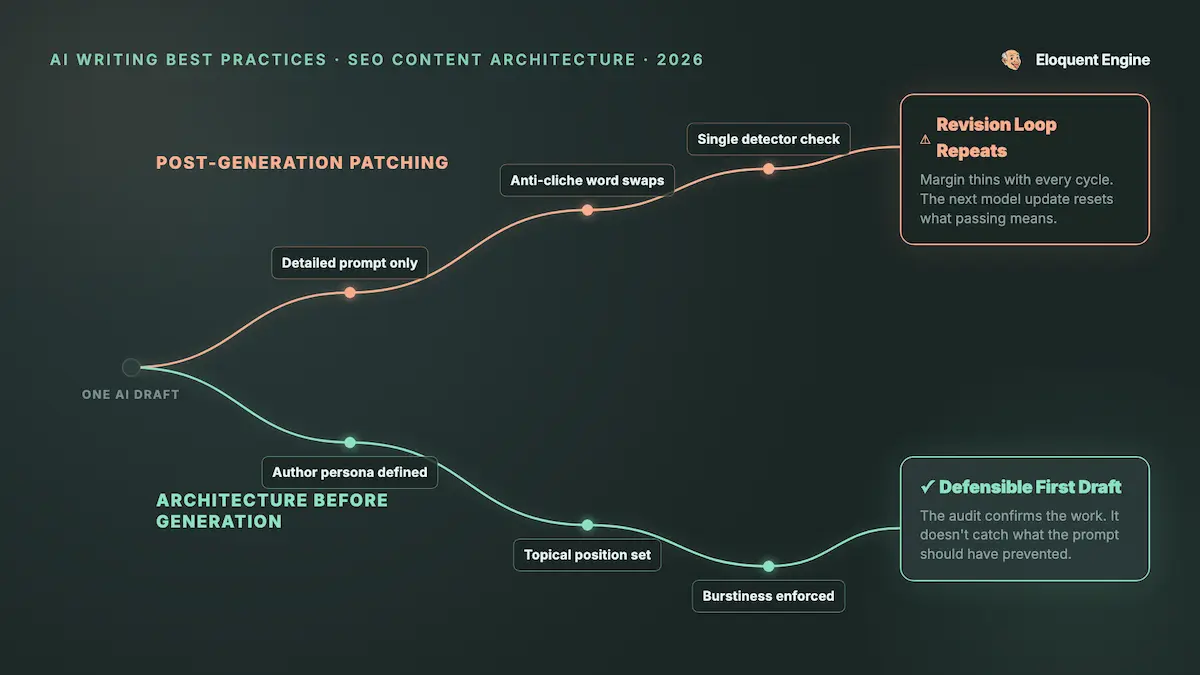
Running it through a humanizer after generation only masks the problem. If your output needs humanization, the system architecture failed at generation time. Post-processors are selling a second product to fix the first product’s failure. What AI humanizer tools actually do is randomize perplexity and burstiness scores. They do not know what your brand sounds like and they do not care. The detection score they lower is only a symptom; the broken generation architecture is the root problem.
There is a growing practitioner view that AI should function as a brand voice exploration tool first, analysis and discovery, before it touches content generation at all. That framing is closer to correct. Understand the voice, encode the voice, then generate from it. The sequence matters more than the tool. Whether Google penalizes AI content is the wrong question. Whether your audience can tell you sound like everyone else is the question that determines retention.
What information the system actually needs, and why guidelines are not enough
The consensus view in the practitioner community is that a clear brand style guide, tone, vocabulary, dos and don’ts, can significantly improve AI output consistency. I assumed this too, at the time. Built detailed guidelines documents, watched the output come back hollow anyway. Guidelines describe voice in abstract terms. Systems need behavioral examples to encode it.
Examples. Real examples. That is the input the system actually needs. Actual sentences from the brand showing how vocabulary choices play out, how argument structure works, what “direct” looks like at the sentence level in this brand’s specific construction. The difference between feeding the system a guideline and feeding it examples is the difference between telling a copywriter “we’re irreverent” and showing them fifty pieces of the brand’s existing content.
SaaStr’s observation that brand strength is a prerequisite for AI effectiveness, not an output of it, applies directly here. Brand clarity has to exist before it can be encoded. If your team cannot identify what makes the voice distinct in behavioral terms, specific patterns in specific content, not “warm and direct”, the system cannot surface those patterns either. It reflects what it receives.
What actually needs to go into the system, honestly, is four things most brand context documents do not contain:
- Vocabulary at the word level. Not “we use plain language.” Ten actual sentences showing which words the brand consistently chooses and which it avoids even when they would be the natural pick.
- Structural patterns from real content. Does the brand lead with the claim or build to it? Where does the primary assertion land? These patterns require examples to surface. They cannot be described in the abstract.
- Negative examples. What the brand has cut from its own content is often more distinctive than what it kept. Most guidelines never document refusals. Those refusals are frequently the most recognizable dimension of the voice.
- Founder and customer language. Unedited founder communications and the exact words customers use to describe the brand’s value. This is where authentic voice lives before it gets polished into something that sounds like everyone else.
The teams that have genuinely resolved the editing-hours problem, where AI generation actually reduces hours rather than shifting them, built this input layer before they wrote a single prompt template. The ones still editing heavily probably skipped this step and convinced themselves it was optional. AI detection scores that flag their content are the downstream signal of that skipped step. Brand voice fidelity is determined by the quality of context input at the beginning, not by post-generation editing. The output is only as differentiated as the context you fed the model.
How to diagnose which variable is actually broken before switching anything
When publishing platforms made content creation easy in the early 2010s, every brand started a blog. Volume exploded. Most of it sounded identical, the same structure, the same advice, the same informational voice, because it was produced by the same tools with no brand differentiation built in. The brands that survived the flood were those with distinctive, recognizable content, not high-volume publishers. They were the ones readers could identify without seeing the logo. The same dynamic is repeating now, at ten times the volume and ten times the speed. The question is where your program sits in that pattern.
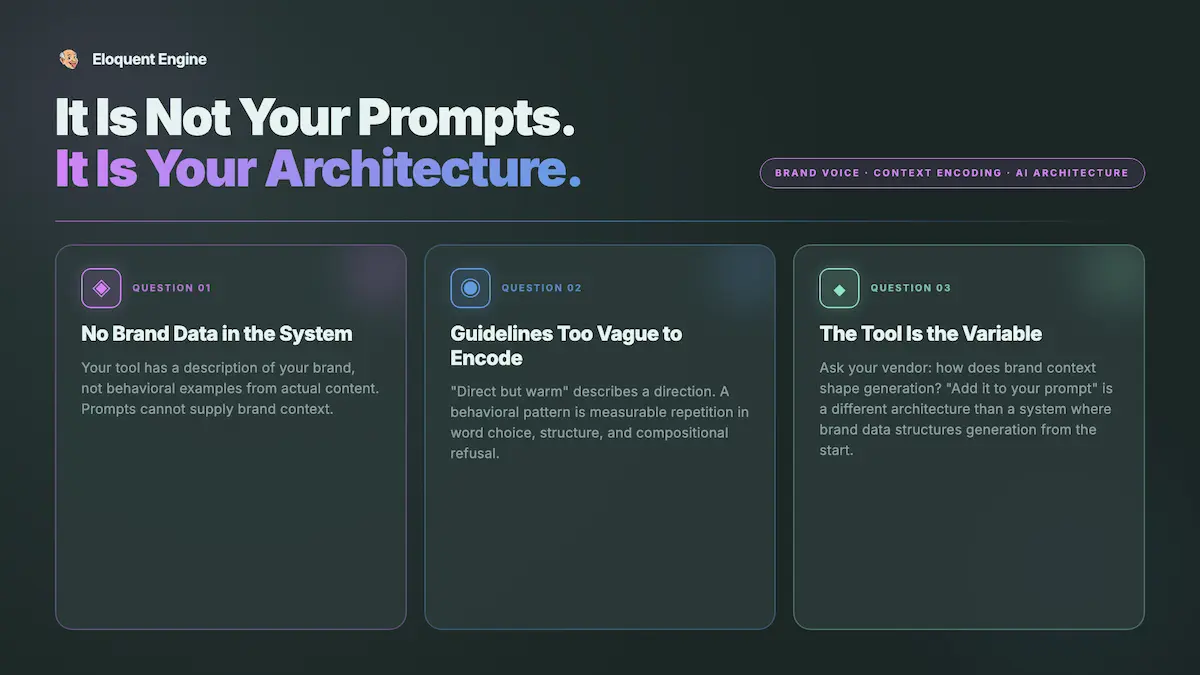
There are three variables that break brand voice in AI content. They are distinct, and the fix is different for each:
- No brand data in the system. Your tool has a description of your brand, not behavioral examples from actual content. Build the brand context document first, founder communications, best-performing copy, customer language, before changing anything else. This is fixable within your current tool.
- Guidelines too vague to encode. Your brand voice document uses adjective lists rather than patterns extracted from real content. Rebuild each guideline as a behavioral example. “We’re conversational” becomes a specific sentence showing what conversational looks like in this brand’s construction. Do this before evaluating any tool.
- The tool is the variable. Ask your vendor directly: how does brand context shape generation in your system? If the answer is “add it to your prompt,” that is a different architecture than a system where brand data structures generation from the start. How AI writing tools differ in their approach to brand context is the diagnostic most teams skip entirely when evaluating options.
A prompt library is a tactic, not a content strategy. Isolating the right variable is where the strategy begins.
Start here, not with another prompt
Pull ten pieces of your brand’s most authentic content. Not the most polished, the most real. Extract three patterns from each: one vocabulary choice, one structural choice, one thing the piece refuses to do. Thirty observations. That is the beginning of a brand context document the system can actually use.
From there, the diagnostic question is direct: does your current tool accept this document as a foundational input, or does it treat it as one more prompt variable? If you are evaluating whether your current tool can actually encode brand context or whether a different architecture makes sense, that question is where the evaluation should start.
Without brand data in the system, brand voice cannot be encoded. This is non-negotiable.