Your AI Writing Tool Is Saving You Hours and Costing You Margin. Here Is the Math That Proves It.
You bought the tool. You watched the demo. The content came out fast, and for about two weeks, it felt like the capacity problem was solved. Then you looked at what your editors were actually doing with the output. Not the demo output. The output on your most demanding client account, the one with the specific voice and the stakeholder who reads everything twice. The one where vanilla output gets sent back without comment, because the client has learned that sending comments is optional when the agency is supposed to know better.
Three years ago, every agency owner I talked to was evaluating AI tools on feature lists and pricing. Nobody was running the editing hours after. Nobody was asking what detectable content costs when a client finds it. The tools churn out words. The agencies flood their clients with interchangeable, disposable drafts and call it a content strategy. The ROI calculation most agencies run measures the wrong number entirely. Here is the right one.
What does a content piece actually cost you right now?
Before any AI tool touches your workflow, a 5-20 person agency producing 1,000-1,500 word B2B blog posts is carrying something close to this cost structure, at a blended internal rate of $50 per hour:
| Activity | Time (hours) | Cost per piece |
|---|---|---|
| Brief development and research | 1.0 – 1.5 | $50 – $75 |
| Drafting | 2.0 – 3.0 | $100 – $150 |
| Editing and brand alignment | 0.75 – 1.25 | $37 – $62 |
| Client revisions (avg. 1.2 rounds) | 0.5 – 1.0 | $25 – $50 |
| QA and publication prep | 0.25 – 0.5 | $12 – $25 |
| Total | 4.5 – 7.25 hours | $224 – $362 per piece |
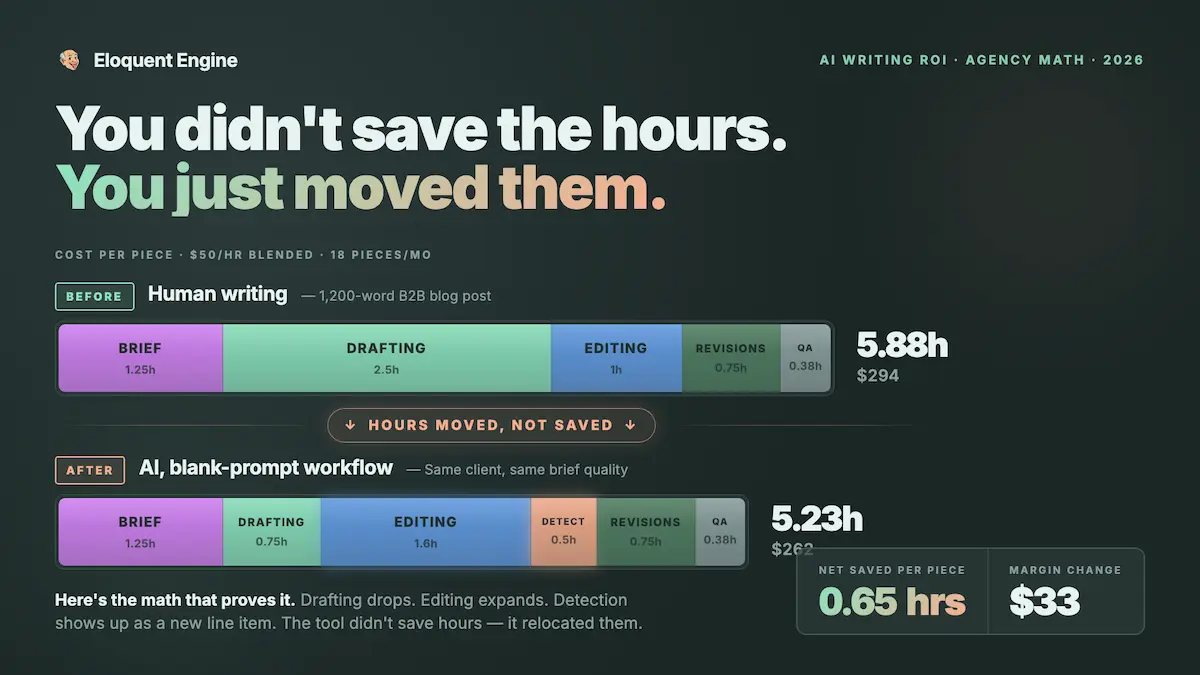
Drafting is 40-50% of total cost. That is the target an AI tool should attack. But you do not save the drafting hours. You save the drafting hours and lose some or all of them in editing. The tool did not save hours. It moved them. And the ROI paradox in the wider market reflects exactly this: enterprises report positive AI returns at high rates while most AI pilots fail to deliver measurable ROI. They are measuring drafting. They are not measuring what comes after.
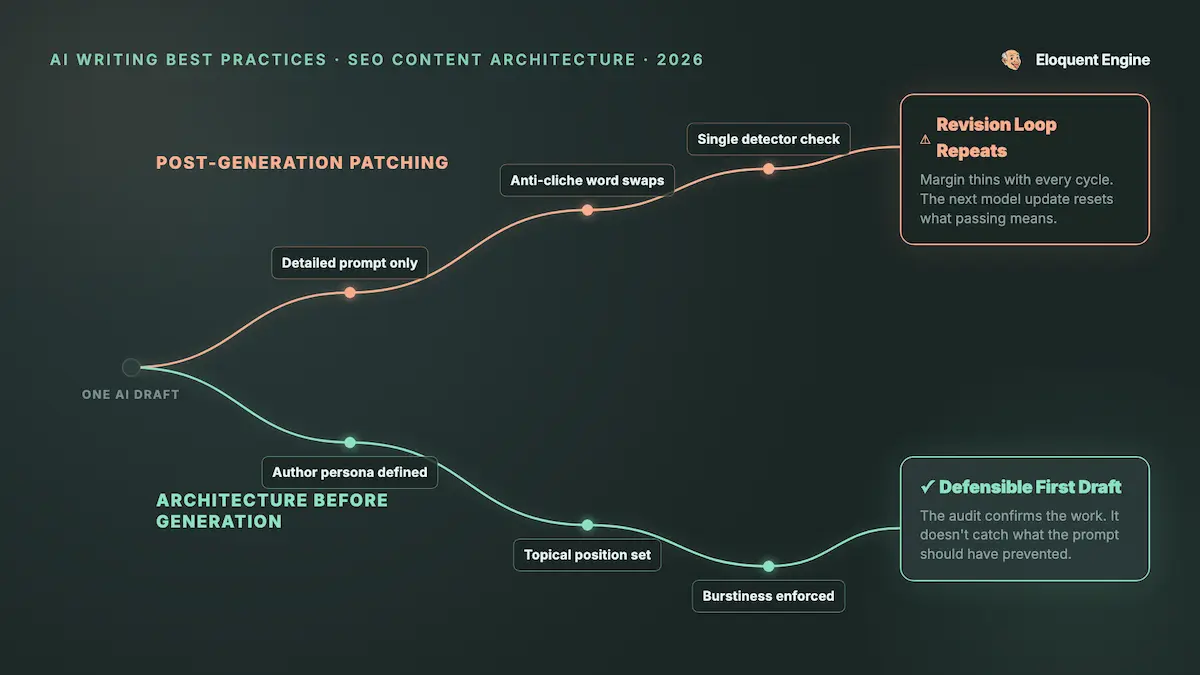
A prompt library is not a content strategy. Encoding a brand voice document into the brief before the model generates is. The agencies that confuse those two things are the ones who bought a tool, ran it for ninety days, and are now back to freelancers. The ones that do not confuse them are building content architectures that survive model updates and client scrutiny.
The tool saved hours on drafting and cost hours in editing, so it moved the work rather than saving it.
What are the three costs no AI tool shows you in the demo?
AI content detection fires on pattern, and generic prompts produce predictable patterns. That is not an opinion. It is how tools like Originality.ai and GPTZero are built. The cost of ignoring that pattern shows up in three places that never appear in a vendor demo, because demos run clean briefs on open topics where any generator performs well. Your client work does not look like that.
Editing overhead that expands instead of shrinks
A content manager gets a draft from a tool running a blank prompt against a client in enterprise HR software. The structure is recognizable. The vocabulary is correct. The voice sounds like every other SaaS blog in the category. She spends ninety minutes rewriting individual sections because the draft argues like a generalist, not like the client’s brand. That ninety minutes is not editing. It is drafting with extra steps, done after the fact, at a higher stress level because the deadline is now closer.
If your output needs to be substantively rewritten for brand coherence, the system was broken before the first word. The root cause is that the model never had brand context to encode. Running AI generation with no brand context document and then correcting the output is a hollow loop that costs more than it saves.
Post-processors are selling a second product to fix the first product’s failure. How AI humanizer tools work and why they cannot fix this problem structurally is worth understanding before you add one to your stack. The humanizer pass is a symptom of broken generation input, not a solution to it.
Detection remediation time
Content scoring 65-80% AI probability on Originality.ai creates a binary choice: publish and carry the risk, or spend 30-45 minutes per piece bringing the score down. Neither option is free. The detection risk is not hypothetical. Production AI implementations surface systemic problems that weren’t visible in pilots, and agencies are learning this the same way enterprises are: after the client flags something.
Junior staff running free tools and nobody checking the output is exactly the scenario where detection risk compounds silently. One detectable piece is a conversation. A pattern of them is a relationship that ends without warning.
Brief development that nobody prices correctly
With human writers, brief development is roughly fixed overhead. With AI tools, brief quality determines output quality at every stage. A content brief that encodes tone, audience language, competitive framing, and E-E-A-T signals before the model generates is structurally different from a brief that names a topic and a word count. Building the right brief takes time. Most tools sell you generation and call brief development your problem. Why AI writing sounds fake is a brief design problem, not a model quality problem. The fix happens before prompting, not after.
The before and after math: what a brand research layer actually changes
Think of a content production workflow the way you think about a manufacturing line. The raw material goes in at one end; a finished product comes out the other. Every station on the line either adds value or compensates for a defect introduced upstream. When you run AI generation from a blank prompt, you are running a line with no quality control at the input stage. Every station downstream, including editing, QA, and detection remediation, is compensating for something that should never have left the first station broken. The line looks efficient because generation is fast. The finished product cost tells a different story.
The proxy scenario below is built from realistic agency cost structures. It reflects a 15-20 piece per month shop serving three to five B2B clients. No fabricated client names, no inflated results. Just the math that runs when you account for the full line.
Before: generation with no brand context layer
Generation is fast. Drafting time drops from 2.5 hours per piece to 45 minutes. That is real. What happens next is also real, and it is the part the vendor’s ROI calculator does not include.
Editing time climbs from 1.0 hour to 1.5-1.75 hours because the output does not hold the client’s voice at the section level. The content sounds like every other SaaS blog in the category because it was built from the same interchangeable blank prompt architecture every other agency is running. Detection scores on Originality.ai run 55-75% AI probability on average across a realistic mix of client briefs. That number requires either acceptance of detection risk or 30 minutes per piece in remediation. Brief development stays at 1.0-1.5 hours per piece because no brand context document exists to front-load that work.
Net math: drafting saves 1.75 hours. Editing adds 0.5-0.75 hours. Detection remediation adds 0.5 hours. Brief development stays flat. Total savings per piece: 0.5-0.75 hours. At $50 per hour blended rate and 18 pieces per month, that is $450-$675 in monthly labor savings before tool cost. If the tool costs $400 per month, the margin improvement is negligible. The line appeared faster, but the unit economics stayed flat.
Where the context enters the system determines output quality more than the AI technology itself. Tools evaluated on feature lists and pricing while actual output quality goes untested produce exactly this result. The mainstream consensus that “scalable workflows include content production pipelines” is technically accurate and operationally useless if the pipeline is producing detectable, interchangeable output that requires downstream compensation at every station.
After: generation with a brand research and context layer
When brand voice, audience language, competitive framing, and entity coverage targets are encoded into the system before generation, the first station on the line produces different raw material. The raw material is structurally different from what blank-prompt generation produces. Sentence rhythm varies. Vocabulary distribution reflects the client’s documented language, not the model’s defaults. Argument structure follows the client’s established positioning rather than the generic “here is a problem, here is a solution, here is a conclusion” scaffold that detection tools have learned to flag.
Drafting stays at 45 minutes. Editing drops to 30-40 minutes because the editor is refining a draft that already speaks the client’s language, not retraining a voice that was never encoded. Detection remediation is reduced or eliminated on content generated with genuine brand context, because pattern variance at the structural level changes the detection signal. Brief development shifts from per-piece overhead to a one-time brand context document built per client and maintained, not recreated for every assignment.
Net math: drafting saves 1.75 hours. Editing saves 0.5-0.75 hours. Detection remediation is reduced or eliminated. Brief development is front-loaded once per client. Total savings per piece: 2.0-2.5 hours. At $50 per hour and 18 pieces per month, that is $1,800-$2,250 in monthly labor savings before tool cost. That number justifies a tool cost of $400-$600 per month and leaves real margin on the table. How AI content writing for agencies can scale client output without scaling headcount depends entirely on whether the context enters the system before generation or gets patched in afterward.
The difference between those two scenarios is not model quality. It is where the brand context lives in the workflow.
What do realistic detection pass rates actually look like?
You have run Originality.ai on competitor content. You have seen what 80% AI probability looks like in a report and understood what it means for a client relationship. You know the difference between a claim and a score. So when a vendor says their tool “passes detection,” you know that claim is missing a context window, a content category, and a sample size.
AI content detection fires on pattern. Calibrate your expectations against that mechanism, not against marketing claims. Generic prompts produce predictable sentence rhythm, vocabulary distribution, and structural patterns. Detection tools index those patterns. A blank prompt run through any major generation platform on a competitive B2B topic will produce a score that reflects exactly how predictable the output was, regardless of what the interface calls itself.
Detection scores are a symptom. The disease is context-free generation. Encoding brand voice at the brief level, before the model generates, produces structurally distinct output because the inputs were structurally distinct. That is not a claim about detection evasion. How AI content detection works and what triggers it is worth reading before you benchmark any tool’s pass rate. The mechanism tells you what to measure. Pass rate claims are only meaningful when they specify the detection tool, the content category, and what the brief architecture looked like. Anything less is a deliberately vague number.
Ask for score distributions across realistic client briefs in your vertical. Not cherry-picked examples on open-ended topics where any well-prompted generator performs cleanly.
The client transparency decision is also a math problem
An agency produces twenty pieces per month for a SaaS client at a retainer that assumes human writing. The team switches to AI generation to protect margin. Nobody tells the client. The content passes a casual read. Three months later, the client’s marketing director runs a piece through Originality.ai because she saw something in an industry newsletter about AI detection. The score comes back at 71%. The conversation that follows is not about content quality. It is about whether the agency has been billing for work it did not do.
That conversation costs more than the margin the agency protected. Not hypothetically. In retainer replacement cost, in reference loss, in the internal time spent managing the fallout. The risk is real and it compounds as detection tools improve and clients become more familiar with running them.
The transparent path looks different. Framing AI-assisted content as a capacity and consistency advantage, backed by a documented brand research process, a detection benchmark, and human editorial oversight, is a conversation that clients who understand the system respond to differently than clients who discover it on their own. What the evidence actually shows about Google and AI content gives you the ranking argument. The client relationship argument is simpler: you can explain a system. You cannot explain a pattern of omission.
Billing agency rates for lightly edited output without disclosure is a risk you are carrying on behalf of the retainer. Choose your path deliberately.
The decision rule you can run before the next tool purchase
Apply this in sequence. The criteria narrow to a number you can act on.
Step 1: Calculate your real editing overhead on AI output
Take your most demanding active client brief. Generate a piece with the tool you are evaluating. Time the editing pass. Not on a demo brief. On that client. If editing time increases by more than 30 minutes per piece compared to your current process, the drafting savings are being consumed downstream. The tool does not improve your margin at that account.
Step 2: Benchmark detection before you scale
Run ten pieces through Originality.ai before you commit to volume. Score distributions across a realistic content mix tell you more than a single test. If scores cluster above 60% AI probability, the brief architecture needs work before the tool is production-ready. Scaling a prompt template without benchmarking detection scores first is how agencies build a detection problem at volume instead of catching it at sample size.
Step 3: Apply the threshold
If drafting savings minus editing overhead increase equals less than one hour per piece, a tool priced above $300 per month does not improve your unit economics at 15-20 pieces monthly. If a brand-encoded system reduces both drafting and editing time, savings of 2.0-2.5 hours per piece at that volume justify $400-$600 per month in tool cost with margin intact.
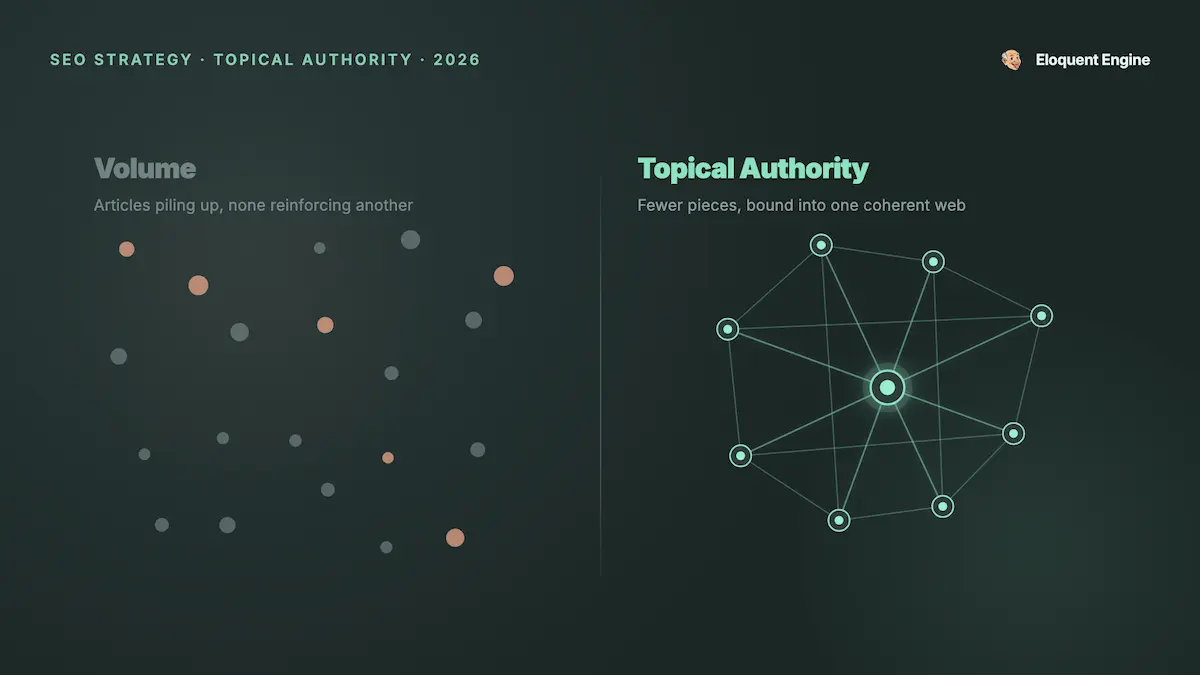
The agencies building content architectures that survive the next two years are encoding brand context before the model generates, clustering content around pillar pages before publishing individual articles, and auditing detection scores before scaling any new template. Why marketers are moving away from volume-first content systems is the structural shift underneath this math. The real decision is whether the tool supports a system worth building.