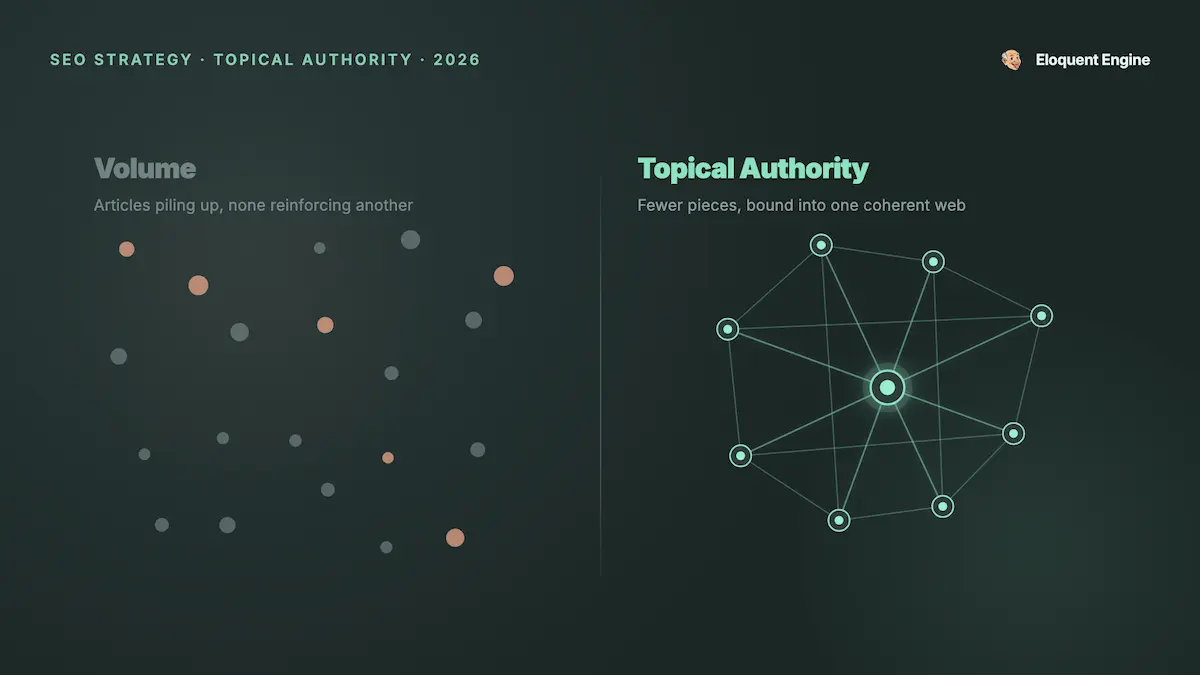
You’re comparing Eloquent Engine and Jasper because you need AI-written content that publishes without blowing up your clients’ domain authority or killing your editing budget. That’s the actual decision. Everything else, templates, integrations, feature counts, is secondary to one question: does the output hold up when it matters?
Two paths from here. You pick a tool built around detection performance at the generation layer, and you get first drafts that publish. Or you pick a tool built around feature breadth and ease-of-use, and you get output that quietly inflates your revision cycles while you wonder why every article still needs an hour of cleanup before it’s safe to send. Every hour cleaning up AI copy is an hour you’re not billing. That math erodes your margins faster than the subscription cost ever will.
This comparison covers three things that actually determine which tool is right for your operation: detection architecture, brand voice implementation, and where Jasper’s ecosystem genuinely wins.
By the end, the choice should be clear.
The detection question: architecture versus afterthought
AI detectors are difficult to defeat. Before making claims about Eloquent Engine’s detection performance, consider that overpromising here is exactly how tools lose credibility.
Every detector, GPTZero, Originality.ai, ZeroGPT, is trained on different data sets, using different classifiers, tuned to catch different patterns. What passes one detector today might not pass tomorrow. Detection model updates happen quietly and without warning, and any tool claiming a permanent, universal solution is selling something that doesn’t exist yet.
What does exist, and what the architecture decision actually determines, is how hard the tool makes detection in the first place.
Two signals drive AI detection classifiers: perplexity score, which measures how predictable word and phrase choices are across a piece, and burstiness, which measures how much sentence length and rhythm varies within that piece.
AI-generated text scores low on both by default. Human writing scores high on both by default. That’s the gap the tool either closes or doesn’t.
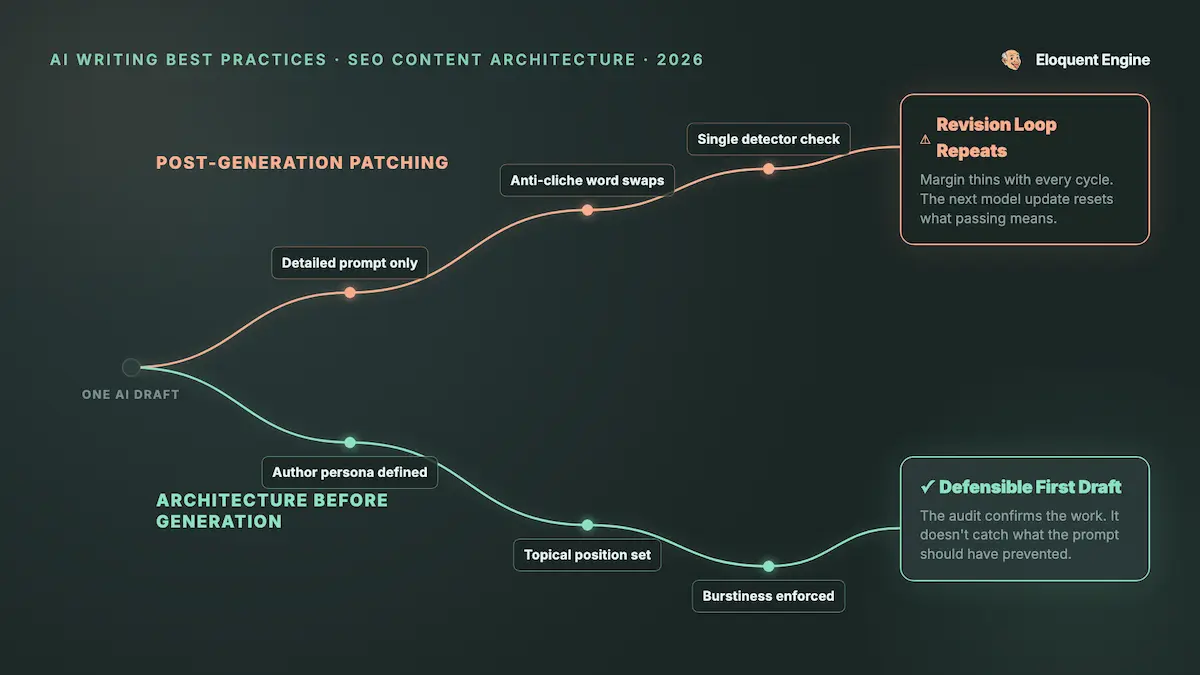
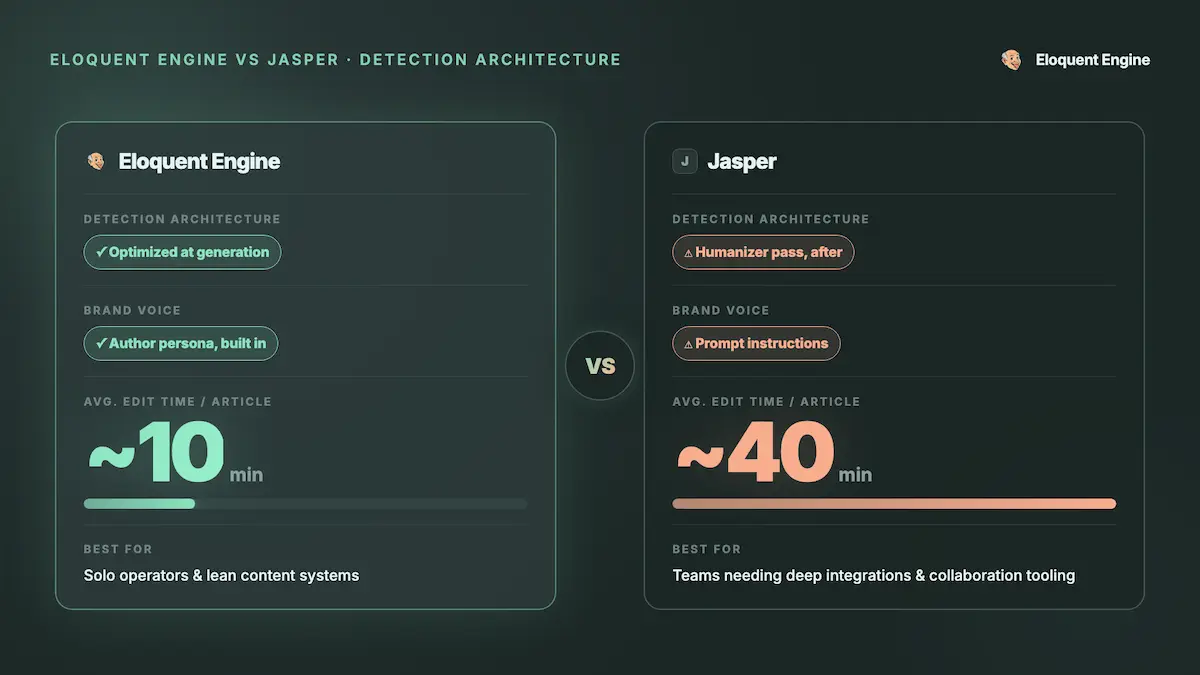
Jasper’s approach to this gap is a humanizer pass. Generate the content, then run it through a secondary tool or layer to add variation before publishing.
A humanizer will adjust word choices and add some variation without recalibrating the underlying perplexity and burstiness patterns at the sentence and paragraph level. Document-level detection is still a hard problem for any humanizer approach, but paragraph-level and sentence-level detection is where modern classifiers are increasingly operating.
Smoothing a document’s surface doesn’t fix what classifiers find underneath.
Eloquent Engine closes this gap during generation by optimizing perplexity and burstiness at the sentence construction layer as the content is being written, which produces measurably different output than post-generation patching. If that claim is wrong, or if our architecture stops producing detection-safe output after a future model update, I’ll say so publicly and update this comparison.
That’s not a hedge.
That’s accountability for a specific, testable claim.
The counterpressure worth naming: neither Jasper nor Eloquent Engine publishes independently audited, third-party verified detection pass rates.
If you’re skeptical of this comparison because it comes from Eloquent Engine, that skepticism is fair. The best verification is replicable testing: run the same brief through both tools, submit unedited output to current versions of Originality.ai, GPTZero, and ZeroGPT, and see what the data says. The methodology matters as much as the results.
Our guide to creating AI content that passes detection walks through exactly how that testing works and what the signals mean, so you can run it yourself. Now, if you’re just looking for a snapshot of performance here and now, then here is the AI detection score for this very article:
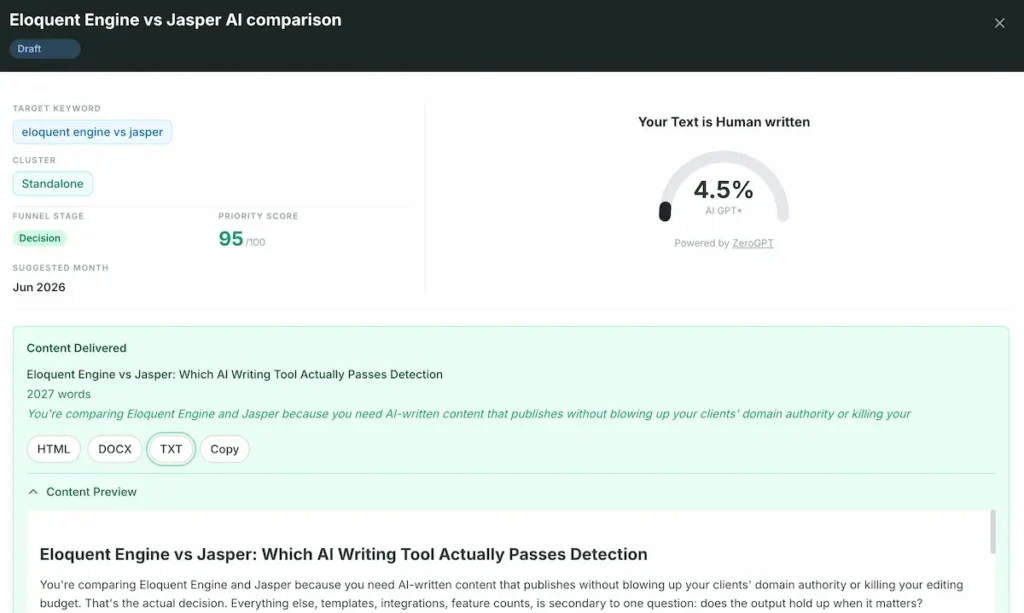
If you’re looking for more substantial proof, you have two more options:
- create a free account and write an article
- run this article through ZeroGPT
What Jasper’s silence on detection pass rates tells youn is this: a company that could publish strong detection results would publish them. The absence of data is still information.
Still, I want to be clear: what passes today might not pass tomorrow, and that’s true for both tools.
The architectural advantage is durability under model updates, not immunity from them. We’re close. Not all the way there yet. But the gap between generating to detection metrics versus patching after the fact is real, and it compounds at scale.
Brand voice: the functional gap most comparisons miss
If you’ve tried Jasper’s brand voice feature and felt the output was sloppy and interchangeable with every other AI article in your niche, that’s the experience of its design.
Jasper’s brand voice implementation is instruction-based: you feed it tone guidelines, sample content, and style parameters, and the model attempts to follow those instructions during generation.
The instructions calibrate the model’s behavior at the prompt level. The output reflects whatever the LLM can do with those instructions, which is constrained by the model’s defaults.
The anxiety this creates for agencies and freelancers is real. You’ve built a brand voice document. You’ve trained your team on it. You’ve written the client’s voice guidelines carefully. Then the AI generates something that’s technically on-brand, maybe hits the right tone markers, but reads as generic AI output underneath.
Voice training is everything, and when it misses at the sentence level, the first draft requires cleanup. If the first draft requires cleanup, it’s a liability not an asset.
Eloquent Engine enforces brand voice at the sentence construction layer, calibrating output semantically by modeling an author persona with documented opinions and a named voice before generation begins.
The difference in output is measurable: the result isn’t a document that followed tone instructions, it’s a document that was generated by a calibrated author identity. Topically, semantically, and consistently across a content cluster, not just within a single article.
And going even deeper, we also model a vocabulary set based on research specific to each brand. This is broken into 5 quadrants of thought:
- vocal inner
- vocal outter
- silent inner
- silent outter
- domain expertise
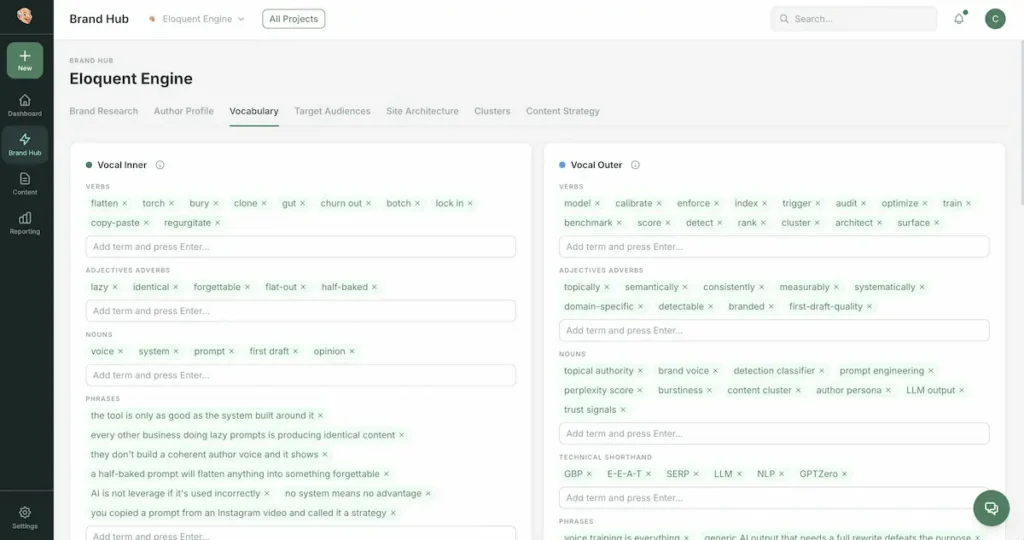
By building our content architecture in competing fields of thought, we’re able to create articles with varied burstiness and perplexity, and that commit to opinions your brand would actual voice to an audience. This vocabulary is visible in your dashboard and can be modified to include idioms, personal phrasings and more characteristics that make the content sound even more personal to you and the brand(s) you’re writing for.
The distinction has practical relief: you stop re-editing to inject personality and stop patching generic filler with human-sounding sentences after the fact.
The author persona is built into what the tool indexes against during generation, which means voice consistency scales without subcontractors.
If you haven’t built a dedicated brand voice document yet, that step matters regardless of which tool you use. The tool is only as good as the system built around it.
Edit cycles and what bad output actually costs your operation
Here’s where the status quo quietly costs more than switching does. Most people underestimate their edit cycle time because they measure it per article, not per month. One article that needs forty-five minutes of cleanup is easy to rationalize. Twenty articles a month at forty-five minutes each is fifteen hours of unbillable work.
The math on bad AI workflows eats your business model before you notice it happening.
Staying with a tool that produces first-draft junk is an active drain – a real cost of missed billable hours, delayed client deliveries, and prompt rot as you re-evaluate templates that still produce inconsistent output.
The switching cost of learning Eloquent Engine’s interface is finite, and 30 minutes or less as we do all of the heavy lifting for you. The cost of staying with a tool that needs a human to fix everything compounds indefinitely.
Three more clients doesn’t mean anything if output quality degrades and revision cycles scale with volume. The question for agencies and freelancers isn’t whether switching has friction. It does.
The question is whether the friction of switching once outweighs the friction of editing every month. The ROI math on AI writing for agencies is worth running against your actual numbers before you decide this is a minor difference.
Where Jasper is the better choice
Jasper’s ecosystem advantage is material. If your operation runs on HubSpot, Webflow, or Zapier integrations, and you’ve built workflows that pipe content directly into those platforms, Jasper’s integration depth is real and the switching friction is also real.
That’s not a minor consideration for a ten-person agency with established automations. Tearing out a working integration to save editing time is only worth it if the time savings are material enough to justify rebuilding the workflow.
Jasper also wins on team collaboration tooling. Shared brand vaults, team workspaces, access controls: if you’re managing multiple writers and editors inside one platform, Jasper’s infrastructure for that is more developed.
Eloquent Engine is built for operators who are producing content themselves, or managing a tight content system with minimal overhead. It’s not yet a team platform in the way Jasper is.
And their template library is genuinely useful if you produce high-volume, format-specific content: product descriptions, ad copy, email sequences. Jasper’s templates are not fluff. They’re built on real use cases and they flatten production time for commodity content formats.
(If you’re using exactly three of those templates and haven’t touched the rest since onboarding, you already know which category you’re in.)
The detection risk doesn’t disappear just because Jasper’s ecosystem is more comfortable. Questions about whether humanizer tools actually solve the detection problem or just delay consequences are worth taking seriously before you assume the integration value outweighs the output risk.
This article on why marketers are switching from Jasper covers this in more depth for anyone running that specific calculation.
Pricing isn’t what you think it is
Jasper’s plans run higher than Eloquent Engine’s but the subscription price is the wrong number to draw a reasonable comparison.
The right number is cost per publishable piece. Take your monthly subscription, add your hourly rate multiplied by total edit hours, divide by articles published. That’s your actual cost per piece. If Jasper’s output needs an average of forty minutes of revision per article and Eloquent Engine’s needs ten, the cheaper subscription isn’t cheaper. It’s just cheaper on paper.
Spending more time editing AI content than it would take to just write it means the tool isn’t doing its job. The subscription cost is sloppy math if you’re not accounting for your own time. Our pricing page breaks down plans by use case, which makes that per-piece calculation more concrete.
The Eloquent Engine vs Jasper decision comes down to one question
What is the bottleneck that is costing you money right now?
If your bottleneck is workflow integration and team collaboration tooling, and your edit cycles are already manageable, Jasper’s ecosystem is worth the premium. The integrations are real, the team infrastructure is built, and switching has genuine friction with limited upside for your specific operation.
If your bottleneck is detection risk, revision cycles, or brand-less output that reads like it came from the same template as every other business in your niche, Eloquent Engine was built to fix that problem at the architecture level.
Generic AI output that needs a full rewrite defeats the purpose of using AI at all. Voice training is everything, and a tool that enforces brand voice semantically during generation produces measurably more consistent first drafts than one that applies tone instructions at the prompt layer.
The logic chain is short. Content that gets flagged or devalued produces no return on the time invested. A tool that reduces detection risk reduces that exposure. Lower detection exposure means fewer revision cycles. Fewer revision cycles means more publishable output per hour. More publishable output per hour means you can scale client volume without scaling your time. Each step in that chain is testable against your own numbers.
Most people reading this are experiencing the second bottleneck while convincing themselves they need to solve the first. The integrations look important. The feature count looks like safety. But if the first draft requires cleanup, it’s a liability not an asset, and switching to a tool built around that standard is a decision you can defend to your team and your clients with specific, concrete reasoning.
Start with your actual edit cycle time per article. That number tells you which category you’re in faster than any feature comparison will. How Eloquent Engine’s generation architecture works is worth reading before you make the call, because understanding why the output is different is what makes the decision defensible, not just the output itself.